 admin
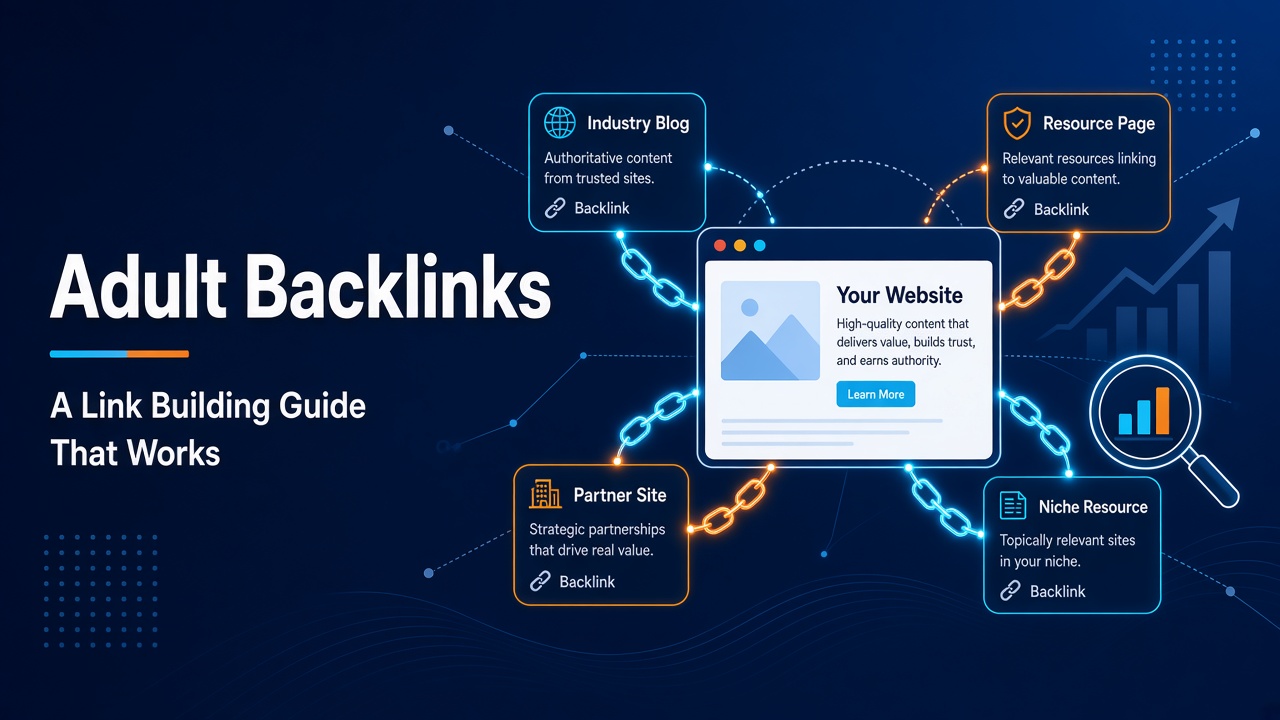
Most advice on adult backlinks falls into two camps. One says links are the only thing that matters and sells them by the dozen. The other says adult sites cannot get good links at all. Neither helps you decide what to do on Monday morning.
This guide takes a middle path. It explains what makes a backlink worth having, what Google actually says about links, where adult sites can realistically earn them, how to audit what you already have, and how to judge a link building agency before you pay one. It is written for adult business owners, directory operators and platform marketers, and it keeps explicit detail out.
A caution first. We reviewed 20 pages for this guide, and the adult-specific ones are almost all vendor marketing with no data, no named results and no dated evidence. Where the evidence is thin, we say so.
What makes an adult backlink worth having?
A good backlink is a link from a relevant, real, editorially independent page that sends readers to a page on your site that deserves the attention. Relevance and editorial independence matter more than a score on a third-party tool, and Google publishes no safe number of links, no score cutoff and no ideal anchor percentage.
That last point comes from a link building agency’s reading of Google’s documentation rather than from Google itself, but it matches what Google’s public pages say: they describe link spam in detail, and give no quotas for good links. Practical checks are simple:
- Would a real visitor click it? A link no human would follow is rarely worth the effort.
- Is the page about something related to yours? A payments guide linking to a payments-friendly directory makes sense. A random casino blog does not.
- Is it editorial? Someone chose to link because it helped readers, not because they were paid or traded for it.
- Is the target page worth landing on? A useful guide or a clean listing page earns clicks. A thin page does not.
- Is it crawlable? Google generally follows links built as <a> elements with an href attribute. Links created only with scripts may not be reliable.
Third-party scores such as Domain Rating can help you sort a long list quickly. They are not Google’s metrics, and a high score on an irrelevant site is a weak reason to want a link.
What Google says, in plain terms
Google’s spam policies define link spam as creating links primarily to manipulate rankings. The examples include buying or selling links for ranking, excessive link exchanges, links with optimised anchor text in guest posts or press releases, and advertorials where payment buys links that pass ranking credit. Google does not ban paid links, but asks that they carry rel="sponsored" or rel="nofollow".
Google’s link best practices add a few useful rules of thumb:
- Make anchor text descriptive and specific, and relevant to both pages. Generic text such as "click here" is discouraged.
- Do not stuff keywords into anchors, and do not place many links side by side without context.
- Use `nofollow` selectively. Google says to use it for sources you do not trust, not for every external link.
- Mark paid links with sponsored or nofollow, and user-inserted links with ugc or nofollow.
Two further policies matter for adult sites. "Expired domain abuse" covers buying an expired domain and repurposing it mainly to manipulate rankings. "Site reputation abuse" covers third-party content published on a host site mainly to take advantage of that host’s established ranking signals. Both are common tricks in the bulk-link market, and both are good reasons to avoid it.
Classification: the adult-specific wrinkle
Google’s guidance for sites with explicit content says to group explicit pages on a separate domain or subdomain and to mark them with an adult rating. If you do not, Google may classify the whole site as explicit and filter it when SafeSearch is on.
This affects link building in two ways. First, the page you ask people to link to should usually be a clean, non-explicit page, such as a guide, a company page or a resource, and not an explicit listing. Second, if a link leads to a page behind an age gate, make sure Googlebot can still reach it, or the link may add little. Plan this before you start outreach.
Build something worth linking to first
Links follow useful pages. Before you contact anyone, make sure you have at least one asset that a stranger would be glad to cite. For adult businesses, the best assets are usually practical and non-explicit:
- A guide to a problem your audience faces, such as payments, age assurance, classification, privacy or platform rules.
- A checklist or template people can use immediately.
- A glossary or reference page that is accurate and kept up to date.
- Original data, even small, such as an anonymised survey of your own customers or a review of public policy changes. Ahrefs describes a "statistics page" approach, where a regularly updated page of industry figures attracts links over time, though its examples are self-reported and from other industries.
- A tool, such as a calculator, that solves a small problem.
Be honest about effort. A page like this takes research, design and updates. It also takes promotion, because good pages do not attract links on their own.
Seven ways to earn adult backlinks
The table summarises the routes that are realistic for adult brands. None guarantees results, and each needs a different mix of time, money and risk.
|
Route |
How it works |
Strength |
Main risk |
|
Linkable assets |
Publish a useful guide, data page or tool, then tell relevant people |
Durable and fully yours |
Slow; needs promotion |
|
Digital PR and data stories |
Pitch an original finding or expert comment to journalists and editors |
Can earn editorial links |
Many outlets avoid adult brands; no guarantees |
|
Partners, associations and curated directories |
Listings and mentions from real relationships |
Relevant and low risk |
Directories that accept anyone for a fee |
|
Unlinked mentions and reclamation |
Find places that mention your brand without linking, and ask politely |
Warm leads, high acceptance |
Limited volume |
|
Expert contributions |
Provide quotes, comments or articles to publishers who want them |
Builds authority |
Publisher policies; time |
|
Write an original article for a relevant host |
Reaches new readers |
Google treats optimised anchors and mass campaigns as link spam |
|
|
Sponsored placements |
Pay for visibility, with the link qualified |
Predictable |
Must be labelled; links should be sponsored or nofollow |
Digital PR deserves a caveat. One link building agency’s guide admits that "digital PR" is its own label and not a Google category, and stresses editorial independence: no guaranteed coverage and a disclosure of any material connection. That is a healthy way to think about it.
Directories and listings
Curated directories can be useful, especially in an industry where mainstream discovery is limited. The key word is curated. A good directory checks who it lists, describes them accurately and has real visitors. A bad one accepts anyone who pays, repeats the same text and exists mainly to sell links.
Before you submit, check whether the directory:
- Has an editorial policy and applies it.
- Shows real activity, such as recent listings and visible traffic signals.
- Marks paid listings and qualifies their links.
- Is relevant to your category and region.
- Does not sit among unrelated spam such as casino or pharmacy pages.
Mass directory submission, where one description is pushed to hundreds of sites, is the pattern Google’s policies describe. Skip it.
Reclaiming mentions and fixing broken links
Two low-risk tactics are often overlooked.
Unlinked mentions. People already talk about your brand, your guides or your data. Search for your business name, your product names and your best pages. When someone mentions you without a link, write a short, polite note thanking them and pointing to the page they referred to.
Broken or outdated links. If a link to you leads to an old URL that now returns an error, redirect the old URL to the closest relevant page. This recovers links you already earned.
Neither tactic produces a flood, but both are cheap and convert at a higher rate than cold outreach.
Anchor text and landing pages
Anchors tell readers and search engines what to expect. A natural profile is uneven: some links use your brand, some use a page title, many use plain URLs, and a few use descriptive phrases. Google’s guidance asks for descriptive, concise anchors relevant to both pages, and warns against stuffing.
Two habits keep you safe. First, do not ask for exact-match commercial anchors. Let the linker describe your page in their own words. Second, point links at pages that deserve them, not only at your home page or your most commercial page. A balanced profile is a sign of real citations.
Paid links and disclosure
Some adult businesses pay for placements, and that can be legitimate if handled properly. Two kinds of disclosure matter.
For search engines, qualify the link with rel="sponsored" or rel="nofollow".
For readers, label paid content clearly. The US Federal Trade Commission’s native advertising guide says it is deceptive to mislead consumers about the commercial nature of content. It says a disclosure is needed when an ad’s format or style is similar enough to editorial content that people would take it for independent reporting. The guide is from 2015 and was later modified, and it applies to the United States, so check the rules in each market and take advice. This is not legal advice.
Be sceptical of sellers who list prices without stating the currency, the unit or whether links are qualified. One adult link insertion page we reviewed did exactly that.
Audit what you already have
Before you build more, look at the links you have. Google Search Console’s Links report shows top linked pages, top linking sites and top linking text. It is a useful starting point, with three limits. It is a sample and not a complete list. It groups subdomains and subdirectories under the root domain. And it does not show whether a link is nofollow.
A sensible audit has four steps:
- Export your linking sites from Search Console and a second tool, so you can compare.
- Sort by relevance and by pattern, looking for obvious spam, repeated anchors and unrelated networks.
- Try to remove the worst links by contacting the site owner or the seller who placed them.
- Consider disavow only as a last resort.
Google describes its disavow tool as an advanced feature to be used with caution. It says to use it only if you have many spammy, artificial or low-quality links and those links have caused, or will likely cause, a manual action. It also says most sites do not need it, and that misuse can hurt your performance. If an agency suggests disavowing hundreds of domains as a routine, ask why.
Keep a simple record as you go: the linking page, the date you found it, the target page, the anchor, whether it is earned or paid, and what you decided. This log turns a one-off audit into a habit, and it gives a new agency or colleague the history they need. It also makes it easier to spot a pattern early, such as the same seller appearing again and again, before it becomes a problem.
Spotting risky links
Some patterns signal trouble. Treat these as prompts to investigate, not automatic verdicts.
- Sudden bursts of links from unrelated sites.
- Repeated exact-match anchors across many domains.
- Sites with no real content or with content in unrelated languages.
- Link networks that share templates, hosting and linking patterns.
- "Write for us" pages with price lists.
- Expired or repurposed domains that now host unrelated content.
- Promises of a set number of links a month, regardless of quality.
What does link building cost, and how long does it take?
Costs vary widely and the data is vendor-led. BuzzStream’s pricing guide reports averages of about $295 for direct guest posts, about $461 through vendors, and about $179 for link insertions, and says agency retainers commonly run from $2,500 to $10,000 a month. Its methodology is only partly described and it sells related software, so treat these figures as rough. We have not quoted adult-specific prices because we could not verify a reliable range.
Timelines are also unproven. Several adult vendor pages say results take three to six months, but none show data. Google’s own hiring guidance says to ask any SEO what results to expect, on what timeline, and how success will be measured. Agree on leading indicators early: placements, referring domains, referral traffic and enquiries.
Choosing a link building agency
A link building agency can save time, but you remain responsible for what it does on your behalf. Google’s guidance says an irresponsible SEO can damage your site’s search presence, and lists red flags including guaranteed rankings, secrecy and link popularity schemes.
Whether you hire a general link building agency or a specialist adult link building agency, ask for:
- A written description of methods, including those it refuses to use.
- Named, live placements with URLs you can check.
- A link report showing date, host, URL, link attribute, anchor, landing page and how the link was earned.
- A disclosure policy for paid content.
- A plan for classification, including which pages receive links.
- Reporting beyond rankings, such as referral traffic and enquiries.
- Ownership and exit terms for any content, accounts and data.
One adult agency page we reviewed claimed a guarantee of success while also saying SEO is a long-term process with no guaranteed outcome. That kind of contradiction is a reason to ask more questions.
An adult SEO agency that treats link building as one part of a wider plan, alongside site structure, content and technical health, is usually a safer partner than a vendor who sells links as a standalone product.
Common mistakes
- Buying links before the site is ready. Misclassified pages, blocked age gates and thin content waste every link you add.
- Chasing scores. A high third-party score on an irrelevant site is a weak reason to want a link.
- Pointing every link at one page. It looks unnatural and leaves your other pages with nothing.
- Skipping disclosure. Paid content that looks like editorial invites both policy and consumer-protection problems.
- Treating directories as a checklist. Fifty low-quality listings do less than five good ones.
- Disavowing by default. Google says most sites do not need the tool, and misuse can hurt.
- Judging too early. Links take time to be found and weighed, and results depend on competition and starting point.
- Hiring on promises. Guaranteed rankings and fixed link counts are warning signs, not features.
Measuring what matters
Count outcomes, not just links.
- New referring domains, reviewed for relevance and not only for count.
- Referral visits and what those visitors did.
- Branded searches for your business name over time.
- Enquiries or sign-ups that start from a referral.
- Pages indexed and impressions for the pages you promoted.
- Quality notes on each link, including any removals.
Review monthly and judge over several months. If links arrive but traffic and enquiries do not, change the assets or the audience, not just the volume.
A 90-day starter plan
This plan is a sequence, not a promise. Nobody controls how fast search engines respond.
|
Phase |
Focus |
What gets done |
|
Days 1 to 14 |
Foundation |
Audit existing links; check classification and age gates; pick one page to promote; fix crawlable links and redirects |
|
Days 15 to 45 |
Assets |
Publish or improve one guide, data page or tool; set up Search Console tracking; build a list of 20 relevant prospects |
|
Days 46 to 75 |
Outreach |
Reclaim unlinked mentions; pitch partners, associations and curated directories; offer expert comment to relevant publishers |
|
Days 76 to 90 |
Review |
Check placements, referral visits and enquiries; remove or fix problem links; decide what to repeat |
Frequently asked questions
Do adult sites need backlinks?
Links are one of several signals, and they help search engines discover and assess pages. They do not replace a well-structured site and useful content.
Is it safe to buy adult backlinks?
Buying links for ranking is link spam under Google’s policies. Paid placements are acceptable only when qualified with sponsored or nofollow, and they carry their own risks.
Should I disavow bad links?
Usually not. Google says most sites do not need the tool and that it should be used only for many spammy links that have caused or will likely cause a manual action.
How many backlinks do I need?
There is no safe number. Google publishes none, and relevant links matter more than counts.
Can an adult link building agency guarantee rankings?
No. Google says no one can guarantee a number-one ranking.
Next steps
Start with your best clean page and your existing links. Make the page worth citing, audit what you already have, and pursue a small number of relevant links with honest disclosure. Judge progress on traffic and enquiries.
If you would like help, Escort Marketing Agency (EMA) is an adult SEO agency and link building agency for legal adult-industry businesses. EMA markets legal businesses and does not provide, broker or list adult services. Contact us to discuss your goals and get a free audit.
References
- Google Search Central, "Spam policies for Google web search" (updated 28 August 2026): https://developers.google.com/search/docs/essentials/spam-policies
- Google Search Central, "Link best practices" (updated 10 December 2025): https://developers.google.com/search/docs/crawling-indexing/links-crawlable
- Google Search Central, "Qualify your outbound links to Google" (updated 10 December 2025): https://developers.google.com/search/docs/crawling-indexing/qualify-outbound-links
- Google Search Central, "Guidelines for sites with explicit content": https://developers.google.com/search/docs/specialty/explicit/guidelines
- Google Search Central, "Do you need an SEO?" (updated 5 June 2026): https://developers.google.com/search/docs/beginner/do-i-need-seo
- Google Search Console Help, "Links report": https://support.google.com/webmasters/answer/9049606
- Google Search Console Help, "Disavow links to your site": https://support.google.com/webmasters/answer/2648487
- FTC, "Native Advertising: A Guide for Businesses" (December 2015, modified 2021): https://www.ftc.gov/tips-advice/business-center/guidance/native-advertising-guide-businesses
- Xpand Digital, "Link Building Guide 2026" (April 2026, updated August 2026): https://xpanddigital.io/blog/link-building-guide-2026
- Ahrefs, "High-Quality Backlinks" (November 2023, modified August 2026): https://ahrefs.com/blog/high-quality-backlinks/
- BuzzStream, "Link Building Pricing" (updated October 2026): https://buzzstream.com/blog/link-building-pricing/