 admin
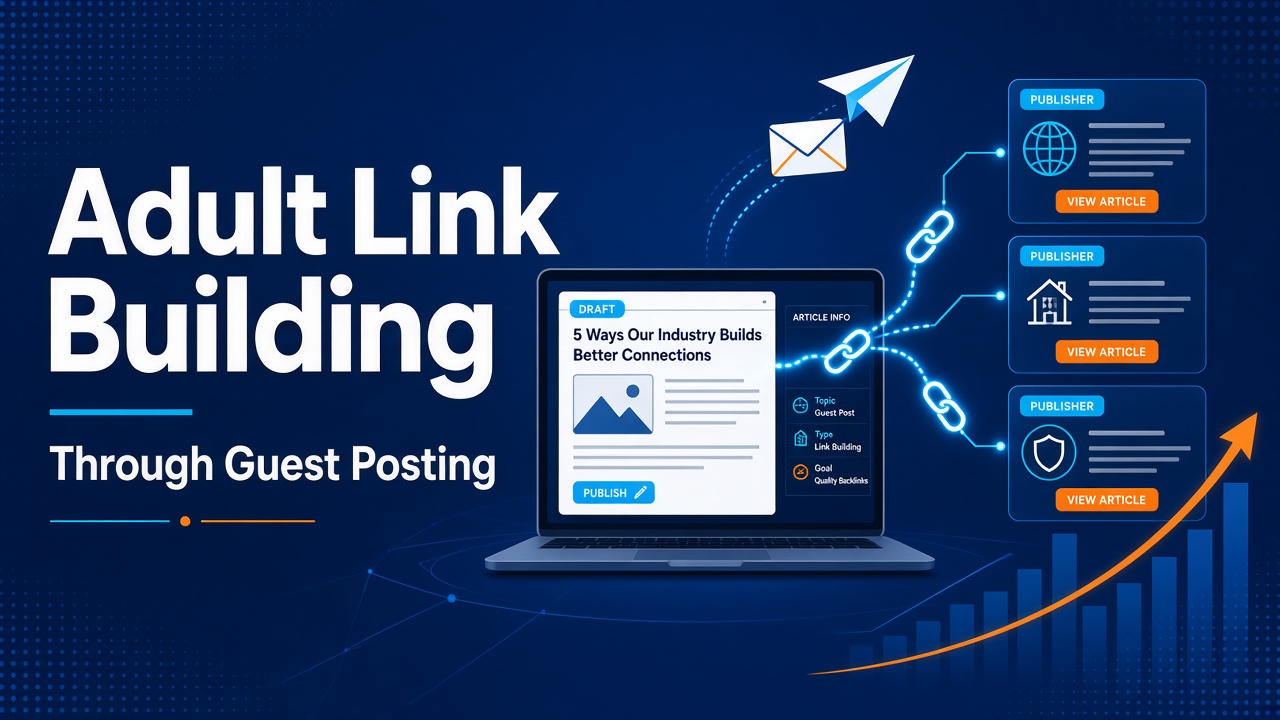
Guest posting is one of the oldest link building tactics, and one of the most abused. For adult businesses it is also one of the hardest to use well. Many publishers will not work with adult brands, many "guest post" sellers are link marketplaces in disguise, and Google’s rules on links in guest posts are strict.
That does not make guest posting useless. Done carefully, it can build visibility, credibility and a handful of relevant links. This guide explains what Google says, what is different for adult sites, which routes are realistic, how to write and label a post, what it costs, and how to judge a link building agency before you hire one. It is written for adult business owners, directory operators and platform marketers, and it avoids explicit detail.
Does guest posting still work for adult sites?
Guest posting can help adult sites, but as a slow, selective way to earn visibility and a few relevant mentions, not as a bulk source of ranking links. Google says guest posts are fine when they inform users and educate another site’s audience, and treats large-scale link-driven campaigns as a violation. The evidence that guest posts still lift rankings is thin.
Two statements from Google are worth knowing. In 2017, Google reminded site owners that distributing content at scale mainly to build links back to their own site breaks its link scheme guidelines. It said guest and syndicated posts are acceptable when they "inform users, educate another site’s audience or bring awareness to your cause or company".
In April 2020, Google’s John Mueller was asked about linking to your own guest posts. He said links placed on other sites are generally considered unnatural link building and recommended nofollow for them, but also said an occasional post is nothing to worry about. At that scale he expected no real SEO advantage or disadvantage, and suggested viewing guest posting as a way to build an audience rather than as an SEO tactic. Both of those pages are several years old, so check Google’s current documentation, but the direction has not changed.
The practical conclusion is to treat a guest post as publicity with a link attached, not a link with publicity attached.
What Google’s rules mean for your links
Google’s spam policies define link spam as creating links primarily to manipulate rankings. The list includes buying or selling links for ranking, excessive link exchanges and, in Google’s words, "links with optimized anchor text in articles, guest posts, or press releases distributed on other sites". Advertorials or native advertising where payment is received for articles that include links passing ranking credit are also listed.
Google does not forbid paid or sponsored links. It asks that they be qualified with the rel="sponsored" or rel="nofollow" attribute. Google’s guidance on qualifying outbound links prefers sponsored for advertisements and paid placements, and says nofollow is for cases where neither sponsored nor ugc fits.
Four rules follow for anyone doing guest posting:
- No exact-match anchor text stuffed into articles you place on other sites.
- Qualify paid links. If money changes hands, the link should carry sponsored or nofollow.
- Do not republish the same article across many sites. Google’s 2017 guidance also warned against duplicated content and, where duplication is unavoidable, advised canonical and nofollow.
- Write for readers. Google lists keyword-stuffed links, writers who lack topic knowledge and mass distribution among the practices it dislikes.
Google’s spam policies also cover "site reputation abuse", where third-party content is published on a host site mainly to take advantage of that host’s ranking signals. If you are a publisher hosting adult guest content on an established site, that policy is relevant to you. If you are the guest, it is a reason to choose hosts that publish real editorial content, not pay-to-play sections.
Why adult guest posting is different
Four things set adult guest posting apart from the mainstream version.
A smaller pool of publishers. Many mainstream sites will not accept content from adult brands, and many have policies that rule it out. Expect a lot of declined pitches and check each site’s guidelines first.
Classification risk on both sides. Google’s guidance for sites with explicit content says explicit pages should be grouped on a separate domain or subdomain and marked with an adult rating, because Google may otherwise classify a whole site as explicit and filter it under SafeSearch. If a mainstream publisher links to an explicit page, or if your explicit pages are on the same domain as your guest-post landing page, you can create classification problems. Point guest-post links to a clean, non-explicit page.
A noisy link market. Sellers of "adult link insertions" advertise metrics and quick turnaround, but one vendor page we reviewed stated no disclosure or nofollow policy and gave no currency or unit for its prices. BuzzStream, which sells outreach software, notes in its own pricing guide that most link insertion offers in its marketplace data come from low-quality sites. Treat any marketplace claim as unverified.
Reputational risk. A weak link can sit beside your brand name for years. Choose placements you would be happy to show a partner, a payment processor or a journalist.
Four routes that work better than bulk guest posting
The most reliable route to relevant links is often not a guest post on a random blog. These four lanes are more realistic for adult brands.
|
Route |
What it looks like |
What it needs |
Main risk |
|
Adult-industry publications and trade blogs |
Expert articles, commentary, industry data for readers who work in the sector |
A clear editorial angle and a publisher that accepts adult-brand contributors |
Low-quality sites that sell placements |
|
Adjacent business publications |
Non-explicit expertise for marketers, web developers, payments, hosting, compliance and privacy readers |
A topic that serves that audience, written without explicit content |
Publisher policies that rule out adult brands |
|
Partner, association and curated directory sites |
Member profiles, resource pages, event write-ups, interviews |
Real relationships and accurate listings |
Directories that accept anyone for a fee |
|
Original resources and data |
A guide, checklist or study others cite |
Research, design and promotion time |
Effort and slow payoff |
The second route, adjacent business publications, matches how this very article is built: a brand shares practical expertise on a topic readers care about, without explicit content, and earns a modest mention. Adult businesses have genuine expertise in classification, payments, age assurance, privacy and platform policy, and those subjects interest mainstream B2B audiences.
How to write a guest post that earns its place
A good guest post serves the host’s readers first. Use this checklist.
- Start from the host’s audience. Read recent posts and comments. Pitch a topic they have not covered, with a clear reason their readers would care.
- Keep it non-explicit and professional. Even adult-industry hosts often have standards about tone and imagery.
- Offer something specific. A process, a checklist, a worked example, or original data beats a generic overview.
- Write it properly. Use a clear structure, short paragraphs and sources for any claim. Do not invent statistics, quotes or case studies.
- Link sparingly. One relevant link in the body or the author bio is typical. Link to a page that serves the reader, such as a guide or a service overview, and not necessarily to your home page.
- Choose natural anchors. A brand name, a page title or a plain URL looks like a citation. An exact-match commercial phrase repeated across posts looks like a pattern.
- Do not syndicate. Publish original work on each host. If you must republish, ask the editor about a canonical link.
- Use a real byline. Google’s helpful-content guidance encourages making clear who created a page. A real or consistent professional name with a short bio is better than none.
Disclosure and link attributes
If you pay for a placement, two kinds of disclosure matter.
For search engines: qualify the link with rel="sponsored" or rel="nofollow", as Google asks.
For readers: label paid content clearly. The US Federal Trade Commission’s guidance on native advertising says it is deceptive to mislead consumers about the commercial nature of content, and that a disclosure is needed when an ad’s format or style is similar enough to editorial content that people would take it for independent reporting. The guide is dated 2015 and was later modified, and it applies to the US, so check the rules in each market and take advice where needed. This is not legal advice.
A simple internal rule works: if you paid, if you supplied the text for the host to publish under its own name, or if the host gave you a link in return for something, treat it as sponsored. If in doubt, disclose.
A vetting checklist for guest-post hosts
Not every site that accepts a post is worth your time. Before you pitch, check each of these.
|
Check |
What to look for |
|
Real audience |
Genuine traffic and engagement, not only a high metric score |
|
Editorial standards |
Published guidelines, named editors, articles that are useful on their own |
|
Topical fit |
Readers who would plausibly care about your subject |
|
Adult-friendliness |
A written policy or clear past examples of accepting adult-brand contributors |
|
Outbound links |
Not stuffed with commercial links; sponsored links qualified |
|
"Write for us" pages |
Pages that advertise prices for posts are a warning sign |
|
Index health |
The site’s pages appear in search results for its own name |
|
Clean surroundings |
No unrelated casino, pharma or spam sections |
Keep a record of each host you contact, the date, the response and the outcome. A simple spreadsheet is enough, and it prevents duplicate pitches.
A simple workflow
- Set the goal. Is it brand visibility, referral traffic, a link to a specific resource, or all three? Choose one primary goal.
- Build a short list. Aim for 20 to 30 well-matched hosts, not hundreds.
- Vet each host with the checklist above.
- Pitch an idea, not a finished article, unless the host asks for a draft. Keep the message short, specific and honest about who you are.
- Write to the host’s standards, then accept reasonable edits.
- Agree the link and disclosure in writing before you publish.
- Track results and adjust.
Pace matters. A steady trickle looks like a real business doing real outreach. A sudden burst of dozens of posts looks like a campaign.
What guest posting costs
Costs vary widely, and the data is vendor-led. BuzzStream’s pricing guide, which uses marketplace data from a link marketplace, reports an average of about $295 for direct guest posts and about $461 when bought through a vendor, with ranges that climb steeply for higher-authority sites. It reports link insertions at an average of about $179, and agency retainers of $2,500 to $10,000 a month. The author’s methodology is not fully described, the page contradicts itself in places, and BuzzStream sells related software, so treat these as rough indications.
Adult-specific pricing is harder to verify. The adult link insertion vendor page we reviewed lists prices with no currency and no stated unit, and does not say how links are labelled. Ask any seller for the unit, the currency, the link attribute and the disclosure approach in writing.
Two budgeting principles help:
- Pay for work, not for links. Research, outreach, writing and relationship time are real costs. A fixed price per live link invites shortcuts.
- Compare with other channels. A strong resource page, a partnership or an event write-up can cost less per useful mention than a bought placement.
We have not quoted agency prices, because we could not verify a reliable adult-specific range.
Choosing a link building agency
A link building agency can save time if you lack outreach capacity, but the risks are real. Google’s guidance on hiring an SEO warns against guaranteed rankings, secrecy, link popularity schemes and thousands of backlinks for a low price. It also says you are responsible for the actions of any company you hire.
Whether you choose a general link building agency or a specialist adult link building agency, ask these questions:
- How do you earn links, step by step, and which methods do you refuse?
- Can I see recent placements, with the actual URLs, so I can check them?
- Which links are labelled `sponsored` or `nofollow`, and how do you disclose paid content?
- Who writes the content, and how do you ensure it is original and non-explicit?
- What is your adult-industry experience, and how do you handle explicit-content classification?
- How do you report, and what will you not claim?
- What happens if a link is removed or a site is penalised?
- What does it cost to leave, and who owns the assets?
Red flags include guaranteed rankings, a fixed number of "DA 50+ links" promised each month, private networks, no named placements, long contracts before deliverables are defined, and an unwillingness to explain methods.
An adult link building agency should also understand the constraints in this guide: the smaller publisher pool, classification risk, and the need to keep guest-post landing pages clean. A good adult SEO agency will treat link building as one part of a wider plan that includes site structure, content and technical health, because links cannot fix a site that Google cannot classify or crawl properly.
An illustrative plan for a directory operator
The plan below is a hypothetical example, not a client case and not a promise of results. Imagine a directory that lists legal adult businesses and wants relevant mentions over six months.
- Month 1. Audit the site’s classification, fix the landing pages, and publish one genuinely useful resource, such as a guide to choosing a payment provider. Build a vetted list of 25 hosts.
- Months 2 and 3. Pitch six hosts with tailored ideas. Aim for one or two accepted posts. Offer data or a checklist the directory is well placed to provide.
- Months 4 to 6. Follow up with accepted hosts, add partner and association mentions, and write one more post for a different audience, such as web developers or payment specialists.
By the end, success might be a few live placements, some referral visits and a handful of new referring domains. The plan is deliberately modest. It prizes relevance and repeatability over volume.
Anchors, pace and the shape of a natural profile
A natural link profile is uneven. Some links use the brand name, some use a page title, many use plain URLs, and a few use descriptive phrases. Guest posts are only one source. If most of your links come from posts you wrote yourself, with the same commercial phrase as anchor, the pattern is easy to see.
Keep these habits in mind:
- Vary the anchor naturally and let brand and URL anchors dominate.
- Space placements over time instead of publishing several in a week.
- Mix sources. Mentions from partners, press, directories and customers should sit alongside guest posts.
- Keep records, so you can audit your profile and fix problems early.
Measuring results
Do not measure guest posting by one keyword position. Track these instead.
- Placements live, with date, host, URL, link attribute and landing page.
- Referring domains gained, using Search Console’s links report and a backlink tool.
- Referral traffic from each host, and what those visitors did.
- Branded searches for your business name over time.
- Enquiries or sign-ups linked to referral visits.
- Quality notes on each host, including any later problems.
Review monthly and judge over several months. If a channel produces mentions but no traffic and no enquiries, adjust the topic or the hosts.
Common mistakes
- Chasing metrics scores instead of relevance and real readers.
- Using the same anchor on every post.
- Pointing links at explicit pages, which can create classification problems.
- Buying posts in bulk from marketplaces with unverified quality.
- Hiding paid placements. Disclosure protects both you and the host.
- Recycling one article across many hosts.
- Ignoring the host’s audience. Posts that do not serve readers rarely get traffic or lasting links.
- Treating guest posts as the whole strategy. They are one tactic among several.
Frequently asked questions
Is guest posting allowed by Google?
Yes, when it informs users and serves the host’s audience. Google treats large-scale link-driven article campaigns and optimised anchors in guest posts as link spam.
Should guest post links be nofollow?
Paid links should be qualified with sponsored or nofollow. For unpaid editorial posts, Google’s public comments suggest nofollow is the cautious choice for links in guest posts, though an occasional follow link is unlikely to cause problems.
Can adult sites get guest posts on mainstream blogs?
Sometimes, particularly on business and marketing publications that welcome non-explicit expertise. Many hosts decline adult brands, so check each site’s policy and expect refusals.
How many guest posts do I need?
There is no magic number. A small number of relevant, well-placed posts is better than many weak ones.
Does an adult link building agency guarantee rankings?
No agency can. Google says no one can guarantee a number-one ranking. Be wary of anyone who does.
Next steps
Start with a short list of hosts that fit your audience, a topic only you can write well, and a landing page that is clean and useful. Label anything paid, track every placement, and review results after a few months before you scale.
If you would like help, Escort Marketing Agency (EMA) is an adult SEO agency and link building agency for legal adult-industry businesses. EMA markets legal businesses and does not provide, broker or list adult services. Contact us to discuss your goals and get a free audit.
References
- Google Search Central, "Spam policies for Google web search" (updated 28 August 2026): https://developers.google.com/search/docs/essentials/spam-policies
- Google Search Central, "Qualify your outbound links to Google" (updated 10 December 2025): https://developers.google.com/search/docs/crawling-indexing/qualify-outbound-links
- Google Search Central, "Guidelines for sites with explicit content": https://developers.google.com/search/docs/specialty/explicit/guidelines
- Google Search Central, "Do you need an SEO?" (updated 5 June 2026): https://developers.google.com/search/docs/beginner/do-i-need-seo
- Search Engine Journal, "Google Issues Warning About Guest Posting to Build Links" (May 2017): https://www.searchenginejournal.com/google-issues-warning-guest-posting-build-links/200038/
- Search Engine Journal, "Google Answers: Is It OK to Link to My Own Guest Post?" (April 2020): https://www.searchenginejournal.com/google-answers-is-it-ok-to-link-to-my-own-guest-post/360660/
- FTC, "Native Advertising: A Guide for Businesses" (December 2015, modified 2021): https://www.ftc.gov/tips-advice/business-center/guidance/native-advertising-guide-businesses
- BuzzStream, "Link Building Pricing" (updated October 2026): https://buzzstream.com/blog/link-building-pricing/