 admin

Adult websites face the same core SEO requirements as any other site: crawlability, indexation, speed, security, and reliable website uptime. The difference is the narrower set of hosting providers willing to accept the content, the higher risk of policy-driven interruptions, and the greater impact when technical foundations fail.
Marketing leaders who treat hosting as a pure infrastructure decision often discover later that crawl errors, intermittent downtime, or weak HTTPS configuration quietly limit organic growth.
A clearer scope starts with governance and documentation rather than vendor lists. Define what “good enough” looks like for the specific site, assign ownership for each technical layer, and create a short evidence trail that survives staff changes or provider migrations. This approach turns hosting SEO from a recurring headache into a controlled set of checks and thresholds.
Scope and assumptions
The framework below assumes the site is already live or near launch, serves adult content that complies with applicable local laws, and relies on organic search as one growth channel. It focuses on the hosting and server layer that influences SEO, not on content strategy, backlink tactics, or paid acquisition.
Key assumptions:
- The hosting provider allows adult content and does not impose sudden content-level blocks without notice.
- DNS, domain registration, and SSL certificates are under the site owner’s control or can be moved.
- Technical access (server logs, CDN settings, robots.txt, sitemap) is available to the person running the checks.
- Search engines still crawl and index adult sites when technical signals are clean; the primary constraints are usually self-inflicted or provider-related rather than blanket bans.
Governance begins with a one-page ownership map. List who owns DNS, who manages the server or managed hosting account, who reviews SSL renewal, and who monitors uptime alerts. Without this map, problems surface only after rankings or traffic drop.
Crawl and indexation checks
Start with the basics that determine whether search engines can even see the site.
Confirm robots.txt allows the pages that should rank and blocks only what is intentionally private (admin areas, staging, certain media directories if desired). A single disallow rule that is too broad can remove large sections of an adult site from the index overnight.
Verify the XML sitemap is current, submitted in Search Console (or equivalent), and returns a 200 status. Check that the sitemap lists the preferred HTTPS URLs and does not mix HTTP and HTTPS versions.
Review recent crawl stats and coverage reports. Look for spikes in server errors (5xx), soft 404s, or “crawled – currently not indexed” pages that previously ranked. Adult sites often accumulate large media libraries; if the server or CDN throttles bots under load, crawl budget is wasted and new or updated pages lag.
Test a sample of important URLs with the URL Inspection tool and with a fetch-as-Google equivalent. Note any difference between what the browser sees and what the crawler receives. Inconsistent rendering or blocked resources (CSS, JS that affect layout or internal links) create gaps between user experience and indexable content.
Document the findings with screenshots or export dates. This becomes the baseline before any hosting change.
Architecture and metadata
Hosting choices influence architecture more than most marketing teams realize.
Server response time and Time to First Byte affect both Core Web Vitals and crawl efficiency. Choose or configure hosting that consistently delivers under 200–300 ms TTFB for the majority of requests under normal load. Adult sites with heavy image or video assets benefit from a CDN that is adult-friendly and configured for origin shielding or proper cache headers.
HTTPS is non-negotiable. Mixed content (HTTP resources on an HTTPS page), expired certificates, or incomplete redirects from HTTP to HTTPS all generate warnings and can suppress ranking signals. Prefer providers that support automatic certificate renewal via Let’s Encrypt or equivalent and that allow full control over HSTS headers if needed.
URL structure should remain stable across hosting migrations. Avoid providers that force path changes or introduce query-string tracking that pollutes clean URLs. Canonical tags must point to the preferred HTTPS version; relative canonicals or incorrect absolute ones create duplicate-content risk, especially when a site has both www and non-www variants or multiple language versions.
Internal linking architecture matters for crawl depth. If the hosting or theme setup generates large numbers of thin or paginated pages without clear hierarchy, bots may never reach the high-value service or location pages that drive commercial intent.
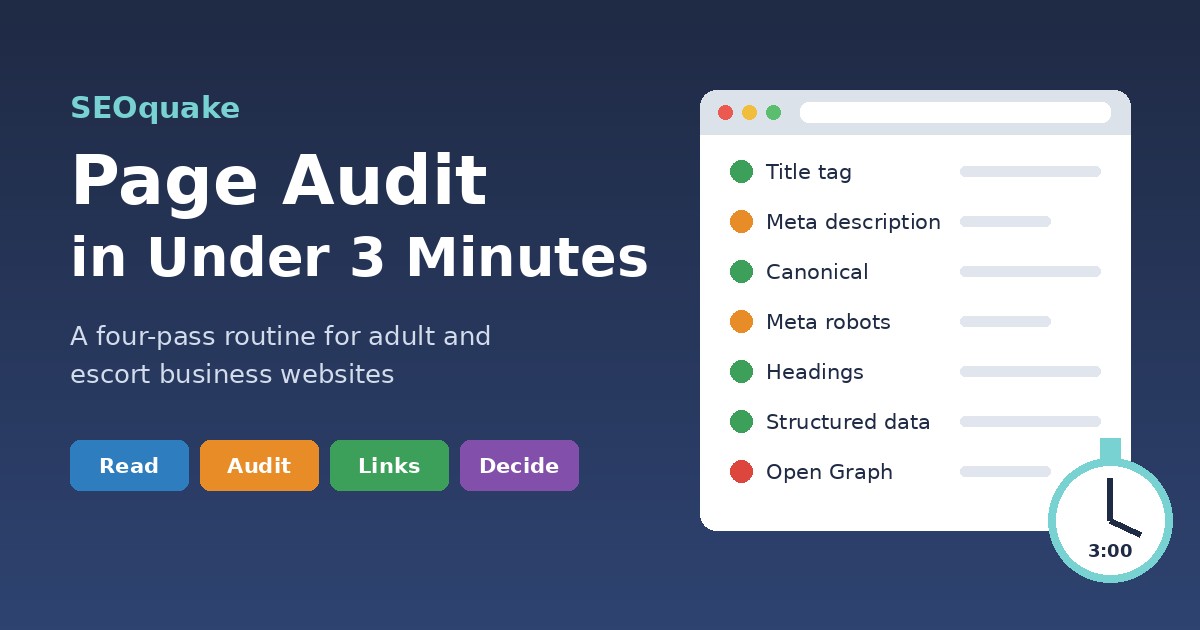
Metadata itself is not a hosting issue, but the ability to edit title tags, meta descriptions, and structured data without fighting the platform is. Managed adult hosting or page builders that lock these fields create long-term SEO friction.
Validation steps
Before declaring a hosting setup SEO-ready, run a short validation sequence:
- Confirm the production domain resolves only to the intended server or CDN endpoints.
- Force an HTTPS request and verify the certificate chain is complete, and the redirect from HTTP is a clean 301.
- Fetch the homepage and three deep commercial pages with a tool that reports status code, response headers, and final URL.
- Check that robots.txt and the sitemap are reachable and correctly formatted.
- Run a limited crawl (Screaming Frog or equivalent) limited to 500–1,000 URLs and review for 4xx/5xx errors, redirect chains, and missing canonicals.
- Compare server performance access logs against Search Console crawl stats for the same period to spot discrepancies in bot behavior.
- Measure TTFB and largest contentful paint on mobile under simulated 4G conditions for key templates.
Any failure in this sequence is a blocking issue. Fix or document the residual risk before proceeding to content or link work.
Monitoring and troubleshooting
Ongoing monitoring prevents silent degradation.
Set uptime checks from multiple geographic locations with alerts for downtime longer than a few minutes. Adult sites often see traffic spikes; a provider that looks stable under light load can fail under load and produce temporary 5xx responses that search engines interpret as quality problems.
Track Core Web Vitals in Search Console and with real-user monitoring if available. Sudden drops often correlate with CDN misconfiguration, origin overload, or certificate problems rather than content changes.
Review crawl stats weekly or bi-weekly. An unexplained drop in crawled pages or rise in server errors should trigger an immediate check of hosting status, firewall rules, and bot-blocking settings. Some adult hosting providers aggressively rate-limit unknown bots; if Googlebot is affected, indexation suffers.
When troubleshooting ranking or traffic drops, isolate the hosting layer first. Compare the current server IP, SSL status, and response headers against the last known good baseline. Migrations, IP changes without proper redirects, or temporary DNS issues are common and fully reversible if caught early.
Keep a simple incident log: date, symptom, root cause (hosting-related or not), resolution, and any residual SEO impact. Over time this log reveals whether the current adult hosting provider is a recurring source of risk.
Checklist
Use this as a living document rather than a one-time audit.
Governance
- Ownership of DNS, hosting account, SSL, and monitoring is named and current.
- Baseline crawl and coverage reports are saved with dates.
Crawl & Indexation
- robots.txt is intentional and tested.
- Sitemap is valid, submitted, and HTTPS-only.
- No widespread 5xx or soft-404 patterns in recent crawl data.
Architecture & Performance
- Consistent HTTPS with clean redirects and valid certificate.
- Acceptable TTFB under normal and peak load.
- CDN (if used) is adult-permissive and correctly configured for HTML and assets.
- URL structure and canonicals remain stable.
Validation & Monitoring
- Pre-change validation sequence completed and documented.
- Uptime and Core Web Vitals monitoring active.
- Process exists to investigate crawl or performance anomalies within a defined window.
Provider Fit
- Adult content is explicitly allowed under current terms.
- Technical support response times and escalation paths are known.
- Exit plan (data export, DNS control, certificate portability) is documented.
Closing
Scoping adult website hosting SEO is less about finding the “best” provider and more about defining measurable technical standards, assigning clear ownership, and maintaining a short evidence trail.
When those elements are present, hosting decisions become faster, migrations carry less ranking risk, and marketing teams can focus on content and acquisition instead of fighting invisible technical debt.
Site owners and technical managers who have refined this process often find that the highest leverage comes from the documentation itself: a shared checklist and baseline that survives personnel changes. If you have adapted a similar governance model for adult or high-risk content sites, the practical details of what you monitor and how you set thresholds are worth sharing.