 admin
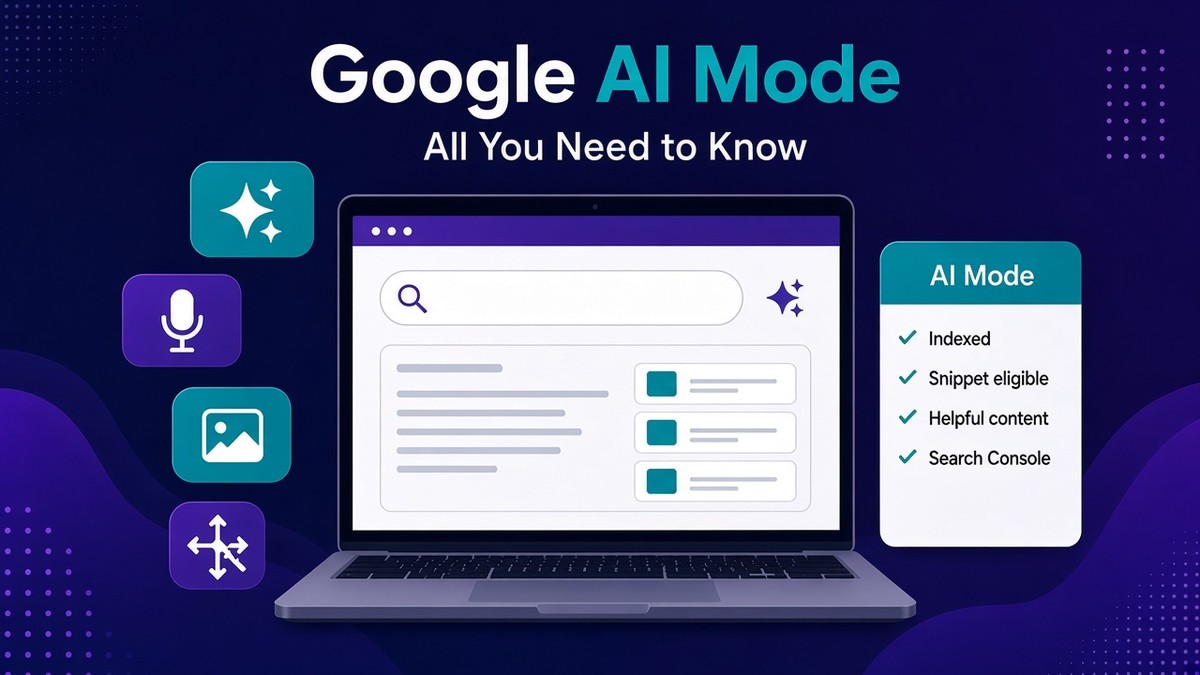
Short answer: Google AI Mode is a conversational search experience inside Google Search that answers a question directly, then links to web pages for further reading. Google describes it as its “most powerful AI search experience.” For site owners, three facts matter most. Pages are chosen as supporting links through normal indexing, not a special submission. Google now reports AI feature impressions in Search Console, but not clicks or queries. And Google’s own pages say nothing specific about adult content in AI Mode, so any claim about it should be treated as unverified. This guide covers what is documented as of 31 October 2026. Google changes AI Mode often, so check the linked pages before acting.
What Google AI Mode is
Google’s help page says AI Mode lets you ask a question and get an AI-powered reply, with follow-up questions and links to the web for going further. It accepts text, voice, images and files. You can keep asking follow-ups inside the same conversation.
Its main technical idea is query fan-out. Google says AI Mode divides a question into subtopics and searches for each one at the same time. A single question like “which camera is better for travel under a certain budget” can become several searches covering weight, battery, lens options and reviews. The answer is then assembled from the results.
Google also states two limits. The response may not always be right, and when the system has low confidence it may show web links instead of a written answer. Treat AI Mode as a research assistant that can be wrong, not as a source of record.
How AI Mode differs from AI Overviews
AI Overviews are summaries that appear at the top of some regular search results. AI Mode is a separate space you move into, built for longer and more complex questions. Google’s Search Central documentation says it is “particularly helpful for queries where further exploration, reasoning, or complex comparisons are needed.” The same documentation notes that AI Mode and AI Overviews may use different models and techniques, so the links they show can differ.
Google’s own documentation says query fan-out can show a wider and more diverse set of links than traditional search. In practice, this means a page can be cited for a subtopic question you never targeted directly. It also means a page that ranks well for the main phrase may not appear.
In May 2026, Google added a way to move from one to the other. Users can ask a follow-up question directly from an AI Overview and continue in AI Mode. That means AI Overviews are now a doorway into AI Mode, so the two are harder to treat as separate channels.
Where AI Mode is available and how it has grown
Availability is a moving target, so this section uses dated announcements rather than a single status.
| Date | Change | Source |
|---|---|---|
| 21 August 2025 | Expanded to over 180 new countries and territories in English. It had been in the US, India and the UK. Agentic booking started for Google AI Ultra subscribers in the US. | Google blog |
| 19 May 2026 | Gemini 3.5 Flash became the default model globally. Google reported more than one billion monthly AI Mode users. | Google I/O 2026 post |
| 3 June 2026 | Search Console began rolling out dedicated generative AI performance reports. | Search Central, via secondary report |
| 28 October 2026 | Ads in AI Mode scaling in ten markets, with Brazil, Mexico and the UK planned for Q4 2026. | Google ads blog |
Two cautions apply. First, the one-billion-user figure is Google’s own claim from its I/O announcement, not an independent measure. Second, features differ by country, language, age and subscription. Google’s help page lists personalization as requiring users to be 18 or older with history enabled, and some newer models are limited to paid Google AI Pro and Ultra subscribers. Check the help page for your target market before assuming a feature applies.
What AI Mode can do now
From Google’s I/O 2026 announcement and its 2025 product post, the documented features are:
- A redesigned search box that accepts text, images, files, videos or Chrome tabs.
- Follow-ups from AI Overviews into a conversation.
- Personalization. Personal Intelligence lets users connect Gmail and Google Photos, with Google Calendar said to be coming. Google says this expanded to nearly 200 countries and territories and 98 languages without a subscription.
- Agentic tasks. Booking was announced for restaurants first, with local services and event tickets to follow. Google named OpenTable, Resy and Ticketmaster as partners in 2025.
- Generative layouts such as tables and simulations, and background “information agents” that monitor the web, announced for AI Pro and Ultra subscribers.
Some of these were described as “this summer” or “in the coming months” at the time of announcement, so confirm each is live in your market. For business owners, the practical point is that AI Mode is moving from answering questions toward completing tasks. A business that is easy for software to read, with clear hours, services and contact details, is better placed for that shift than one that is not. That is a general reading, not a documented ranking factor.
How pages become links in AI Mode
This is the part site owners most want answered, and Google’s answer is plain. In its AI features documentation, Google says a page must be indexed and eligible to be shown with a snippet to be a supporting link. There are “no additional technical requirements.” There is no special markup, no AI file, and no submission form.
That puts the work back on standard SEO:
- The page can be crawled and is indexed.
- The content is useful, original and clearly structured.
- The page is not blocked by snippet controls.
Google lists the controls site owners have. These are robots.txt, the nosnippet and data-nosnippet attributes, max-snippet, noindex, and the Google-Extended token for use by other Google AI systems. Each has a cost. Blocking snippets can remove a page from AI features, but it can also change how the page appears in ordinary results.
Since 31 August 2026, Google says a Search generative AI control in Search Console has been available to all sites worldwide. It lets a site opt out of AI features including AI Overviews and AI Mode. That detail comes from a secondary report, because Google’s original post could not be read in full during research. Check it directly in Search Console before relying on it.
Planning content around query fan-out
Fan-out changes how a page should be planned. A page written only for one head phrase answers one question. A page that also answers the questions around it gives AI Mode more to work with. Take a business owner asking AI Mode how to choose a payment or hosting setup for an adult-business site. The system may split that into separate searches on provider policies, technical requirements, costs and risks. A page that covers those four angles clearly, with headings that match the way people phrase them, offers more than one entry point.
This example is an illustration of the method, not a data point. We have no AI Mode data on how often any real query fans out or into what. The way to see it for your own topics is to test: run the question in AI Mode in a logged-out browser, read the sources shown, and note which subtopics those sources cover that your page does not. That list is your content gap. Repeat on another day, because answers change.
Good fan-out content has a few traits that need no special tools:
- Headings phrased as questions or tasks, so each section stands alone.
- The answer first, then the detail, so a snippet makes sense out of context.
- Named conditions and limits, such as “this applies only if” or “check local law”, so a summary does not overstate your claim.
- One topic per page. Avoid stuffing five unrelated services onto one URL.
Common misunderstandings
“AI Mode will replace regular search.” Google has not said that. Its own help page describes AI Mode as an extension of AI Overviews, and the ordinary results page still exists. How usage will split over time is not documented.
“You need a new strategy and a new file.” Google’s guidance says no additional technical requirements apply. Work on indexing, content and technical health carries over.
“If I rank first, I will be cited.” Google says fan-out can show a wider and more diverse set of links. A page ranking well for the head phrase may not be one of the links, and a page that ranks lower may be.
“More AI-written pages will help.” Google’s spam policies target scaled content produced mainly to manipulate rankings. Quantity is a risk, not a plan.
“A tool score tells me my AI visibility.” Tools sample prompts at one moment. Treat their numbers as directional, ask for the sample size and date, and compare with your own logged-out tests.
Measuring AI Mode in Search Console
Until mid-2026, there was no separate view. Search Engine Journal reported in June 2025 that AI Mode data counts inside the Performance report totals and that follow-up questions count as new queries. There was no filter.
That has changed in part. Google announced Search generative AI performance reports on 3 June 2026, and Search Engine Roundtable reported on 1 September 2026 that they were live after a slow rollout. The reported metrics are:
- Impressions in generative AI features across Search and Discover
- Pages that appeared
- Countries
- Devices (Search only)
- Dates
The same reports say what is missing. There are no clicks and no queries. AI Overviews and AI Mode are reported together, not separately. A site with too little data may not see the report at all. Because the report shows impressions without clicks, you cannot calculate a click-through rate from it. Treat it as a visibility signal, not a traffic report.
Ads in AI Mode
Google announced on 28 October 2026 that ads in AI Mode were scaling in Australia, Canada, India, Kenya, Malaysia, New Zealand, Nigeria, Pakistan, the Philippines and Singapore, with Brazil, Mexico and the UK planned for Q4 2026. Ads are labelled “Sponsored.” Google also said it is launching multi-turn ads in the US, which can appear in follow-up questions.
One distinction matters for adult advertisers. Google’s Ads Help page on AI Overviews says ads do not show in AI Overviews for sensitive verticals, and it names adult content among them. That page covers AI Overviews, not AI Mode. The AI Mode ads page that Google links to was not read in full during research, so this guide makes no claim about how adult or escort-related ads are treated in AI Mode. Advertisers should read Google’s current Ads policies directly and not assume either way.
Is AI Mode citation stable?
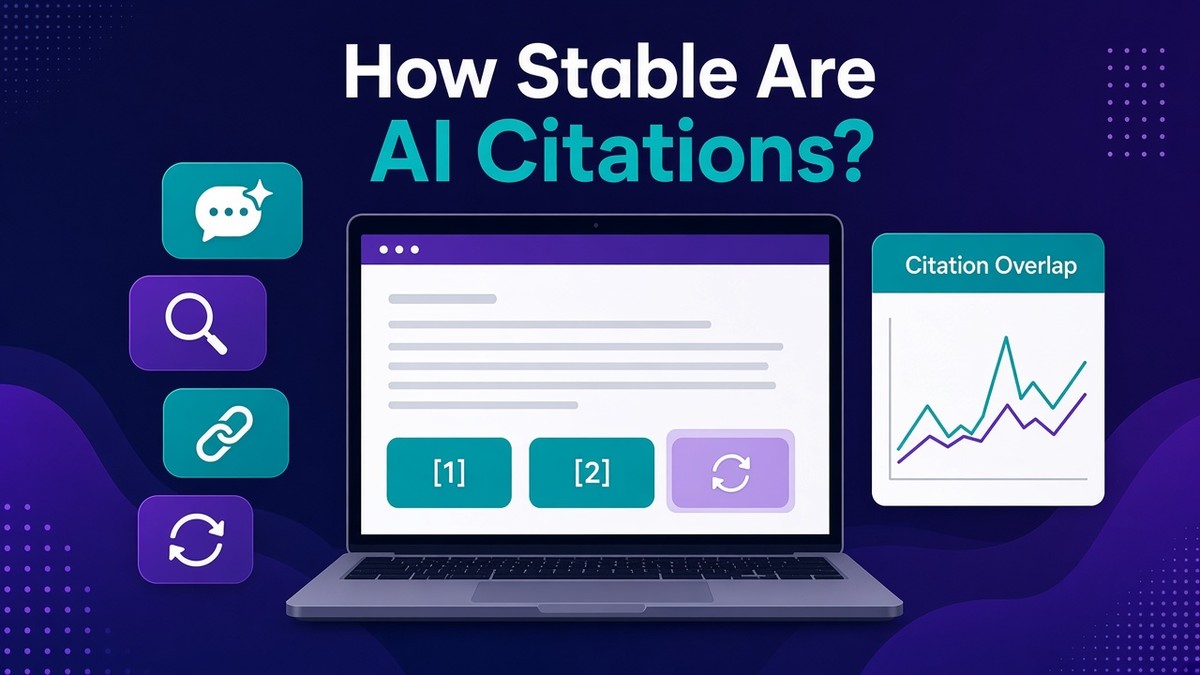
Not very, based on the published studies we reviewed, but with an important limit: nearly all of them measure other systems, mainly ChatGPT, not AI Mode. Semrush, for example, reported about 25.6% overlap in cited sources between different ChatGPT reasoning modes in a 100-prompt test. Other vendor studies found low overlap between repeated runs of the same prompt. Those studies are small, often run by companies that sell AI visibility tools, and not peer reviewed.
We did not find a study of AI Mode citation stability that we could verify. So the sensible reading is cautious. A page cited today may not be cited tomorrow, a screenshot of one answer proves little, and any specialist who promises a fixed position in AI Mode is promising something Google does not offer.
If you want to track your own visibility, keep the method honest. Pick a fixed list of prompts that match real customer questions, run each several times on different days, and log the date, location, device and whether you were signed in. Record the sources shown, not just whether you were named. Report ranges and repeat rates, not a single score. A pattern that holds across many runs is evidence. A single appearance is not.
What this means for adult businesses
Google’s AI Mode help page and its AI features page do not mention explicit or adult content at all. That is the honest starting point, and it means there is no documented rule to quote. What exists is Google’s general guidance for explicit content in Search, and the same eligibility rule for AI features: a page that is not indexed or not eligible for snippets cannot be a supporting link.
Three consequences follow, each framed as a general reading and not as documented AI Mode behaviour:
- Technical access still decides eligibility. Google’s explicit content guidelines describe using a separate domain or subdomain for adult material, marking pages with an adult rating or an RTA label, and making sure Googlebot can reach content behind an age gate. Google says to verify Googlebot by reverse and forward DNS lookup or by published IP ranges. A page Googlebot cannot reach cannot be indexed, and so cannot be a supporting link.
- Non-explicit pages carry the load. Informational pages, such as directory guides, business explainers, policy and safety pages, and location pages, are easier for any system to summarise. Whether AI Mode treats them differently from other pages is not documented.
- Do not build pages for AI Mode alone. Google’s spam policies cover scaled content, doorway pages and keyword stuffing. Many near-identical pages made to catch fan-out subtopics risk those policies.
This guide assumes lawful, adult-only operations. It is general information, not legal advice. Laws and platform rules on adult content differ by country, so check with a qualified professional in your market.
What to do now
Keep the list short and testable:
- Check indexing and snippet settings. Confirm key pages are indexed and not set to nosnippet by accident.
- Check bot access. Make sure verified Googlebot can pass any age gate.
- Open the Search Console AI report if it appears for your property, and note impressions by page and country. Record a baseline.
- Answer the follow-up question. Add a clear, specific section to existing pages for the questions a buyer asks next, such as pricing method, turnaround, eligibility and policy. Keep claims you can support.
- Keep business details consistent across your site and profiles.
- Test in a logged-out browser and record the date, location and exact prompt. One screenshot is an anecdote.
- Ignore guarantees. Nobody can promise a place in an AI answer.
Hiring an adult AI SEO specialist
If you plan to hire an AI SEO specialist, treat “AI SEO” as the same discipline with a new measurement problem. Google’s own guidance on hiring an SEO says no one can guarantee a top position, and it lists red flags. Those apply here.
Ask a candidate these questions:
- What would you change on our pages, and why does Google’s documentation support it?
- How do you handle age gates and Googlebot verification?
- How do you report AI visibility, with what sample size and how often?
- What do you do when results change from one run to the next?
- Which parts of your advice are documented by Google and which are your own judgement?
Warning signs include guaranteed citations, secret “AI algorithm” claims, one-off screenshots as proof, and a plan that skips indexing and content quality. Start with limited, read-only Search Console access, as Google suggests for any SEO engagement. A specialist who understands adult-industry rules should also be able to explain what they would not do, such as publishing explicit text on pages meant for broad indexing.
FAQ
Is Google AI Mode the same as AI Overviews?
No. AI Overviews are summaries on some results pages. AI Mode is a conversational space for longer questions, and Google lets users move from an AI Overview into AI Mode.
Do I need special markup to appear in AI Mode?
Google says there are no additional technical requirements beyond being indexed and eligible to show a snippet.
Can I see AI Mode traffic in Search Console?
Impressions in generative AI features, yes, if the report is shown for your property. Clicks and queries are not in that report, and AI Mode and AI Overviews are not separated.
Can I opt out?
Google’s snippet controls apply. A reported Search generative AI control also exists in Search Console. Opting out can reduce visibility, so decide with data.
Does AI Mode treat adult sites differently?
Google’s AI Mode pages do not say. We found no documented rule, so we make no claim.
Can anyone guarantee a citation in AI Mode?
No. Citations vary and Google does not offer placement.
Final thoughts
AI Mode changes how people ask questions, but the route to visibility still runs through crawlable, indexed, useful pages. Escort Marketing Agency (EMA) is a digital marketing agency for adult businesses, not an adult service. If you want help reviewing indexing, age-gate access and AI visibility measurement for your own site, or you are looking to hire an adult AI SEO specialist, Connect with us today at https://escortmarketing.agency/.
References
- Google Search Help, “Get AI-powered responses with AI Mode in Google Search”: https://support.google.com/websearch/answer/16011537
- Google Search Central, “AI features and your website”: https://developers.google.com/search/docs/appearance/ai-features
- Google (Robby Stein), “AI Mode in Search gets new agentic features and expands globally” (21 August 2025): https://blog.google/products-and-platforms/products/search/ai-mode-agentic-personalized/
- Google, Search announcements at I/O 2026 (19 May 2026): https://blog.google/products-and-platforms/products/search/search-io-2026/
- Google (Shashi Thakur), ads in AI Mode expansion (28 October 2026): https://blog.google/products/ads-commerce/ads-in-ai-mode-global/
- Google Ads Help, “About ads in AI Overviews” (covers AI Overviews, not AI Mode): https://support.google.com/google-ads/answer/16297775
- Search Engine Journal, report on AI Mode data in Search Console Performance totals (16 June 2025).
- PPC Land, “Google finally gives Search Console its own generative AI visibility reports” (announcement dated 3 June 2026; secondary report): https://ppc.land/google-finally-gives-search-console-its-own-generative-ai-visibility-reports/
- Search Engine Roundtable (Barry Schwartz), Search Console generative AI report and control live (1 September 2026; secondary report): https://www.seroundtable.com/google-search-console-generative-ai-tools-live-41984.html
- Semrush, “Only 25% of cited sources overlap between ChatGPT’s different reasoning modes” (30 June 2026): https://www.semrush.com/blog/chatgpt-reasoning-ai-visibility/
- Google Search Central, “Guidelines for sites with explicit content”: https://developers.google.com/search/docs/specialty/explicit/guidelines
- Google Search Central, “Verifying Googlebot and other Google crawlers”: https://developers.google.com/search/docs/crawling-indexing/verifying-googlebot
- Google Search Central, “Spam policies for Google web search”: https://developers.google.com/search/docs/essentials/spam-policies
- Google Search Central, “Do you need an SEO?”: https://developers.google.com/search/docs/beginner/do-i-need-seo