 admin
Short answer: The website marketing strategies that hold up in 2026 are mostly the unglamorous ones: make the site easy for search engines and people to reach, give each page one clear job, publish content that adds something new, earn mentions from places your customers trust, own a channel such as email, and stay inside the rules that apply to adult businesses. This guide sets out 17 strategies in four groups, with what to do, what to watch for and what to measure for each. It uses Google’s documentation, US and UK regulator guidance, and dated studies, and it makes no promise about rankings, traffic or AI citations, because no one can. It is written for adult business owners, directory operators and platform marketers, assumes lawful, adult-only operations, and is general information, not legal advice.
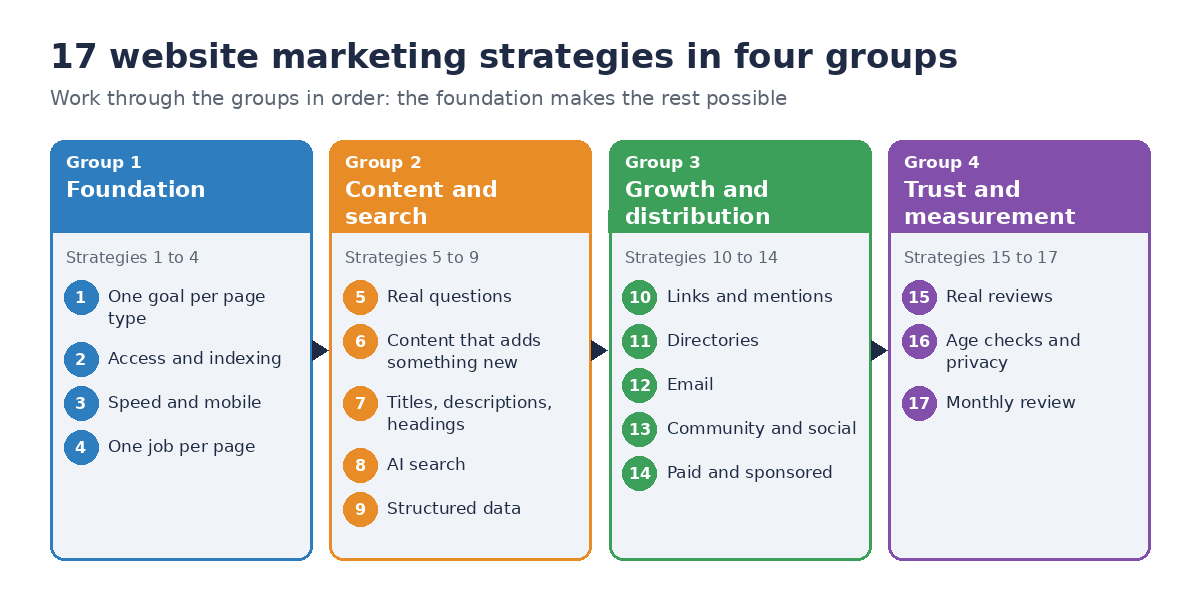
Figure 1. The 17 strategies in four groups. Work through the groups in order: the foundation makes the rest possible.
How to use this list
Do not try all 17 at once. The groups are in the order we suggest working through them, and the 90-day plan near the end shows one way to sequence them. If you have a small team, pick the foundation group first, then one or two strategies from each other group. Each strategy has three parts: Do this (specific steps), Watch for (the usual way it goes wrong) and Measure (what to record). We say where evidence is thin, and we do not quote search volumes or difficulty scores, because we did not have a keyword data source for this guide and will not invent figures.
Group 1: Foundation (strategies 1 to 4)
1. Set one measurable goal per page type
A website with “more traffic” as its goal cannot be steered. Decide what each page type is for: an enquiry, a sign-up, a listing request, a purchase, a read. Then pick one number per type.
Do this:
- List your page types (service, listing, category, guide, contact) and write one goal per type.
- Open Search Console’s Performance report, which shows clicks, impressions, click-through rate and average position, and can be grouped by queries, pages, countries and devices. Its default view covers the past three months. Save a baseline export before you change anything.
- Set up tracking for the action that matters, such as form submissions, in your analytics tool.
Watch for: Google notes that chart and table totals in the report can differ, because they aggregate differently. Compare like with like.
Measure: Baseline clicks, impressions and conversions per page type, with the date.
2. Fix access and indexing first
A page that cannot be crawled or indexed cannot earn visits, however good it is. Check this before spending on content.
Do this:
- Read your robots.txt and sitemap. On 30 October 2026 we read escortmarketing.agency’s: one rule group for all crawlers with an empty
Disallow, and a sitemap index listing 459 post URLs and 62 page URLs. - Check each page template for a
noindextag and for a canonical URL that points to the page itself. Google’s robots meta tag documentation explains that a crawler must be able to fetch a page to see anoindexrule. Its canonical guidance recommends a self-referencing canonical on the preferred page and warns against conflicting signals. - If any pages are explicit, follow Google’s guidelines for sites with explicit content: keep them on a separate domain or subdomain where possible, label them with the
adultrating or an RTA label, and handle age gates so Googlebot is not blocked by mistake.
Watch for: One wrong setting in a template can repeat across hundreds of pages. Check per template, not only the homepage.
Measure: Pages submitted versus pages indexed in Search Console; number of templates checked.
3. Make the site fast, stable and usable on a phone
Google’s Core Web Vitals guidance gives targets for loading (Largest Contentful Paint of 2.5 seconds or less), responsiveness (Interaction to Next Paint under 200 milliseconds) and visual stability (Cumulative Layout Shift under 0.1). Google also indexes the mobile version of a page, per its mobile-first indexing guidance, so the phone view must carry the same main content as the desktop view.
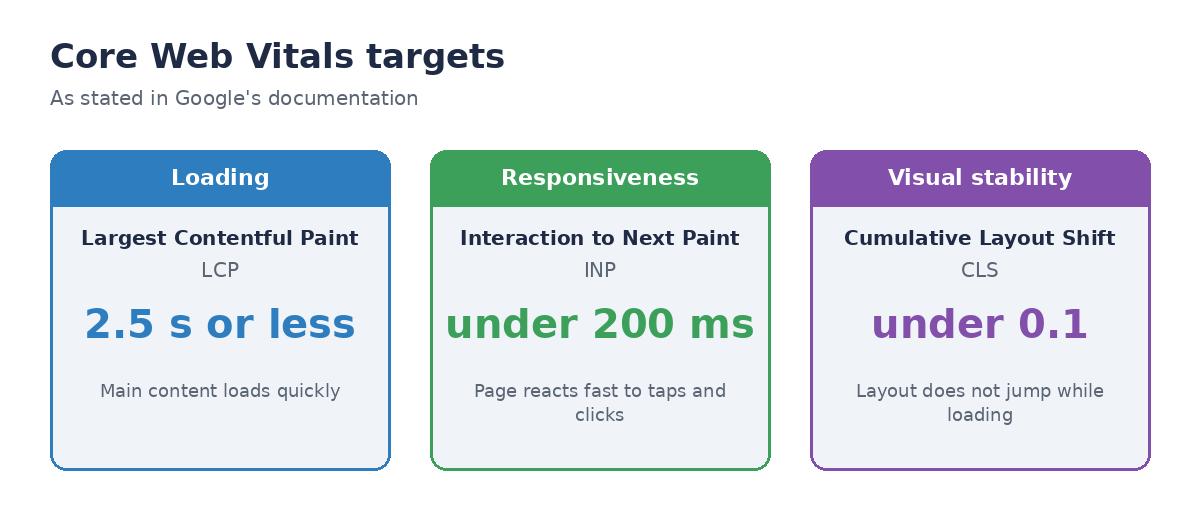
Figure 2. Core Web Vitals targets as stated in Google’s documentation.
Do this:
- Check your key pages in a real phone browser and in Search Console’s Core Web Vitals data.
- Compress large images, remove unused scripts and limit heavy third-party tags.
- Make sure the main text, navigation and forms work without sideways scrolling.
Watch for: Age-gate overlays and consent banners that shift the layout or block the page on a phone.
Measure: The three vitals for your top templates, monthly.
4. Give every page one job
Pages that try to answer everything answer nothing, and pages that repeat each other compete. Map each important question to one owner page.
Do this:
- Build a sheet with columns for the question, the page type, the owner URL and the next action.
- Merge or redirect pages that answer the same question.
- Link related pages to each other with descriptive anchor text, following Google’s link best practices.
Watch for: Creating many near-identical pages for each place or service. Google’s spam policies cover scaled content and doorway pages.
Measure: Number of questions with one owner page; number of overlaps resolved.
Group 2: Content and search (strategies 5 to 9)
5. Build content around real questions
Start from what people actually ask, not from a keyword list you cannot check.
Do this:
- Pull queries from Search Console, your enquiry emails and your sales calls. Record each question’s exact wording, the date and the source.
- Group questions by intent: learn, compare, decide, fix, local, brand. Check the search results for two questions: if the same pages appear, they belong on one page.
- Add search volume and difficulty from a keyword tool only if you have one, and record the tool and date.
Watch for: Writing to a keyword list with no check on what the search results contain.
Measure: Questions answered per month; Search Console impressions for the new pages after a few weeks.
6. Publish content that adds something new
Google’s helpful content guidance asks whether content provides original information, reporting, research or analysis, and says trust is the most important of the signals it describes. It also frames content in terms of Who, How and Why, and lists warning signs such as content made mainly to attract search visits and changing dates to look fresh.
Do this:
- Before publishing, write one sentence on what a reader will learn that the top results do not tell them.
- Use your own experience and data where you have it: process notes, anonymized aggregate figures, documented rules with dates and sources.
- Show who wrote or reviewed the page and when it was last changed in substance.
Watch for: Rewriting other pages, or using AI tools to expand headlines into long pages. Google’s generative AI content guidance says producing many pages without adding value is a problem.
Measure: Pages that pass the one-sentence test; return visits and enquiries from those pages.
7. Tune titles, descriptions, headings and internal links
These are small changes that are cheap to make.
Do this:
- Give every page a unique, descriptive title. Google’s title link guidance sets no length limit but says titles are truncated to fit the device width, and asks for descriptive, non-stuffed titles.
- Write unique meta descriptions that summarize the page. Google’s snippet guidance says it sometimes uses the description and sometimes builds the snippet from page text.
- Use one clear H1 and a heading outline that reads like the answer.
Watch for: Treating a tool’s character-count tip as a Google rule. Several audit tools use their own thresholds.
Measure: Click-through rate for edited pages against the earlier period.
8. Prepare for AI search
Google says optimizing for generative AI search is still optimizing for search, and that you do not need special files. Its AI features page says a page needs to be indexed and snippet-eligible to appear in AI Overviews and AI Mode. Other AI products use their own crawlers, and OpenAI’s crawler documentation describes separate bots for search, training and user requests, with independent settings.
Do this:
- Decide which AI crawlers to allow and write it down. Check your firewall as well as robots.txt.
- Check that key text is in the raw HTML. A 2024 study by Vercel and MERJ found none of the major AI crawlers it tested rendered JavaScript, though it is dated and covers one network.
- Put a clear answer in the first sentences of each section and cite sources with dates.
Watch for: Paying for guaranteed AI citations. Ahrefs’ study of 1.9 million AI Overview citations found 76.10% of cited pages ranked in Google’s top 10, so ordinary search work is the base; the study is vendor-run and covers Google’s AI Overviews only.
Measure: AI bot requests in server logs; a fixed set of test questions, run monthly and logged with date and product.
9. Add structured data where it fits
Structured data tells search engines what a page contains. Google’s introduction to structured data recommends JSON-LD and the Rich Results Test, and says markup must follow the guidelines to be eligible for rich results. Valid markup does not guarantee a rich result.
Do this:
- Mark up what is on the page and true: your organization, breadcrumbs, and FAQs only where the page really contains them.
- Test with Google’s Rich Results Test before publishing.
- If any pages are explicit, check Google’s explicit-content guidance for the
hasAdultConsiderationproperty.
Watch for: Marking up content that is not visible, or copying markup from another site.
Measure: Valid items in Search Console’s enhancement reports.
Group 3: Growth and distribution (strategies 10 to 14)
10. Earn links and mentions
Links still matter, but how you get them matters more. Google’s link spam rules list buying or selling links for ranking, excessive link exchanges, automated link creation, low-quality directory links, and paid articles or large-scale guest posting that pass ranking credit or use keyword-optimized anchors. They also say paid links are acceptable for advertising if marked with rel="sponsored" or rel="nofollow", as described in Google’s guide to qualifying outbound links.
Do this:
- Publish one asset worth citing: a dated rules summary, a small real dataset, a checklist.
- List 20 to 30 sites your customers read, such as trade bodies, business and privacy outlets and curated directories, and pitch each one a specific, useful piece.
- Use a brand or descriptive anchor, not the same keyword phrase across sites.
Watch for: Link sellers who will not name the sites. In a study of 1,000 domains (October 2025), Semrush reported moderate correlations between its own Authority Score and AI mentions, and nearly identical results for nofollow and followed links. It is correlational and vendor-run, but it points to quality and mentions over raw counts.
Measure: New linking sites per quarter from the Search Console Links report, and referral visits.
11. Use directories and listings selectively
A listing on a curated directory with real editors and real readers can send visitors and build trust. A listing on an open directory that accepts everyone adds little and sits on Google’s low-quality list.
Do this:
- Check whether the directory rejects some applicants, has a published standard and shows signs of an audience.
- Keep your name, address, description and links consistent across listings.
- Keep a list of where you are listed, and review it twice a year.
Watch for: Paying for a listing and not qualifying the link when it is a paid placement.
Measure: Referral visits and enquiries from each listing, noted by source.
12. Build an email list you own
Search and social traffic can change overnight. A list of people who asked to hear from you is yours. In the United States, the CAN-SPAM Act sets rules for commercial email: no false or misleading header information, no deceptive subject lines, clear identification of ads, a valid postal address, a clear way to opt out honored within 10 business days, and responsibility for what others send on your behalf. The FTC guide says each violating email can carry penalties of up to $53,088.
Do this:
- Offer a useful sign-up reason: a checklist, a rules update, a listing alert.
- Put a visible opt-out link and your postal address in every email, and honor opt-outs within the stated time.
- Check the rules for each country you send to. CAN-SPAM is a US law; other countries have different consent rules.
Watch for: Buying lists and sending to people who never asked.
Measure: Sign-ups, opt-outs, replies and enquiries from email, by campaign.
13. Take part in communities and social platforms, within their rules
Each platform sets its own rules on adult content and on promotion, and those rules change. We did not find a single, current, verified source covering them all, so check each platform’s published policy before you plan around it.
Do this:
- Pick one or two places where your customers already gather.
- Answer questions and share useful material, with your connection disclosed.
- Mark user-generated links on your own site
ugcornofollow, as Google advises.
Watch for: Fake followers and engagement. The FTC’s reviews and testimonials rule bars buying or distributing fake indicators of social media influence that you knew or should have known were fake.
Measure: Referral visits and enquiries by platform; accounts reaching your target audience, not total followers.
14. Use paid and sponsored placements where they are allowed
Paid options for adult businesses are narrower than for most. Google Ads has a Sexual content policy that limits what can be advertised and how. Read the current policy before you plan spend.
Do this:
- Check each ad network’s published adult-content policy and approval process.
- Consider sponsorships of trade events, newsletters and podcasts where your audience is.
- Qualify sponsored links with
rel="sponsored"orrel="nofollow".
Watch for: Treating a paid placement as a way to buy ranking. Google’s policy says that is link spam.
Measure: Cost per enquiry for each placement, with the dates and what you bought.
Group 4: Trust, compliance and measurement (strategies 15 to 17)
15. Collect real reviews and testimonials
Reviews build trust, and fake ones create legal risk. The FTC’s Consumer Reviews and Testimonials Rule, effective 21 October 2024, bars writing, buying or selling fake reviews and testimonials, buying reviews tied to a required sentiment, undisclosed insider reviews, review suppression through intimidation or unfounded legal threats, and fake social media indicators. The FTC says its staff guidance is not definitive and provides no safe harbor, and the rule applies in the United States; other countries have their own rules.
Do this:
- Ask real clients for feedback, with no condition on what it says.
- Publish testimonials only with permission, and redact details that could identify anyone who has not agreed.
- Disclose any connection between you and a reviewer.
Watch for: Invented case studies, and “verified” claims you cannot support. In this sector, privacy matters as much as proof.
Measure: Number of real reviews gathered and where they appear; enquiries from pages that show them.
16. Treat age checks, privacy and consent as part of the funnel
For many adult businesses, compliance is a marketing issue, because it decides who can see and use your site. In the United States, the Supreme Court’s June 2025 decision in Free Speech Coalition v. Paxton, summarized by Faegre Drinker, upheld a Texas age-verification law for sites with a high share of sexually explicit material. In the United Kingdom, Ofcom’s guidance says services that allow pornographic content must have highly effective age checks, lists methods such as open banking, photo ID matching, facial age estimation and mobile network operator checks, and says self-declaration does not qualify. The rules differ by country and state, and some apply only to certain kinds of services.
Do this:
- Ask a lawyer who knows your market which rules apply to you.
- Choose age-check and consent flows that people can complete quickly, and test them on a phone.
- Check what search crawlers receive behind an age gate, using the method in Google’s explicit-content guidance.
- Publish a clear privacy notice and collect only the data you need.
Watch for: A flow so heavy that real customers give up, or one that blocks the pages you want indexed.
Measure: Completion rate of the age-check step, if you run one; pages behind it that are indexed.
17. Review, test and refresh every month
Strategies decay. Rules change, competitors move, pages age. A short monthly review keeps the work honest.
Do this:
- Compare the same periods in Search Console. Google’s guidance on debugging traffic drops suggests using a longer window and comparing like with like.
- Refresh pages whose facts have changed, and change the date only when the content changed.
- Merge or remove pages that answer the same question or no longer serve a purpose, and redirect them to a relevant page.
- Keep a change log with dates, so you can link results to causes.
Watch for: Judging a change after a few days. Google’s SEO Starter Guide says changes can take from a few hours to several months to show.
Measure: A short monthly note: what changed, what moved, what you will try next.
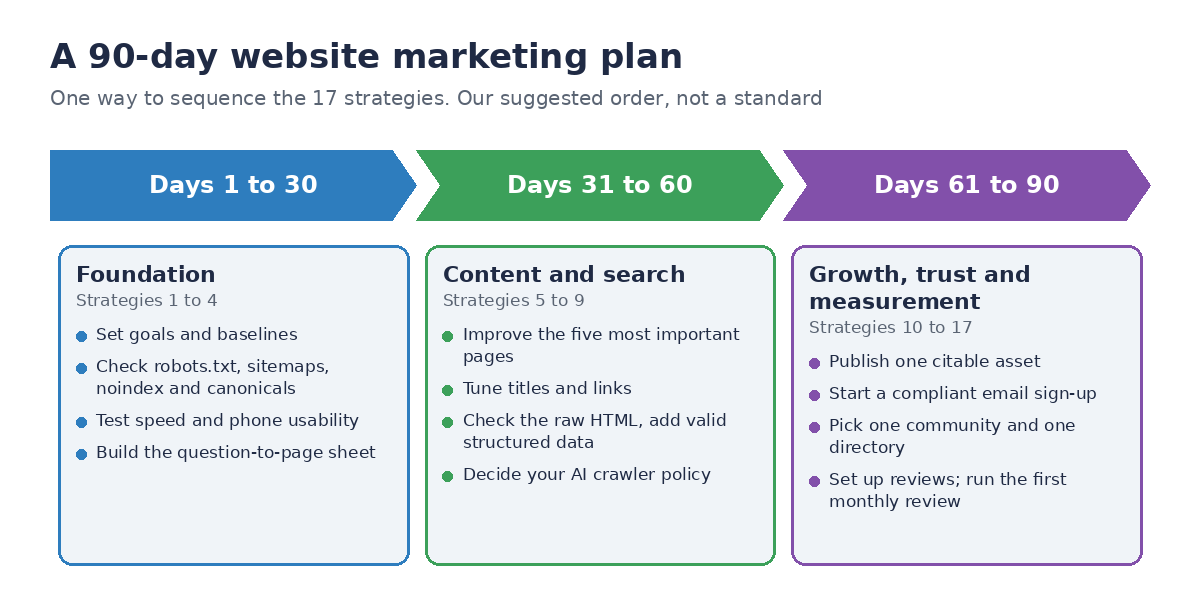
Figure 3. One way to sequence the 17 strategies over 90 days. This is our suggested order, not a standard.
The 17 strategies at a glance
This table is our judgment of effort and risk for a small adult business, not a measured result. Adjust it to your resources.
| # | Strategy | Effort | Risk if done badly | First step |
|---|---|---|---|---|
| 1 | One goal per page type | Low | Low | Save a Search Console baseline |
| 2 | Access and indexing | Medium | High | Read robots.txt and one template’s tags |
| 3 | Speed and mobile | Medium | Medium | Test your top page on a phone |
| 4 | One job per page | Medium | Medium | Build the question-to-page sheet |
| 5 | Real questions | Low | Low | Export Search Console queries |
| 6 | Content that adds something new | High | Medium | Write the one-sentence test for five pages |
| 7 | Titles, descriptions, headings | Low | Low | Fix duplicate titles first |
| 8 | AI search | Medium | Medium | Write your crawler policy |
| 9 | Structured data | Low | Medium | Test one template in the Rich Results Test |
| 10 | Links and mentions | High | High | Publish one citable asset |
| 11 | Directories | Low | Medium | List where you are listed today |
| 12 | Medium | High | Add a compliant sign-up and footer | |
| 13 | Community and social | Medium | Medium | Pick one place and read its rules |
| 14 | Paid and sponsored | Medium | High | Read the ad policy before budgeting |
| 15 | Real reviews | Low | High | Write your review-request rule |
| 16 | Age checks and privacy | High | High | Get legal advice for your markets |
| 17 | Monthly review | Low | Low | Put the review in the calendar |
The “risk” column mostly reflects rules: spam policies for links and content, consumer law for reviews and email, and age-verification rules for access.
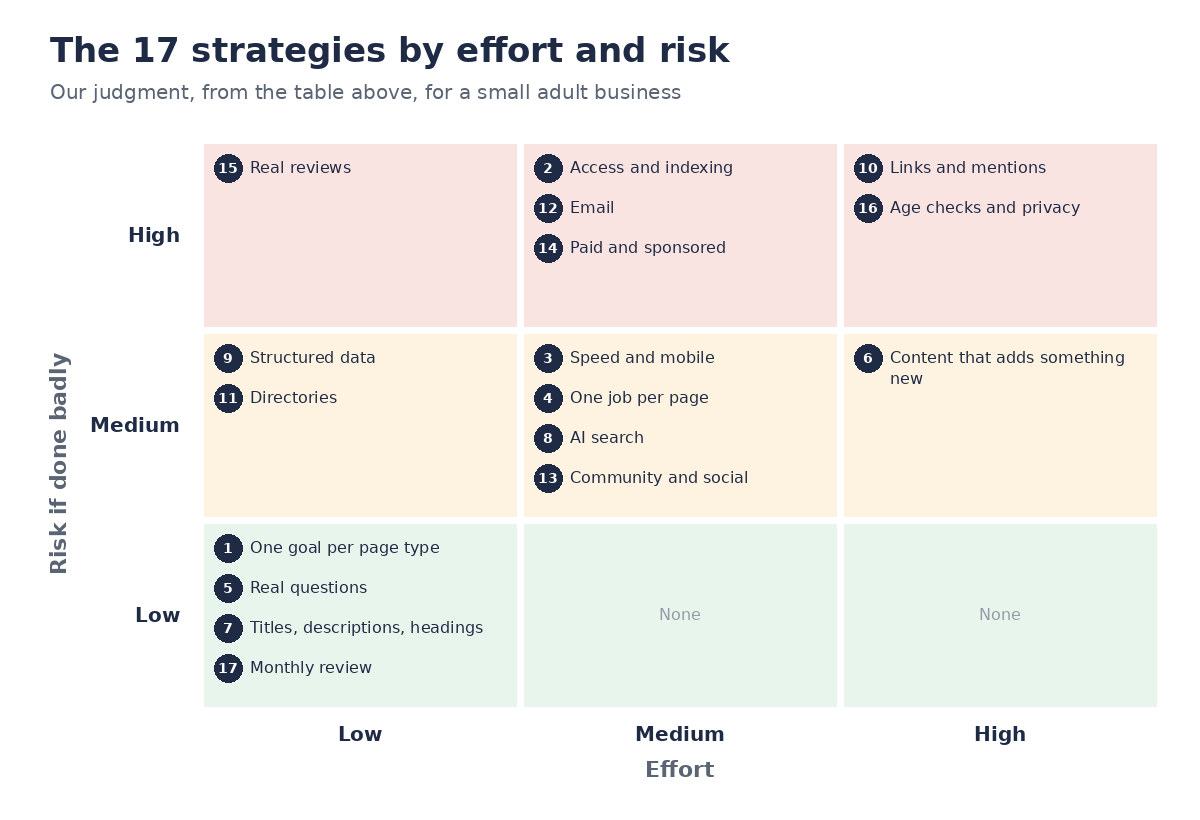
Figure 4. The 17 strategies by effort and risk. Our judgment, from the table above.
Adjusting the list by business type
Escort agencies and independent provider sites. Prioritize strategies 2, 4, 6, 15 and 16. You usually have a small number of pages, so quality and clarity beat volume. Be careful with claims about legality: state the rule for the place, with a date and a source. Privacy is a design requirement: review public names, contact details and image details for anything you did not intend to show.
Directories and listing platforms. Prioritize 2, 4, 6, 10 and 17. Your pages are mostly lists, which are easy to copy, so add something others cannot: published listing standards, a verification method, real dated statistics about your listings. Keep an eye on filter and search pages that create endless crawlable addresses, and avoid mass-producing near-empty location pages.
Platforms and content sites. Prioritize 2, 3, 8 and 16. Explicit pages fall under Google’s explicit-content guidance, so check separation, labels and age-gate handling. Earn links and visits to your non-explicit informational pages, such as help and safety content.
Adult e-commerce. Prioritize 5, 6, 12 and 15. Product pages benefit from exact specifications, care instructions, shipping and privacy policies. Email works well here when it is consent-based and compliant, and reviews help only when they are real.
Service providers to the industry. Prioritize 6, 10 and 12. Your buyers are businesses asking cautious questions: what does this involve, what are the risks, what do the rules say. Original comparisons and plain explanations of rules earn the mentions that matter.
What to report each month
A monthly report should be short enough to read and honest enough to trust.
- What we did. Pages changed, assets published, outreach sent, with dates.
- What moved. Clicks, impressions and conversions for the page types you set goals for, against the previous period.
- What we cannot attribute. Say so plainly. Search results change for many reasons at once, and AI answers vary from run to run.
- What we learned. One or two sentences.
- What we will do next month. Three items at most.
Avoid single scores without a method. If a number cannot be explained in a sentence, it will not help anyone make a decision.
Common mistakes
- Spending on content before checking that pages can be indexed.
- Treating a tool’s tips as Google’s rules.
- Writing the same page many times for different places.
- Buying links without seeing the placements, or without qualifying them.
- Using fake or incentivized-for-sentiment reviews.
- Sending email without an opt-out or a postal address.
- Putting an age gate in front of pages you want indexed without checking what crawlers receive.
- Measuring followers instead of enquiries.
- Changing page dates without changing the content.
- Making many changes at once, so you cannot tell what worked.
- Ignoring privacy on pages that name real people.
- Promising results you cannot control.
A 90-day plan
This order is our judgment, not a published standard.
Days 1 to 30: foundation (strategies 1 to 4). Set goals and baselines. Check robots.txt, sitemaps, noindex tags and canonicals per template. Test speed and phone usability. Build the question-to-page sheet.
Days 31 to 60: content and search (strategies 5 to 9). Improve the five most important pages: answer first, add something new, tune titles and links, check the raw HTML, add valid structured data. Decide your AI crawler policy.
Days 61 to 90: growth, trust and measurement (strategies 10 to 17). Publish one citable asset and pitch it to a short list. Start an email sign-up with a compliant footer. Choose one community and one directory worth your time. Set up a review process, check age-check and privacy flows with a lawyer, and run your first monthly review.
How to choose where to start
If you can do only a few things, do them in this order: 2 (access and indexing), 4 (one job per page), 6 (original content), 15 (real reviews) and 17 (monthly review). They cost little, carry little risk and rarely go wrong. Treat 10 (links), 12 (email) and 14 (paid placements) as projects that need a plan, and 16 (age checks and privacy) as a legal task that needs advice.
Three scenarios
These are method walk-throughs, not case studies. They report no results.
Scenario 1: A single-site agency with a services page and a blog. Start with strategy 2: read robots.txt, then check that the services page and three blog posts are indexed, have self-referencing canonicals and carry no stray noindex. Then do strategy 5: export the queries Search Console already shows for the site, and list the ten questions clients ask by email. Assign each to one page (strategy 4), rewrite the opening of the services page so the first two sentences say what you offer, where and for whom (strategy 6), and set a monthly review (strategy 17). Only then think about links.
Scenario 2: A directory with many listing pages. Strategy 4 matters most. Sample 50 listing pages and compare the text that is unique to each. If most pages differ only by name, decide which listing types deserve to be indexed. Write a standards page explaining how listings are verified and moderated, and publish one dated dataset from your own listings (strategy 10). Check that filters and search pages do not create endless crawlable addresses (strategy 2). Make sure any requirement that listed businesses link to you lets them qualify the link, as Google’s spam policy requires.
Scenario 3: A platform marketer responsible for several brands. Give each brand its own question list and owner pages so the brands do not compete (strategy 4). Write one fact sheet per brand with the name, description and contact details, and keep listings consistent (strategy 11). Keep a shared log of crawler policy and age-gate settings per domain (strategies 8 and 16), and report per brand, not in aggregate (strategy 17).
When to hire an adult and escort SEO specialist
Many of these strategies are within reach of a careful owner. You may need a specialist when:
- You have thousands of pages, several domains or several languages.
- Age gates make it unclear what crawlers see.
- Traffic has fallen and you cannot find the cause.
- You are planning a migration or a template change.
- You do not have time to run and record the work.
If you decide to hire an adult and escort SEO specialist, ask what they will check first and what you will receive, how they handle age gates and explicit-content separation, which link tactics they refuse, and how they report what they cannot verify. Google’s page on hiring an SEO warns against guarantees. Red flags include guaranteed rankings, bulk link packages with no named sites, and requests for passwords or identity documents.
Escort Marketing Agency (EMA) is a digital marketing agency for adult businesses, not an adult service. On its adult SEO page, EMA describes a free audit as a focused review of your public website that flags visible obstacles and questions for deeper investigation, and says it is not a full crawl or an account-level analytics audit. If you want a second opinion on your own checks, you can ask for a free audit report and compare it with your findings. Ask EMA the same questions you would ask anyone.
Frequently asked questions
Which strategy should I start with?
Fix access and indexing. If search engines cannot reach your pages, nothing else you do will show.
How long do these strategies take to work?
Google says changes can take from a few hours to several months to show effects. Plan in quarters, and record what you change.
Do I need all 17?
No. Choose the foundation group, then one or two from each of the others.
Is link building still worth doing?
Yes, within Google’s rules. Earn links and mentions from relevant sites, and qualify anything paid.
Can I guarantee a place in AI answers?
No. AI answers vary between runs and products, and no one controls them.
Is email marketing allowed for adult businesses?
CAN-SPAM sets rules for commercial email in the United States, whatever the industry. Other countries have their own rules. Check the policy of your email provider as well.
What about age verification?
The rules vary by country and state, and some apply only to certain services. Ask a lawyer who knows your market.
Do these strategies work for an independent provider’s website?
The same principles apply, with extra care for privacy and for any rules on advertising in your area.
Is this legal advice?
No. Ask a lawyer who knows your market.
Final thoughts
Website marketing in 2026 is less about a clever tactic than about doing the basics reliably: be reachable, give each page a job, say something new, earn trust honestly, own a channel and keep the compliance work in view. Pick the strategies that fit your team, record what you change, and review monthly.
If you want help with that, or you are looking to hire an adult and escort SEO specialist, Escort Marketing Agency (EMA) works with adult businesses on exactly this kind of review. You can ask for a free audit report, and Connect with us today at https://escortmarketing.agency/.
References
- Google Search Central, “Performance report (Search Console Help)”: https://support.google.com/webmasters/answer/7576553
- Google Search Central, “Robots meta tag and X-Robots-Tag”: https://developers.google.com/search/docs/crawling-indexing/robots-meta-tag
- Google Search Central, “How to specify a canonical URL”: https://developers.google.com/search/docs/crawling-indexing/consolidate-duplicate-urls
- Google Search Central, “Guidelines for sites with explicit content”: https://developers.google.com/search/docs/specialty/explicit/guidelines
- Google Search Central, “Understanding Core Web Vitals”: https://developers.google.com/search/docs/appearance/core-web-vitals
- Google Search Central, “Mobile-first indexing best practices”: https://developers.google.com/search/docs/crawling-indexing/mobile/mobile-sites-mobile-first-indexing
- Google Search Central, “SEO link best practices for Google”: https://developers.google.com/search/docs/crawling-indexing/links-crawlable
- Google Search Central, “Qualify your outbound links to Google”: https://developers.google.com/search/docs/crawling-indexing/qualify-outbound-links
- Google Search Central, “Spam policies for Google web search”: https://developers.google.com/search/docs/essentials/spam-policies
- Google Search Central, “Creating helpful, reliable, people-first content”: https://developers.google.com/search/docs/fundamentals/creating-helpful-content
- Google Search Central, “Google Search and generative AI content”: https://developers.google.com/search/docs/fundamentals/using-gen-ai-content
- Google Search Central, “Influencing your title links in search results”: https://developers.google.com/search/docs/appearance/title-link
- Google Search Central, “Control your snippets in search results”: https://developers.google.com/search/docs/appearance/snippet
- Google Search Central, “AI features and your website”: https://developers.google.com/search/docs/appearance/ai-features
- Google Search Central, “Intro to structured data”: https://developers.google.com/search/docs/appearance/structured-data/intro-structured-data
- Google, “Rich Results Test”: https://search.google.com/test/rich-results
- Google Search Central, “Debugging drops in Google Search traffic”: https://developers.google.com/search/docs/monitor-debug/debugging-search-traffic-drops
- Google Search Central, “SEO Starter Guide”: https://developers.google.com/search/docs/fundamentals/seo-starter-guide
- Google Search Central, “Do you need an SEO?”: https://developers.google.com/search/docs/beginner/do-i-need-seo
- Google Ads Help, “Sexual content” policy: https://support.google.com/adspolicy/answer/6023699
- OpenAI, “Overview of OpenAI crawlers”: https://developers.openai.com/api/docs/bots
- Vercel, “The rise of the AI crawler” (study with MERJ; vendor-run): https://vercel.com/blog/the-rise-of-the-ai-crawler
- Ahrefs, “Search rankings and AI citations” (vendor-run study): https://ahrefs.com/blog/search-rankings-ai-citations
- Semrush, “Backlinks and AI search study” (vendor-run): https://www.semrush.com/blog/backlinks-ai-search-study
- Federal Trade Commission, “CAN-SPAM Act: A Compliance Guide for Business”: https://www.ftc.gov/business-guidance/resources/can-spam-act-compliance-guide-business
- Federal Trade Commission, “Consumer Reviews and Testimonials Rule: Questions and Answers”: https://www.ftc.gov/business-guidance/resources/consumer-reviews-testimonials-rule-questions-answers
- Ofcom, “Age checks to protect children online”: https://www.ofcom.org.uk/online-safety/protecting-children/age-checks-to-protect-children-online
- Faegre Drinker, “Supreme Court decides Free Speech Coalition v. Paxton” (law-firm summary, not the opinion): https://www.faegredrinker.com/en/insights/publications/2025/6/supreme-court-decides-free-speech-coalition-inc-v-paxton
- Escort Marketing Agency, “Adult SEO” page (free audit description): https://escortmarketing.agency/adult-seo/