 admin
Disclosure: this article was written by Escort Marketing Agency (EMA), a marketing agency for adult-industry businesses. EMA also manages this website.
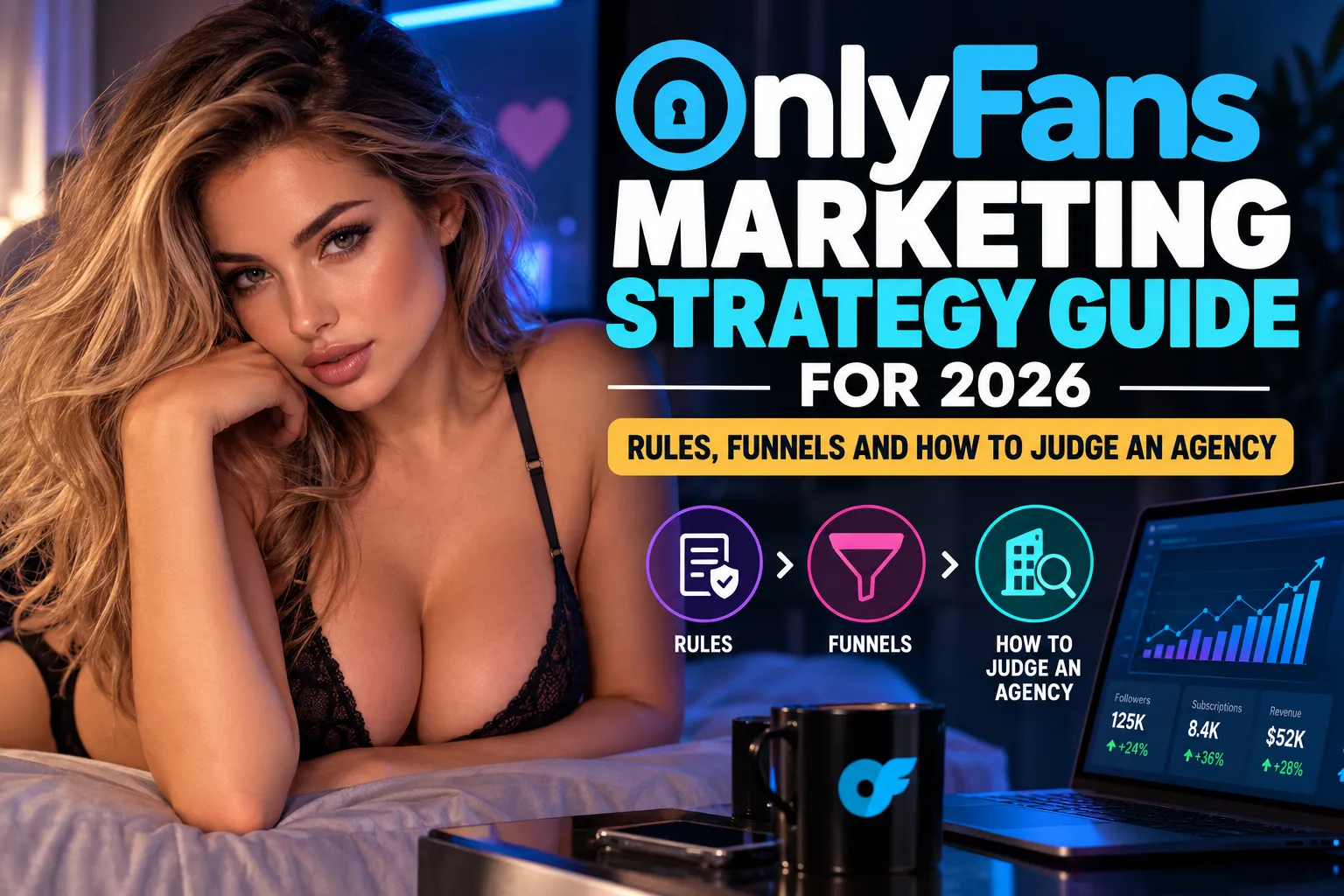
An OnlyFans marketing strategy in 2026 is a system for moving the right people from channels where adult promotion is permitted to a profile they pay to join, then keeping them there at a cost the creator can afford. It is a traffic, compliance and retention problem, not a posting-schedule problem.
The scale of the platform explains why. In the accounts reported for 2024, OnlyFans’ operator recorded about $1.41 billion in revenue on roughly $7.2 billion of gross payments, with 4.6 million creator accounts and 377.5 million fan accounts. With millions of accounts competing, discovery is the scarce resource, and much of the advice about winning it is written by businesses that sell something. Most of the how-to guides we reviewed came from agencies or software vendors, and many of their statistics had no stated source.
This guide takes a different approach. It separates what is documented from what is merely repeated, puts the rules ahead of the tactics, and gives creators and adult-business owners a way to test and measure instead of a list of posting quotas. It also explains what an OnlyFans marketing agency actually does, how the main models differ, and what to check before you sign anything.
How this guide was built. It draws on a review of more than 25 external sources published between 2023 and October 2026, including regulator pages, platform policies, news reporting, and agency and vendor guides. Where a claim comes from a business with a commercial interest, we say so. Platform rules change often, so every rule below carries a source to re-check.
What an OnlyFans marketing strategy is, and what it is not
OnlyFans is where fans pay, not where strangers are reliably found. Several agencies state that most new subscribers arrive from outside the platform, so strategy is largely about earning attention elsewhere and converting it. The claim is widely repeated, but none of the sources we reviewed published data that proves the proportion.
One vendor guide gives an estimated range of 80 to 90 per cent of subscribers coming from external traffic, labelled as an estimate and cited to nothing. An agency article on the platform’s ranking systems argues that search and recommendations are modest sources of new fans and that the home feed mainly serves retention, again without data. An AI-generated research summary from Sacra, built on cited sources, makes a related structural point: creators rely on social platforms they do not control, and receive no fan names or emails from the platform, which makes a rival’s link swap a real risk.
Treat these as working assumptions, not facts. They are sensible enough to plan around, because off-platform attention is clearly central, but you should verify them against your own numbers.
A strategy is also not a posting quota. One agency guide recommends posting daily across 10 to 15 subreddits, three to five times a day on X, and once or twice a day on TikTok, while also stating that content volume alone does not move income. Those two ideas pull against each other, and the quotas are presented without evidence. What you can use from such guides is the structure: a strategy has four jobs, each needing its own owner and metric.
- Discovery: getting seen by adults who might want what you offer.
- Trust: showing consistency, personality and proof of what a subscription contains.
- Conversion: turning interest into a paid subscription through a clear destination.
- Retention: keeping subscribers active long enough for acquisition to pay back.
Rules first: the three layers every promotion must clear
Three rule sets apply to every promotion: OnlyFans’ own terms, each social platform’s policies, and UK law and regulation. Compliance is a growth decision, because an account lost on a mainstream platform takes its audience with it. Check each layer before you plan content or spend.
Layer 1: OnlyFans’ own terms
Before paying for traffic, read what OnlyFans itself allows. SirenCY, an OnlyFans management agency, reports that the platform’s terms bar promoting an account through Google Ads or any similar advertising platform, and advises getting a written answer from OnlyFans before any spend. Note the limits of that reading: “similar” is the author’s interpretation, and we could not access OnlyFans’ terms directly, so confirm the current wording at onlyfans.com/terms. Breaches can reportedly lead to suspension or withheld earnings, which is a high price for an ad test.
Layer 2: the platforms where you promote
The table summarises what the sources we reviewed say. Primary policy pages are preferred where we could reach them; the others are agency summaries and are marked as such.
| Channel | Typical role | What the published rules say | Source and date |
| X | Discovery with labelled adult media | Adult content must be marked. Consent-based adult media is allowed if kept low-profile, but not in profile pictures, headers, list banners, community covers or live video. Under-18s and users with no birth date cannot view marked content. | X Help Centre, page dated May 2024 (primary) |
| Community discovery | Sitewide policy permits labelled adult content, but each community sets its own link, karma, account-age and verification rules. | Aruna Talent, 31 August 2026 (agency summary; Reddit’s own policy was not reachable) | |
| Instagram and Threads | Brand and teaser content | Nudity and links to pornographic sites are removed. Links to adult subscription sites are limited to adult viewers. | SirenCY rules matrix, 1 October 2026 (agency summary) |
| TikTok, YouTube, Snapchat, Pinterest | Safe-for-work brand content | Sexual services and pornographic links are ruled out, which leaves brand-safe content only. TikTok’s current guidelines took effect on 24 September 2026. | SirenCY rules matrix, 1 October 2026 (agency summary) |
| Dating apps | Not a channel | Promotion is prohibited. | SirenCY rules matrix, 1 October 2026 (agency summary) |
Two cautions apply. First, written rules are not the same as enforcement, and the SirenCY matrix says as much itself. Second, several vendor guides we reviewed devote space to avoiding automated detection, such as disguising links or softening wording to slip past scanners. We do not recommend that approach. It puts the account at the mercy of the next policy or moderation change, and it does nothing to build an audience you can keep.
Paid search has its own rulebook. Google Ads sorts sexual content into tiers, with nudity strongly restricted and suggestive content and sexual entertainment moderately restricted, and restricted ads serving only according to user age, local law and SafeSearch settings. In October 2026 Google added fuller examples to the policy while stating that enforcement had not changed. Meeting Google’s rules does not override OnlyFans’ own terms, so both layers must be cleared.
Layer 3: UK law and regulation
The UK’s Online Safety Act has changed the environment around adult content. Ofcom told services that allow pornographic content to use highly effective age assurance by 25 July 2025. Separately, Ofcom fined OnlyFans’ operator, Fenix International Limited, £1.05 million in March 2025 for giving inaccurate answers to its information requests on age assurance. Ofcom also closed its investigation into whether under-18s could access the platform without making findings, though it said it could reopen the case if new evidence emerged.
These duties fall mainly on platforms, not on individual creators. The practical lesson for marketers is that regulators are watching age access closely. Keep promotion aimed at adults, avoid imagery or channels that appeal to young audiences, and expect identity checks to remain part of the landscape. UK advertising rules also apply to paid promotion, so check the current advertising codes and take legal advice before running any paid campaign. This guide is general information, not legal advice.
Build the funnel backwards from the offer
Design the funnel from the end: define exactly what a paying fan receives, build one destination that explains it, then choose channels that can legitimately carry people there. Each channel should have a single job, and promotional posts, teasers and link placement should be treated as separate decisions with separate rules.
Match channels to roles. Using the rules above, a compliant mix commonly looks like this:
- X and Reddit carry labelled promotion and community participation, where the rules allow it. On Reddit, read each community’s sidebar rules first. The agency guide we reviewed argues that most bans are procedural, caused by ignoring community rules, cooldowns or link placement, instead of by the content itself, although it offers no ban-rate data.
- Instagram, TikTok and YouTube build personality and recognition through safe-for-work content that points people to a neutral, honest bio link.
- Owned channels such as an email list and a simple website capture the audience you do not rent.
Use one honest destination. A single link page that states clearly what the subscription includes, who it is for and that it is for adults only usually builds more trust than a maze of redirects. It also gives you one place to measure.
Treat vendor conversion figures as hypotheses. An Instagram automation vendor reports that bio links convert at 0.1 to 0.5 per cent, link stickers at 0.5 to 1.5 per cent and comment-to-message flows at 5 to 8 per cent. The figures are attributed to the vendor’s own user base, with no method, sample size or definition of “conversion”, and the page promotes the vendor’s product throughout. They are useful as starting guesses to test, not as benchmarks. Automated messages to strangers also raise consent and platform-policy questions that the vendor’s page does not discuss.
Own part of the audience. If the platform does not hand you fan contact details, you need another way to reach people who want to hear from you. A newsletter that sends non-explicit updates, with proper consent and a clear unsubscribe, gives you a channel no platform can switch off. UK rules on electronic marketing apply, so build consent in from day one.
Do not neglect search. Fans who hear about a creator elsewhere may search the name before they click, and your own search data will show whether that is happening. A small site that ranks for the creator’s brand name, describes the offer in plain language and links to the profile gives that demand somewhere to land. Restricted-industry search is its own discipline; our guide to diagnosing the real bottlenecks in adult SEO strategy explains how to map intent to page types before investing more budget.
Price and offer: the arithmetic of a subscription
Pricing is a hypothesis to test, not a formula to copy. The arithmetic below shows why the numbers matter before any promotion begins.
OnlyFans deducts a platform fee of 20 per cent from creator earnings. A worked example from Giggster’s analysis shows that a $10 payment leaves $8 on OnlyFans, and that reaching a $1,000 balance requires $1,250 in fan payments. Giggster is a location-booking company publishing content marketing, but the fee arithmetic is simple and checkable. Add any agency commission, tax and the cost of acquiring each fan, and the margin that remains is far thinner than the headline subscription price suggests.
One agency guide proposes tiers of $5 to $10, $15 to $25 and $30 to $50 or more, with promotional discounts of 30 to 50 per cent. Those ranges come with no evidence. Use them as the edges of your own test, not as the answer.
A fair pricing test changes one variable at a time:
- Keep the profile, content cadence and traffic sources stable for at least 30 days.
- Change a single element, such as the monthly price, the length of a free trial or the welcome offer.
- Compare the new cohort with the previous one on 30-day retention and revenue per subscriber, not only on sign-ups.
- Keep the winner, then test the next variable.
A lower price that brings people who cancel in a week can earn less than a higher price that keeps them for three months. Only cohort comparison reveals that.
Retention, and honesty with fans
Retention is cheaper than acquisition, and most of the tools sit inside the platform. The levers agencies describe are welcome messages, a steady content rhythm, pay-per-view offers, win-back campaigns and renewal incentives. The guide that lists them offers no data on their effect, so measure each one yourself.
The sensitive question is who is actually talking to fans. Reporting by VICE found that some management agencies use outsourced chatters to answer messages, and that fans are typically unaware of the arrangement. One agency named in that piece denied misleading fans. In April 2025, 404 Media reported a class-action complaint alleging that OnlyFans allowed agencies to impersonate creators in messages. Those are allegations, not findings, but the risk is clear: if fans believe they are paying for personal contact that someone else supplies, the brand pays the reputational and possibly legal price.
The safest policy is plain disclosure. State in your profile who answers messages and what a subscriber should expect. Do not promise personal attention that the team cannot deliver. A fan who knows what they are buying is less likely to feel deceived, and less likely to dispute a charge.
Measure with your own baseline
You cannot improve what you cannot attribute. Use a separate tracked link for every channel, record cash spend and hours worked, and calculate four numbers for each channel. No public source we reviewed publishes reliable benchmarks, so your own baseline is the only one that counts.
| Metric | How to calculate it | Why it matters |
| Cost per new subscriber | (Cash spend + value of your hours) ÷ new paying subscribers from that channel | Shows whether a channel is worth its effort |
| 30-day retention | Subscribers still active at day 30 ÷ subscribers acquired | Separates quality traffic from curiosity clicks |
| Net revenue per subscriber | Revenue after platform fee and any agency commission ÷ active subscribers | Shows what acquisition has to pay back |
| Payback period | Cost per new subscriber ÷ net monthly revenue per subscriber | Tells you how long a channel takes to earn its cost |
Illustration only, not a benchmark: if a channel costs £300 in cash plus 20 hours you value at £15 an hour, and brings 25 paying subscribers, the cost per new subscriber is £24. If each subscriber nets £6 a month, payback takes four months, and a retention rate that falls below that makes the channel a loss.
Attribution is imperfect. Use the platform’s tracking-link tools where they exist, tag links on your own pages, and record where fans say they found you. A one-line “How did you hear about me?” in the welcome message costs nothing.
Set the rules for each test before you start: a spend cap, a time limit and the result that ends the test. SirenCY’s paid-test brief recommends exactly this kind of cap and stop rule, and it protects you from the natural urge to keep spending on something that has not worked. One agency guide advises committing at least 90 days before judging a strategy. That is reasonable for organic channels, though a paid test should end much sooner if it breaches its cap.
Six mistakes that cost creators money
Most expensive errors in this market are avoidable, and several follow directly from the research above.
- Spending before reading the terms. Paid traffic is the fastest way to find out that a promotion method breaches OnlyFans’ rules or an ad platform’s policy. Read first, ask in writing, then test small.
- Relying on a single rented channel. Sacra’s summary describes a creator’s funnel resting on a single bio link and on social platforms the creator does not control. If either fails, the audience goes with it. Build an email list and a small site in parallel.
- Copying posting quotas. Quotas in agency guides are presented without evidence. Your own cohort data will tell you more than a stranger’s schedule.
- Trusting unsourced statistics. If a guide cannot say where a figure came from, how it was measured and when, treat it as an opinion. This includes any number in this article that we attribute to a vendor.
- Skipping the baseline. Without cost per subscriber, retention and payback, you cannot tell whether an agency helped or merely took a share of growth that was already happening.
- Blurring who is speaking to fans. Undisclosed outsourced messaging creates the exact reputational and legal exposure described earlier. Disclose it, or do not do it.
Avoiding these will not guarantee growth, and nothing in a public source can. It does keep your downside small while you find what works for your niche, audience and risk tolerance.
What an OnlyFans marketing agency does: three models
The phrase “OnlyFans marketing agency” covers three quite different businesses, and the risks, fees and contract terms differ sharply. Ask which one you are buying before you compare prices.
| Model | What it does | Pay structure reported by vendors | Main risks |
| Marketing-only | Traffic, brand, content and search work around the creator’s offer | Retainers or project fees; one vendor cites $500 to $2,000 a month for basic service | Unclear attribution; results blamed on the platform |
| Chatting-only | Staff answer fan messages and sell pay-per-view content | Commission on revenue; one vendor cites 20 to 50 per cent of net | Impersonation, tone and disclosure problems |
| Full management | Runs the account, marketing and chat | Larger revenue share; one vendor cites 40 to 70 per cent | Loss of control over accounts, content and fan data |
Treat the numbers as questions, not market rates. The pay ranges above come from Desirely, a company that sells AI chatting tools and does not disclose that interest in the article. Its bands are unsourced. Another vendor guide says a 50 per cent split is typical, again without data, and its site earns from tool recommendations. VICE’s 2023 reporting found account managers taking 15 to 25 per cent of creator earnings at the agencies it examined. The ranges conflict, which is itself a warning. Use them to frame what to ask, and expect to negotiate.
Contract checks that matter more than the headline rate:
- Fee base. Is the percentage taken from gross payments or from earnings after the platform’s 20 per cent? Both Desirely and SirenCY stress that an unstated base can change the effective rate materially.
- Who owns the account, the login credentials, the content and the fan relationships when the contract ends? Can you leave with them?
- Term and exit. What are the minimum term, notice period and lock-in clauses? Can fees change without your agreement?
- Will you receive channel-level reports you can verify yourself?
- Who writes to fans, and how is that disclosed?
- Tax and legal status. Treatment depends on your jurisdiction, so get independent legal and tax advice before signing.
Red flags listed in SirenCY’s agency guides include income promises, same-day pressure to sign, unclear fees, no exit route, and requests for your account email or payout details. We would add one more: any agency that cannot explain the current platform rules with sources and dates, or that proposes evading detection, is a compliance risk to your account.
Check the agency like any supplier. Verify the company’s registration, ask for references you can contact, and read reviews sceptically. SirenCY itself warns that praise you cannot verify is common, and, as a competitor, it has its own interest in saying so.
How to choose the best adult social media marketing agency
No independent ranking can name the best adult social media marketing agency. The “best agency” lists we found were published by agencies or affiliates and disclosed no method for how they chose. The best agency for you is the one whose scope, evidence and contract match your goals and your risk tolerance.
Judge candidates on seven points:
- Compliance literacy. Can they explain current rules for each channel, with dates and primary sources, and do they decline tactics designed to dodge moderation?
- Scope clarity. Do they say exactly what they will and will not do, including whether anyone writes to fans on your behalf?
- Will they report cost per subscriber, retention and payback in a form you can check?
- Fee transparency. Is the fee base stated, and are all deductions listed?
- Contract fairness. Do you keep ownership of accounts, content and data, with a workable exit?
- Can they supply verifiable references and examples, with claims limited to what they can show?
- Adult-industry and UK awareness. Do they understand the regulatory setting, privacy risks and reputational stakes?
Where EMA fits. Escort Marketing Agency (EMA) is a marketing agency for adult-industry businesses. It is not an adult service, content provider or booking platform. Its work centres on the search, content and link-based marketing that sits beneath any social strategy, which is why this guide stresses owned channels and brand search. Whether you are considering EMA or any other firm, apply the seven points above and ask for every answer in writing. If you want to see how EMA approaches link-led visibility for adult brands, our piece on why guest posting still matters for UK adult brands sets out the reasoning.
A 90-day plan
A staged plan keeps you from spreading effort across too many channels before you know which one works.
- Days 1 to 14: foundations. Read the rules for OnlyFans and each channel you plan to use. Define the offer in a sentence. Build one honest destination page. Set up tracked links, and record your starting numbers even if they are zero.
- Days 15 to 45: two channels only. Choose two channels that your reading shows are permitted and suit your content. Run them consistently. Review the four metrics weekly, and resist adding a third channel.
- Days 46 to 75: one test at a time. Change a single variable, such as price, trial length or welcome message, and compare cohorts on 30-day retention and revenue per subscriber.
- Days 76 to 90: decide. Keep what paid back, fix what nearly did, and stop what did not. Only now consider an agency, because you can judge any proposal against your own baseline rather than their promises.
Frequently asked questions
Can I advertise my OnlyFans account on Google or Meta?
Possibly, but only if three things line up: the ad platform’s adult-content policy, OnlyFans’ own terms, and local advertising rules. One agency reads OnlyFans’ terms as barring promotion through similar paid platforms. Get written confirmation from OnlyFans before spending anything.
Is an OnlyFans marketing agency worth the cost?
It depends on what you are buying and what you already earn. Marketing-only help can be judged by channel metrics, while revenue-share management has to beat what you could achieve alone after the commission. Build your own baseline first so you can test any offer against it.
How long does it take to see results?
No reliable public data exists. One agency recommends at least 90 days for organic strategy. Set your own checkpoints at 30, 60 and 90 days, and end paid tests as soon as they reach their spend cap.
Do UK rules affect creators?
The Online Safety Act’s age-assurance duties fall mainly on platforms, but regulators’ attention affects everyone in the chain. Keep promotion aimed at adults, follow advertising rules for paid campaigns, and take legal advice on your own situation.
The short version
Marketing an OnlyFans profile in 2026 rewards discipline over volume. Learn the rules for each layer before you plan content. Send people to one honest destination. Measure each channel with your own numbers, and treat unsourced statistics as hypotheses to test. Be open with fans about who they are talking to. When you assess an agency, ask what it does, how it is paid, who owns what at the end, and how it knows. The answers will tell you more than any ranking.
This article is general information and not legal, tax or financial advice. Platform policies and regulations change; check current official sources before acting.
Call or WhatsApp EMA @+91 7980282056