 admin
Adult sites operate under tighter constraints than most other verticals. Payment processors, ad networks, hosting providers, and search engines all apply extra scrutiny. At the same time, competition for high-intent queries is intense and the cost of a technical or compliance misstep is higher than in unrestricted niches.
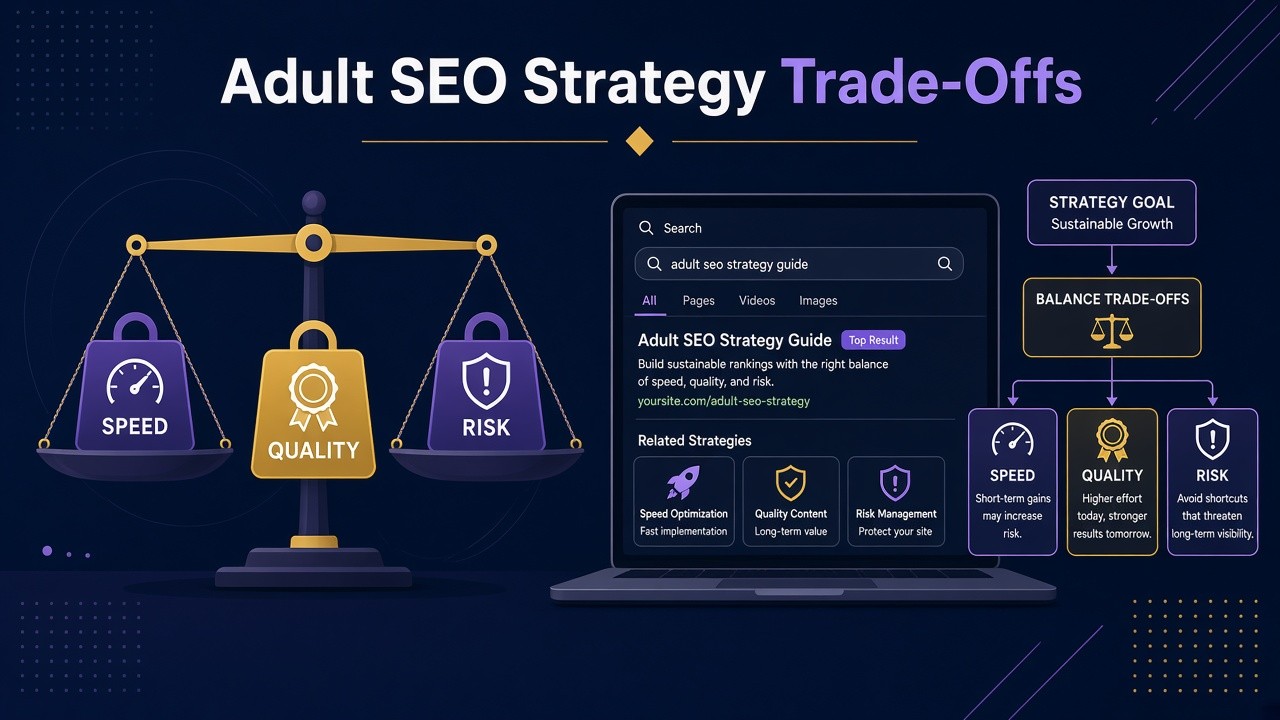
The practical result is that every SEO decision becomes a three-way trade-off between speed of execution, quality of the work, and risk exposure.
This article walks through a decision framework that SEO leads and adult-business owners can use to make those trade-offs more deliberately. It focuses on process, not tactics that change with every algorithm update.
Define the Goal and Audience
Start by stating the actual business goal in one sentence. Typical examples:
- Increase organic sessions to monetized profile or gallery pages by X% within six months while keeping the domain in good standing with major search engines.
- Grow non-branded traffic to service or location pages without triggering additional manual review or payment-processor flags.
- Stabilize rankings for a core set of commercial terms after a previous penalty or de-indexing event.
Write the goal so that speed, quality, and risk can be measured against it. A goal that only mentions “more traffic” forces teams to optimize for the easiest metric (volume) and ignore the other two.
Identify the primary decision-makers. In most adult businesses, the SEO lead owns technical and content quality, while the owner or operator owns risk tolerance and cash-flow timing. Aligning those two perspectives early prevents the common pattern where the SEO team ships carefully while the business side demands faster results, or vice versa.
Map Intent to Page Types
Adult search intent is rarely pure informational. Most high-value queries sit on a spectrum from commercial investigation to transactional. Map the main query clusters to the page types that already exist or that you are willing to create:
- Location + service queries → city or region landing pages with unique supporting content and structured data.
- Specific offering or attribute queries → filtered or dedicated service pages (with strict controls on faceted URL generation).
- Brand or performer name queries → profile or model pages.
- Comparison or “best of” queries → editorial or list pages that can earn links and satisfy broader intent.
The mapping forces an early quality decision: which page types will receive original content, unique media, and ongoing maintenance, and which will be treated as secondary or non-indexable. Sites that treat every possible filter combination as a ranking page usually sacrifice both quality and long-term risk posture for short-term URL volume.
Research and Prioritize Topics
Keyword research in restricted industries benefits from heavier weighting of risk signals. Beyond volume and difficulty, score each topic cluster on:
- Historical volatility (how often rankings for related terms have swung after algorithm or policy updates).
- Commercial intensity (how aggressively competitors bid or spam the same terms).
- Content production cost (original photography, video, or long-form writing versus thin templates).
- Compliance surface (does the page require age-gating, specific disclosures, or geo-restrictions that affect crawlability?).
A simple prioritization matrix works well: plot expected traffic value against a combined quality-and-risk score. Topics that score high on value and low on risk become the first wave. High-value, higher-risk topics are scheduled only after technical foundations and content quality processes are stable.
Low-value topics are deprioritized or handled with noindex strategies.
This step is where speed is most often over-weighted. Teams that chase every medium-volume term without the matrix end up with large numbers of mediocre pages that later require cleanup.
Build the Page and Content Plan
Translate the prioritized topics into a concrete page plan that explicitly records the trade-offs:
- Technical foundation first. Resolve crawl budget waste, duplicate content from faceted navigation, incorrect canonicals, and mobile usability issues before scaling content. These fixes are high-quality, moderate-speed, and strongly risk-reducing.
- Content standards. Define minimum viable quality for each page type (word count is a weak proxy; uniqueness of media, depth of information, and usefulness to the searcher matter more). Document who signs off on originality and compliance.
- Production velocity. Decide how many new pages or major refreshes can be shipped per sprint without dropping below the quality bar. If the business needs faster output, the plan should show which quality or risk controls will be relaxed and for how long.
- Internal linking and architecture. Adult sites frequently suffer from orphan profiles or deep filter pages. The plan should specify how new pages inherit authority and how low-value URLs are prevented from entering the index.
Every item in the plan should carry a short note on the speed/quality/risk balance it represents. That note becomes the reference point when priorities shift mid-project.
Measure Outcomes
Measurement must track all three axes, not only rankings and traffic.
Useful leading and lagging indicators include:
- Index coverage and the ratio of ranking pages to total indexable URLs (quality and risk).
- Organic conversion rate or revenue per session on target page types (business quality).
- Time from brief to indexation and time from indexation to ranking movement (speed).
- Manual action or security-issue notifications, payment-processor flags, and hosting or CDN warnings (risk).
- Content refresh rate and percentage of pages meeting the documented quality standard.
Review the dashboard on a fixed cadence. When speed metrics improve while quality or risk metrics degrade, the trade-off has shifted and the plan needs adjustment. When quality rises but traffic stays flat, the prioritization or intent mapping is probably wrong.
Common Mistakes
- Treating “adult SEO services” as a black-box deliverable instead of a set of explicit trade-off decisions owned by the business.
- Scaling faceted or location pages before the technical SEO for adult websites is stable, creating index bloat that later forces emergency noindex campaigns.
- Copying content structures from mainstream niches without accounting for higher scrutiny on originality and user-generated media.
- Optimizing solely for ranking velocity while ignoring the compliance and payment-risk surface that can erase months of gains.
- Measuring success only by organic sessions rather than by sessions that survive policy and processor filters.
- Allowing the content calendar to run ahead of the technical and quality checklist, so that new pages inherit unresolved crawl or duplication problems.
Verification Checklist
Before any major adult SEO initiative moves from planning to execution, confirm:
- Business goal is written and agreed by both SEO and commercial owners.
- Intent-to-page-type map exists and has been reviewed for indexation risk.
- Topic prioritization includes an explicit risk and quality score, not only volume.
- Technical debt that affects crawl budget or duplication has a scheduled fix.
- Content quality bar is documented and has a named approver.
- Measurement plan tracks speed, quality, and risk indicators.
- Rollback or noindex criteria are defined in advance for pages that underperform or trigger warnings.
Adult SEO strategy improves when teams stop treating speed, quality, and risk as sequential concerns and start treating them as simultaneous constraints. The sites that sustain organic search strategy growth are usually the ones that make the trade-offs visible, record them, and revisit them when conditions change. The framework above is one practical way to keep those decisions grounded in the realities of a restricted industry rather than in generic search advice.