 admin
Independent escorts and the consultants who support them often work in small, fluid teams. One person may handle booking and client communication, another manages the website and photos, while a third (or the same person) tries to keep search visibility from eroding. Without a shared operating rhythm, SEO work becomes reactive: a ranking drop triggers a scramble, a new city page is published without internal linking, or privacy settings are changed in ways that quietly damage crawlability.
The result is inconsistent brand search visibility, thin or duplicated service pages, and growing frustration between the people who own the business and the people who maintain its digital presence. A sustainable rhythm fixes the collaboration problem first, then the rankings follow.
Why It Matters?
Independent escort website SEO sits at the intersection of visibility and privacy. Operators need enough organic presence to reduce reliance on paid directories or advertising, yet every public page carries personal and operational risk. When SEO is treated as an occasional project rather than a recurring process, two things happen: technical debt accumulates, and the people involved stop trusting the system.
A clear operating rhythm creates predictable checkpoints. It tells the operator what information the consultant needs and when. It tells the consultant which changes are safe to make without constant approval. Over time it reduces the number of emergency fixes and replaces them with steady, low-drama improvement.
Current-State Diagnosis
Most independent setups show the same pattern when examined closely.
Service pages exist but were created reactively. A new offering is added to the site because a client asked for it, yet the page receives no unique supporting content, no internal links from existing city or category pages, and no consideration of how it affects the overall site architecture.
Brand search visibility is monitored only when traffic feels low. Privacy controls (robots directives, meta tags, or selective indexing) are adjusted ad-hoc, sometimes blocking pages that should remain crawlable or leaving pages exposed that were meant to stay quiet.
Collaboration friction appears in the hand-offs. The operator updates availability or services in a booking tool or private document but forgets to notify the person maintaining the public site. The consultant ships a technical improvement and only later discovers it conflicts with a privacy preference the operator considers non-negotiable. Without a shared calendar and shared definitions of “done,” both sides waste time re-explaining context.
A short diagnostic conversation usually surfaces the gaps: Which pages are intentionally public? Which service pages currently rank or receive traffic? Who owns the decision to index or noindex a new URL? How often does anyone review Search Console or ranking changes together?
Step-by-Step Framework
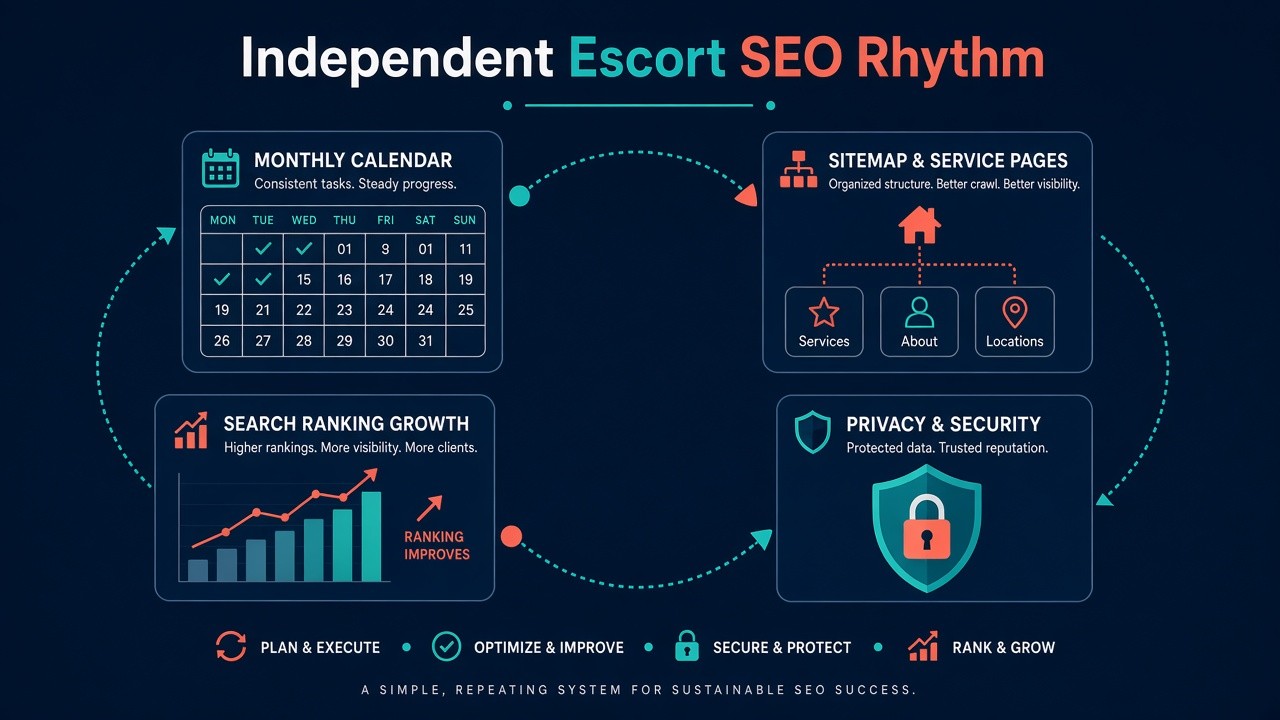
A workable rhythm for independent escort SEO rests on four repeating cycles rather than a single large project.
1. Monthly alignment checkpoint
Schedule a short, recurring conversation (30–45 minutes) between operator and consultant. The agenda is fixed:
- Review brand search visibility and any notable ranking or traffic shifts.
- Confirm upcoming service or location changes that will need new or updated pages.
- Flag privacy or safety constraints that affect what can be published or indexed.
- Agree on the single highest-priority SEO task for the next four weeks.
This meeting prevents the common failure mode in which SEO work continues in isolation while the business reality has already moved on.
2. Service page mapping as a living document
Maintain a simple map that lists every public service or location page, its primary purpose, its current indexation status, and the internal links that point to it. When a new service is introduced, the map is updated first. The update forces three decisions before any content is written:
- Does this page deserve its own URL?
- What existing pages should link to it?
- Are there privacy or geographic limits on how visible it should be?
Treating the map as a shared artifact keeps service page mapping from becoming an afterthought and gives both parties a single source of truth.
3. Privacy-aware publication process
Every new or substantially updated page passes through a short privacy-aware SEO filter before it goes live. The filter asks:
- Is the content consistent with the operator’s current comfort level around discoverability?
- Do robots meta tags, canonicals, and sitemap inclusion match the intended visibility?
- Has personally identifying information been reviewed and minimized where appropriate?
Documenting the answers takes only a few minutes yet prevents the later discovery that a well-ranking page has created unwanted exposure.
4. Quarterly technical and content health check
Once per quarter, run a lightweight audit focused on independent escort website SEO fundamentals: crawl errors, duplicate titles or thin service pages, broken internal links, and mobile usability.
The output is a short prioritized list rather than a 40-page report. Only the top two or three items enter the next monthly cycle. This keeps technical debt from compounding while respecting the limited time most independent operators can devote to SEO.
The four cycles interlock. Monthly alignment feeds the service map. The service map and privacy filter govern what gets published. The quarterly check surfaces issues that the monthly rhythm then resolves. Over six months the process becomes habitual rather than heroic.
Common Pitfalls
- Treating SEO as a one-time website build instead of an ongoing collaboration.
- Publishing new service pages without updating internal links or the service map, leaving them isolated.
- Changing privacy or robots settings without recording the decision, so the next person to touch the site undoes the change.
- Measuring success only by rankings for competitive terms while ignoring brand search visibility, which is often the more stable and privacy-compatible signal.
- Letting the consultant work weeks ahead of the operator’s actual service availability or comfort level.
- Skipping the monthly checkpoint because “nothing major has changed,” only to discover later that several small changes have accumulated into a visibility or privacy problem.
Measurement and Checklist
Track a small set of indicators that both operator and consultant can review quickly:
- Brand search impressions and clicks (Search Console).
- Number of service pages that receive organic traffic versus total public service pages.
- Crawl errors and coverage issues that remain unresolved for more than one monthly cycle.
- Completion rate of the agreed monthly priority task.
Use this checklist at the end of each monthly alignment:
-
- Brand visibility numbers reviewed together
- Upcoming service or location changes noted
- Service page map updated if needed
- Privacy constraints for any new content confirmed
- Single priority task agreed and owner assigned
- Any open technical items from the last quarter still on the radar
The checklist is deliberately short. Its purpose is shared accountability, not bureaucracy.
Next Steps
Choose the next calendar month and schedule the first alignment checkpoint. Before the meeting, each party writes down the three SEO-related frustrations they most want resolved. Bring those lists to the call and use them to set the first priority. Update or create the service page map within the following two weeks. Once those two artifacts exist—the recurring meeting and the living map—the rest of the rhythm can be added gradually.
Independent escort SEO becomes sustainable when the people involved stop relying on memory and goodwill alone. A lightweight, repeating operating rhythm gives both operators and consultants a clear way to stay aligned on visibility, service page quality, and privacy. The rankings improve as a consequence of that alignment, not as a substitute for it.