 admin
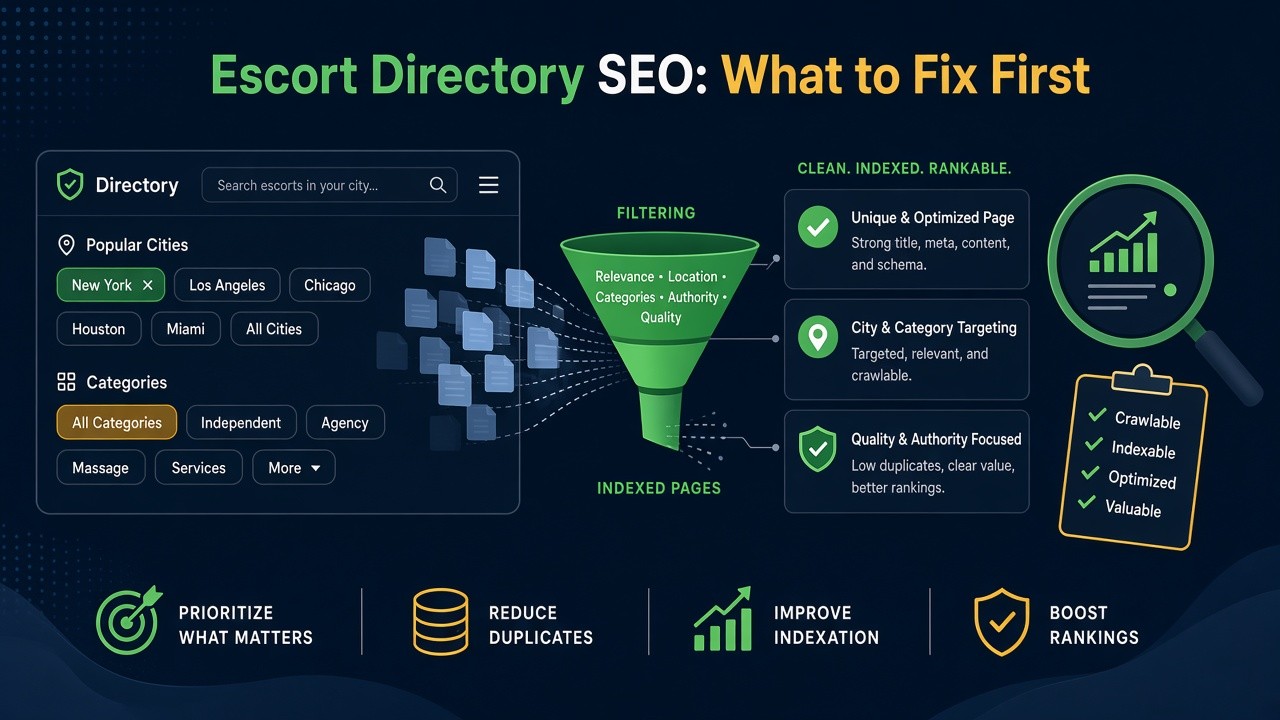
Most escort directories share the same quiet problem: the product team ships feature that make the site useful for users, while the SEO team discovers months later that those same features have created thousands of thin, duplicate, or near-duplicate pages. The result is index bloat, diluted crawl budget, and rankings that refuse to move.
The highest-leverage place to start is not another keyword research spreadsheet. It is the brief and the acceptance criteria that govern how new directory functionality ships.
Why It Matters?
Directory SEO lives or dies on taxonomy and faceted navigation. A city × service × attribute matrix can generate tens of thousands of URLs almost overnight. When those URLs are indexable by default, Google sees a sea of near-identical listing pages and filtered result pages. Ranking signals get split, crawl budget is wasted, and the pages that actually matter (city hubs, high-intent category pages, individual profile pages) struggle to gain authority.
For operators and product teams, the cost is real: slower organic growth, higher paid acquisition reliance, and technical debt that becomes harder to unwind the longer it sits. Fixing the briefing and acceptance process prevents the next wave of problems instead of endlessly cleaning up the last one.
Current-State Diagnosis
Begin with a rapid audit that answers three questions:
- How many indexable URLs exist relative to unique, high-value content?
- Which URL patterns are generating the bulk of thin or duplicate pages?
- Are product and SEO teams working from the same definition of “done”?
Look at Google Search Console coverage reports, a site: search for known filter combinations, and the sitemap versus the indexable page count. Common findings include:
- Faceted navigation parameters left indexable (city + service + availability + price band).
- Duplicate or near-duplicate listing pages created when the same profile appears under multiple taxonomies.
- Soft 404s or thin category pages that rank for nothing but still consume crawl budget.
- Canonical tags that point to the wrong version or are inconsistently applied.
These issues almost always trace back to briefs that treated SEO as a post-launch checklist rather than a design constraint.
Step-by-Step Framework
1. Rewrite the product brief template
Every feature that touches listings, filters, categories, or search must include an explicit SEO section. Require answers to:
- Which new URL patterns will this create?
- Which of those patterns should be indexable, and why?
- What is the canonical version of each page type?
- How will duplicate or near-duplicate content be prevented or consolidated?
- What is the expected impact on crawl budget and index size?
Make the SEO owner a required reviewer before development starts, not after launch.
2. Define clear acceptance criteria for indexability
Acceptance criteria should be testable and binary. Examples:
- All faceted combinations beyond the primary taxonomy (city + primary service) return a noindex, follow directive or are blocked via robots.txt / parameter handling.
- Profile pages have a single preferred URL; secondary taxonomy placements use canonicals or 301s.
- Category and city hub pages contain unique introductory content above a minimum length and include structured data for the listing collection.
- Pagination is handled with rel=next/prev or, preferably, a load-more pattern that does not create additional indexable pages.
- Parameter handling is documented and verified in Search Console.
3. Map the taxonomy before any new filters ship
Treat the directory taxonomy as a product surface. Decide the primary hierarchy (usually location → service type → attributes) and mark everything else as secondary. Secondary facets should not generate new indexable landing pages unless there is clear search demand and unique content to support them.
4. Build a lightweight pre-launch SEO checklist into the definition of done
Before a feature is marked complete:
- Crawl the new URL patterns with a tool or script.
- Confirm robots and canonical behavior.
- Verify that sitemaps only include the intended indexable set.
- Spot-check for duplicate titles, meta descriptions, and H1s.
5. Close the loop with measurement
After launch, track index coverage, crawl stats, and ranking movement on the core pages the feature was supposed to support. If indexable URL count jumps without a corresponding increase in ranking pages, the acceptance criteria failed.
Common Pitfalls
- Treating “noindex” as a permanent solution instead of fixing the underlying generation of low-value pages.
- Allowing every filter combination to inherit the same title and meta template, creating thousands of near-duplicates.
- Shipping “SEO-friendly” clean URLs for facets without first deciding which ones deserve to rank.
- Assuming that because a page is useful for users, it must also be indexable.
- Leaving product and SEO teams with different mental models of what “good” looks like for a directory page.
Measurement and Checklist
Use this short checklist on every directory-related feature:
- New URL patterns documented in the brief
- Indexable vs non-indexable decision recorded
- Canonical strategy defined and tested
- Unique content requirements for hub pages specified
- Parameter handling and robots rules verified
- Sitemap updated only with intended pages
- Pre-launch crawl confirms no unexpected indexable URLs
- Post-launch Search Console coverage reviewed within 14 days
Track two leading indicators: total indexable URLs and the ratio of ranking pages to indexable pages. A healthy directory keeps the former under control while growing the latter.
Next Steps
Start with the next feature on the roadmap that touches listings or filters. Rewrite its brief using the questions above and attach measurable acceptance criteria. Run the checklist before it ships. The first time you catch a potential index-bloat problem in the brief rather than three months later in Search Console, the process will have paid for itself.
The practical takeaway is simple: escort directory SEO improves fastest when product briefs and acceptance criteria treat taxonomy SEO, faceted navigation, and index control as first-class product requirements rather than after-the-fact technical clean-up. Fix the decision process first; the rankings follow.