 admin
You open the monthly report and the numbers look wrong. Organic sessions are down 18 percent. A cluster of commercial keywords that held steady for months has slipped. The client’s account manager is already asking questions. Your white-label partner delivered the usual list of tasks completed, yet the results no longer match the story you have been telling the client.
This is the moment most agencies discover that white label SEO for agencies is not just about handing off work. It is about owning the diagnosis when performance changes. The fulfillment partner executes. The agency still carries the relationship, the expectations, and the risk. When rankings or traffic move, the agency that can quickly separate signal from noise keeps the client. The one that cannot starts losing trust.
Why it matters?
Performance shifts are normal in SEO. Algorithm updates, competitor activity, seasonal demand, site changes, and measurement gaps all create movement. In a white-label arrangement the distance between the people doing the work and the people talking to the client creates friction.
Without a clear diagnostic process, every dip becomes a blame conversation. Agencies that treat diagnosis as a structured step rather than a reactive scramble protect both margin and reputation.
Client confidentiality sits at the center of this. The end client should never see the white label SEO provider. Reporting standards must remain under the agency’s brand and voice. Access credentials, strategy notes, and performance data stay controlled. When diagnosis is loose, these boundaries blur and the risk multiplies.
Current-state diagnosis
Start by freezing the narrative. Do not accept the first explanation. Pull the same data the client sees and the internal data the provider uses.
Confirm access is complete and current: Google Search Console property access, GA4 with the right views and conversion events, CMS publish rights if changes were made, and any rank-tracking or call-tracking tools. Missing or stale access is the most common silent killer of accurate diagnosis.
Establish the baseline that existed before the change. Compare the recent period against the prior three months and the same period last year where seasonality applies. Note any site deployments, content launches, tracking code changes, or known algorithm updates in the window. Annotate everything.
Separate the metrics. Rankings, impressions, clicks, sessions, engagement, and conversions do not always move together. A drop in average position with stable or rising clicks can be healthy. Traffic down with conversion rate up can still be a win. Look for the business outcome first, then work backward.
Check whether the change is concentrated or broad. One landing page, one keyword cluster, one location, or site-wide? Concentrated issues often trace to a specific technical, content, or competitive shift. Broad declines more often point to indexation problems, Core Web Vitals regressions, or larger algorithm effects.
Finally, verify the work that was actually delivered. Request the change log, content briefs, technical tickets, and link reports for the period. Agency SEO fulfillment only works when the delivered work can be mapped to the performance data. If the log is thin or the work cannot be verified, that is itself a diagnosis.
Step-by-step framework
Treat diagnosis as a repeatable sequence rather than an ad-hoc investigation.
- Lock the data window and the comparison baseline. Document the exact dates and the metrics that matter to this client’s goals.
- Validate tracking integrity. Confirm GA4 events, Search Console coverage, and any third-party tools are still collecting cleanly. Broken tracking creates false drops more often than people admit.
- Run a focused technical pass. Crawl for new indexation issues, robots or sitemap changes, redirect problems, Core Web Vitals regressions, and mobile usability flags. Cross-check against Search Console coverage and experience reports.
- Review content and on-page changes. Did new or updated pages go live? Were titles, internal links, or schema altered? Is there evidence of cannibalization or thin pages competing with stronger ones?
- Examine the competitive and external context. Did major competitors publish or earn links in the same window? Was there a known core update or spam update? Has search demand itself shifted?
- Map delivered work to outcomes. Match the provider’s activity log against the pages and keywords that moved. Where the work was done and results improved, note it. Where work was done and results declined, dig deeper. Where no work touched the affected area, the cause is likely external or pre-existing.
- Form a hypothesis and a short test plan. Rank the most likely causes. Decide what to monitor, what to reverse, and what to double down on over the next 14–30 days. Write the client-facing explanation in plain language before any internal debate continues.
This sequence keeps the conversation grounded in evidence rather than opinion.
Common pitfalls
Agencies often accept the provider’s first summary without independent verification. That transfers diagnosis responsibility and weakens the agency’s position with the client.
Another frequent error is reporting every fluctuation as a crisis. SEO is noisy. Clients need context, not panic. Equally damaging is the opposite: smoothing over real declines until the client notices first.
Loose reporting standards create problems later. If monthly reports focus on vanity metrics or omit work completed and next actions, diagnosis becomes harder when numbers move. Client confidentiality is also at risk when providers contact end clients, appear in report footers, or leave their branding in shared tools.
Under-scoping access during onboarding is a quiet failure mode. Without proper GA4, Search Console, and CMS access from day one, later diagnosis is guesswork.
Finally, treating white label SEO as pure task execution without a shared prioritization framework leads to strategy drift. The provider optimizes what is easy to measure; the client cares about what drives revenue. The gap appears as unexplained performance changes.
Measurement/checklist
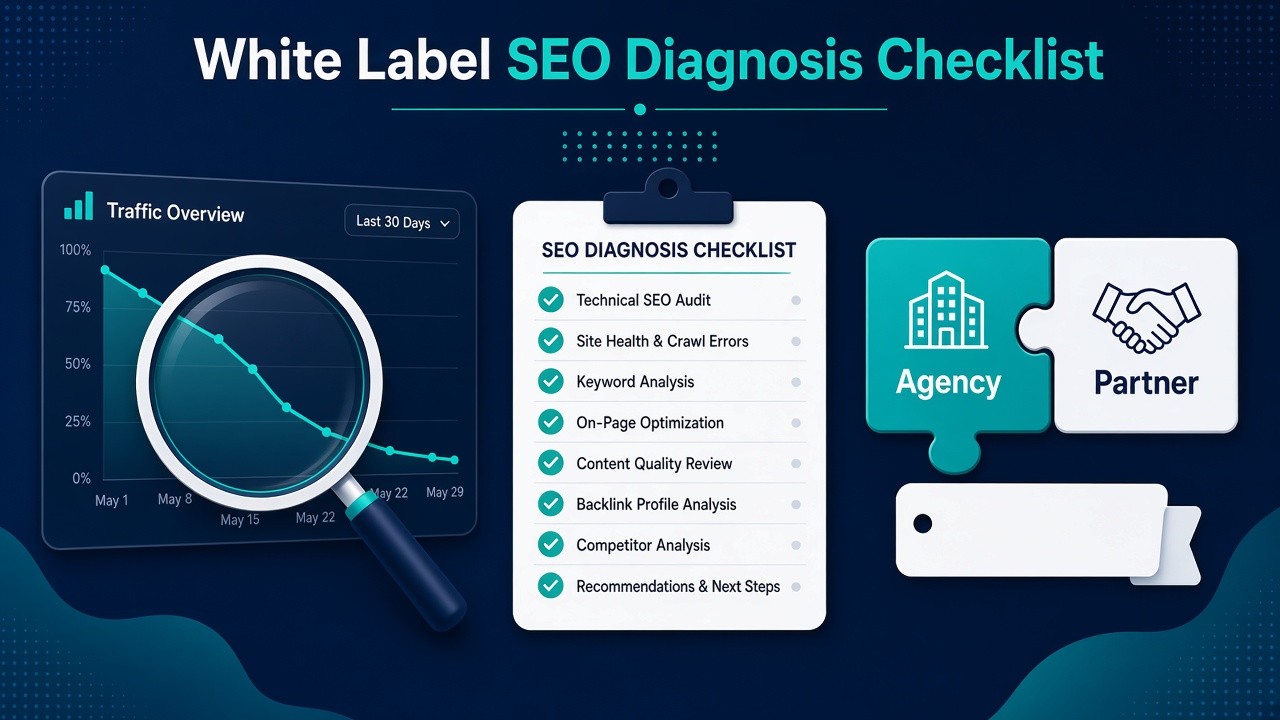
Use this checklist the next time performance shifts:
- Access and tracking confirmed current and complete
- Baseline period and comparison periods defined and annotated
- Rankings, traffic, engagement, and conversion metrics reviewed separately
- Change concentrated or broad? Documented
- Technical crawl and Search Console coverage checked for new issues
- Content and on-page changes in the window reviewed
- Competitive and algorithm context noted
- Provider activity log mapped to affected pages and keywords
- Primary hypothesis written with supporting evidence
- Short-term monitoring plan and client-facing explanation prepared
- Reporting remains fully branded to the agency; no provider visibility
- Confidentiality boundaries (access, communication, data) still intact
Run the checklist in the same order every time. Consistency builds speed and reduces the chance that something obvious is missed under pressure.
Next steps
When the diagnosis is complete, decide whether the current white label SEO provider arrangement still supports the agency’s standards for delivery, reporting, and confidentiality. Some performance changes are temporary and expected. Others reveal gaps in process, prioritization, or quality control that need to be fixed at the partnership level.
If you are evaluating or refining how agency SEO fulfillment works inside your shop, a clear diagnostic process is one of the highest-leverage improvements you can make. It turns reactive client conversations into evidence-based ones and protects the relationship that the white-label model is supposed to scale.
For agencies looking at structured approaches to white-label delivery, including reporting standards and client confidentiality practices, the EMA white-label SEO program outlines practical expectations that many teams find useful when setting or resetting partnerships.
Performance will keep changing. The agencies that diagnose cleanly keep the clients.