 admin

Adult dating platforms face a uniquely constrained SEO environment. Search engines apply stricter scrutiny to adult content, competition for high-intent keywords is intense, and technical issues around profile indexation, category architecture, and trust signals can quietly erode rankings. Without clear prioritization, teams scatter effort across low-impact tactics while the fundamentals that drive long-term organic visibility remain incomplete.
This article gives product and marketing teams a practical framework for ranking SEO work by impact and sustainability. The goal is durable organic growth rather than short-term ranking spikes that collapse under algorithm updates or policy enforcement.
Why It Matters?
Organic search remains one of the highest-ROI acquisition channels for dating platforms when it works. Users searching for “adult dating near me,” specific category terms, or comparison phrases often convert at higher rates than cold social traffic. Yet many adult dating sites underperform because SEO is treated as a secondary marketing function rather than a core product discipline.
Sustainable visibility depends on three interconnected layers: technical accessibility (can engines crawl and index the right pages?), relevance signals (do category and profile pages clearly match search intent?), and trust (does the site demonstrate legitimacy and safety?).
Neglecting any layer creates bottlenecks that no amount of content volume can overcome. Prioritization forces teams to fix the constraints that actually limit growth instead of optimizing what is already easy.
Current-State Diagnosis
Before setting priorities, map the present reality. Most adult dating platforms exhibit a predictable set of patterns:
- Large volumes of thin or near-duplicate profile pages that waste crawl budget.
- Category pages that rank poorly because they lack unique content depth, internal linking structure, or clear user-value signals.
- Technical debt around mobile performance, Core Web Vitals, structured data, and robots directives that inadvertently block valuable pages.
- Weak or missing trust signals—transparent moderation policies, safety information, verified profiles, and clear about/contact pages—that reduce both rankings and conversion.
- Over-reliance on short-term link tactics or keyword stuffing that trigger quality filters.
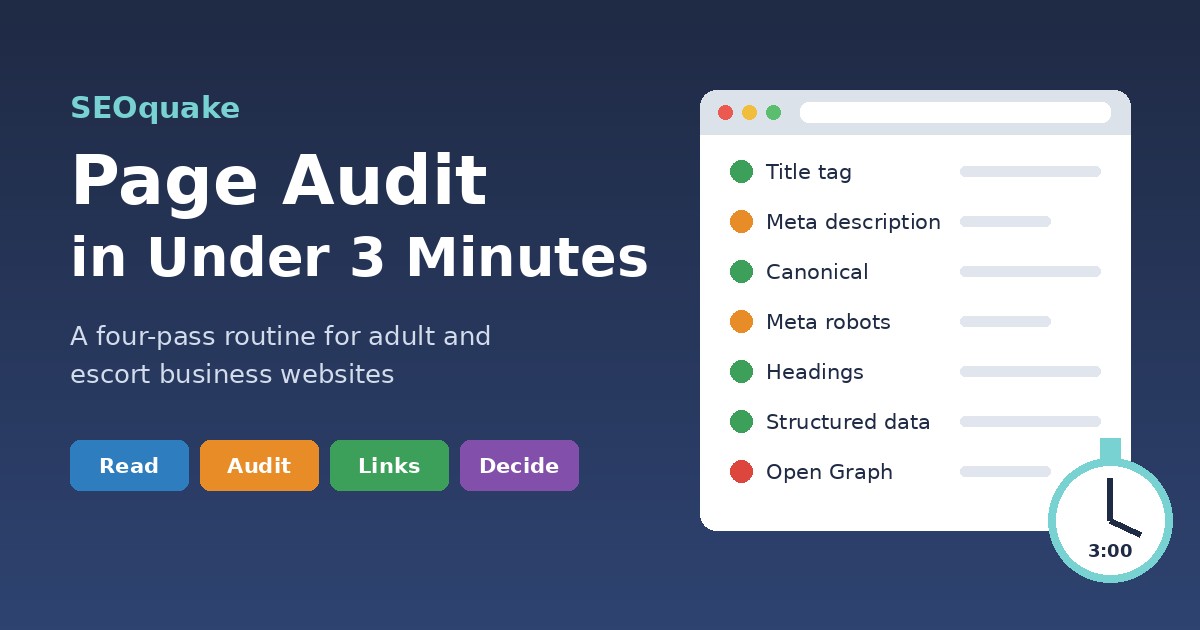
Run a focused audit covering crawlability, indexation status of key templates (homepage, categories, profiles, blog/guides), page experience metrics, and a sample of ranking URLs versus non-ranking peers.
Quantify the gap: what percentage of profiles are indexed? Which category pages receive impressions but low click-through? Where do Core Web Vitals fail on high-traffic templates? This diagnosis turns vague “we need better SEO” into a ranked list of constraints.
Step-by-Step Framework for Setting Priorities
Use a simple impact-versus-effort matrix, weighted toward sustainability. Score initiatives on three axes: potential organic traffic or ranking lift, durability (will the gain survive algorithm and policy changes?), and resource cost. Address foundational blockers first.
1. Technical foundations and crawl efficiency
Fix what prevents engines from seeing and understanding the site. Prioritize:
-
- Clean robots.txt and XML sitemaps that accurately reflect the pages you want indexed.
- Efficient profile indexation strategy—decide which profiles deserve indexation (active, complete, verified) and implement noindex or canonical rules for the rest to protect crawl budget.
- Mobile performance and Core Web Vitals on the highest-traffic templates (category pages and popular profiles).
- Structured data for organization, product/service, and review markup where appropriate and compliant.
Example: A mid-size platform discovered that 70% of its profile pages were thin and competing with each other. By implementing selective indexation (only profiles meeting completeness and activity thresholds) and consolidating low-value pages, crawl efficiency improved and category pages began ranking for broader terms within three months
2. Category page architecture and relevance
Category pages are usually the highest-leverage ranking assets. They should function as useful landing pages, not thin gateways. Prioritize unique introductory content that answers user intent, clear internal linking to related categories and high-quality profiles, and ongoing content freshness signals. Avoid creating dozens of near-identical city or niche pages without substantive differentiation.
3. Trust and safety signals
Adult dating website SEO sites that surface transparent safety information, moderation standards, verification processes, and easy reporting mechanisms tend to earn stronger user engagement metrics and more stable rankings. These pages also reduce bounce rates and support conversion. Treat trust content as ranking infrastructure, not afterthought compliance text.
4. Content that supports discovery and retention
Once technical and category foundations are solid, invest in guides, comparison content, and educational pieces that capture informational and commercial-investigation queries. These assets build topical authority and provide natural internal linking opportunities back to category and profile pages.
5. Measurement and iterative refinement
Only after the above layers are progressing should lower-priority experiments (new keyword clusters, advanced schema tests, or external linking campaigns) receive significant resources.
This sequence keeps effort focused on the constraints that compound: better crawl and indexation improves the value of every subsequent content and trust investment.
Common Pitfalls
-
- Treating every profile as equally indexable. This inflates the site, dilutes authority, and exhausts crawl budget.
- Building large numbers of thin location or niche category pages that offer no unique value. Search engines increasingly reward depth over volume.
- Ignoring page experience on mobile, where most adult dating traffic originates.
- Over-optimizing for exact-match keywords at the expense of natural language and user helpfulness.
- Measuring success solely by rankings or traffic volume while ignoring engagement, conversion, and retention signals that influence long-term visibility.
- Chasing short-term link schemes that violate platform guidelines and create ranking volatility.
Measurement and Checklist
Track a focused set of leading and lagging indicators:
-
- Indexation rate of prioritized profile and category templates.
- Organic impressions and clicks on category pages.
- Core Web Vitals pass rate on key templates.
- Organic conversion rate (registrations or paid upgrades attributed to organic).
- Bounce rate and time-on-page for landing pages from search.
- Crawl stats (pages crawled per day, crawl errors).
Actionable prioritization checklist
-
- Complete technical audit of crawl, indexation, and page experience.
- Define and implement selective profile indexation rules.
- Audit and strengthen top 10–20 category pages for unique value and internal links.
- Publish or improve core trust and safety pages.
- Establish baseline metrics and a monthly review cadence.
- Align product roadmap so new features (verification, moderation tools, profile completeness) support rather than undermine technical SEO goals.
- Document decisions so future team members inherit the prioritization logic.
Next Steps
Start with diagnosis. Allocate two focused weeks to map current indexation, category performance, and technical blockers. Score the resulting opportunities against the impact-effort-sustainability criteria above, then sequence the work so foundational fixes unlock everything that follows. Sustainable organic visibility on adult dating platforms is less about clever tactics and more about consistent removal of the constraints that prevent good pages from ranking.
What is the single biggest technical or architectural constraint currently limiting organic visibility on your platform, and how would removing it change the value of the rest of your SEO efforts?