admin
admin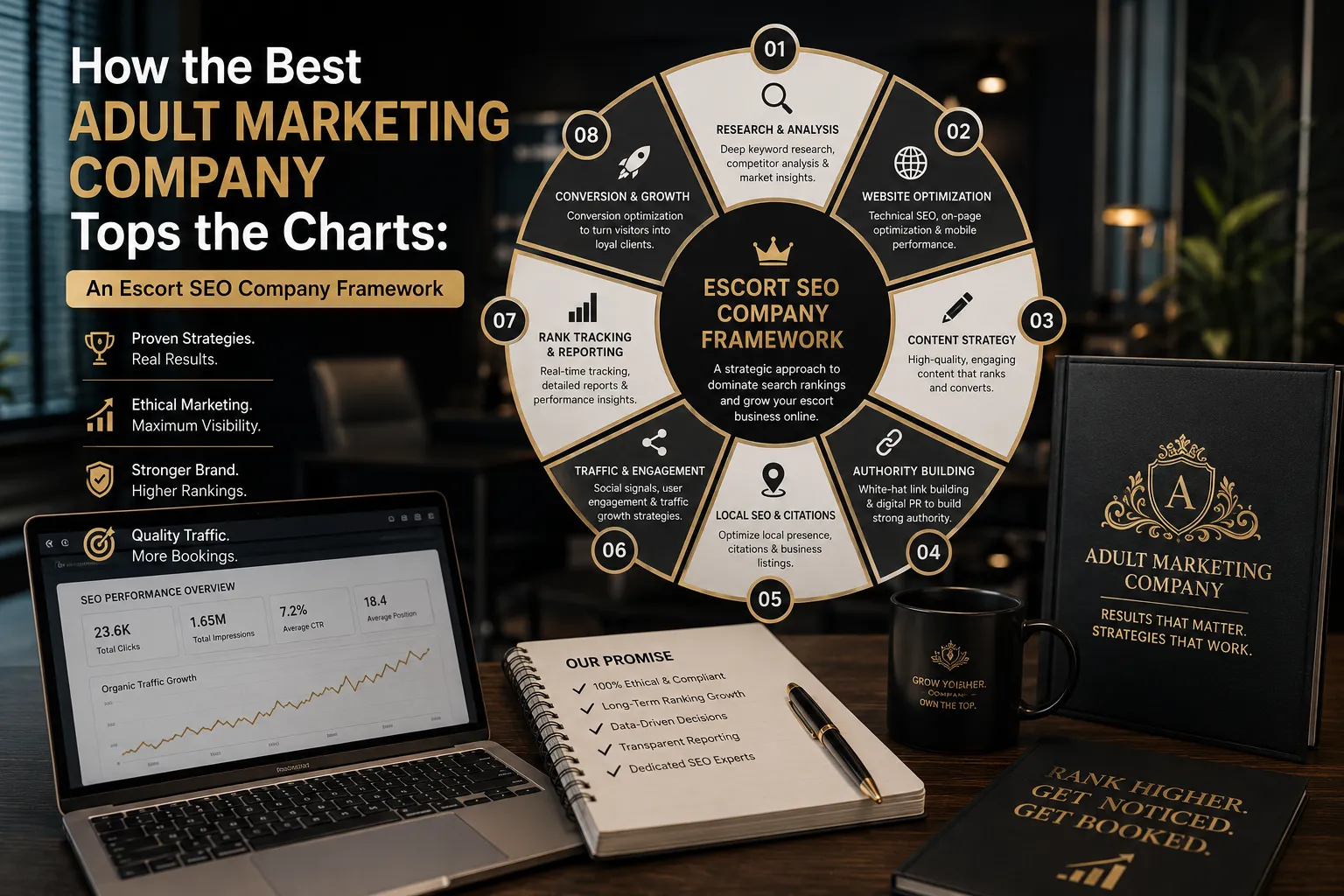
An escort SEO company does not become effective by publishing the most pages or buying the largest number of links. Strong adult marketing is built on clear commercial priorities, accurate audience research, technically accessible websites, useful content, and disciplined measurement. These elements must work together before visibility can support enquiries or sales.
That distinction matters in an industry where mainstream advertising, payment, social, and publishing options can be restricted. A good agency cannot simply copy a general-market campaign and change the imagery. It needs a channel plan and website model suited to the client’s lawful business, audience, geography, and conversion process.
The following framework explains what successful adult marketing teams do differently and how a business can evaluate the work without relying on vague superlatives.
Start with the business model, not a standard package
Adult-sector businesses do not share one customer journey.
An escort agency may depend on location pages, current profiles, availability, privacy information, and an enquiry process. An adult ecommerce store needs collection pages, product information, inventory controls, payment clarity, and checkout optimisation. A creator platform may require profile discovery, subscription education, content moderation, and retention.
The strategy should therefore begin with five questions:
- What lawful product, service, or platform is being marketed?
- Which markets and audience groups can the business actually serve?
- What action should a suitable visitor take?
- Which channel, platform, and payment restrictions apply?
- How will a valid commercial outcome be measured?
An agency that cannot describe these differences is likely to deliver the same keyword list, blog schedule, and backlink package to every client.
Define the primary outcome
Choose one main commercial outcome for the initial programme. It might be a qualified enquiry, a completed purchase, a verified registration, or a paid subscription.
Supporting metrics can diagnose the journey, but they should not replace the outcome. Rankings, impressions, and sessions are useful only when they help explain whether the website is reaching and serving the intended audience.
Build a marketing scorecard before starting work
The phrase “tops the charts” needs a measurable definition.
A useful scorecard separates visibility, website behaviour, commercial outcomes, and risk. This prevents one positive metric from hiding a serious weakness elsewhere.
| Scorecard area | Example measurements | Decision supported |
| Search visibility | Non-branded impressions, clicks, and landing pages | Where demand is growing or declining |
| Technical health | Indexable pages, crawl errors, speed, and security issues | Which defects block discovery or use |
| Engagement | Useful page journeys and key-content interactions | Whether visitors can find what they need |
| Conversion | Valid enquiries, purchases, registrations, or subscriptions | Whether traffic supports the business |
| Quality | Qualified-lead rate, returns, cancellations, or moderation flags | Whether targeting and expectations are accurate |
| Authority | Relevant referring sites, brand mentions, and referral visits | Whether promotion reaches credible audiences |
| Risk | Policy notices, unsafe links, content complaints, and access failures | What could undermine visibility or trust |
Record the baseline before implementation. When tracking is incomplete, fixing measurement becomes the first deliverable.
Research the audience by intent and decision stage
Demographic labels alone rarely produce a useful search strategy.
Research should identify the problem a person is trying to solve, the information needed before action, and the objections that could stop progress. Search Console data, internal site searches, customer-support questions, sales conversations, product returns, and on-site behaviour can all reveal these needs.
Organise findings into decision stages:
- Discovery: the visitor is learning about a category, service, or option.
- Comparison: the visitor is evaluating formats, providers, locations, features, or prices.
- Validation: the visitor is checking privacy, authenticity, policies, availability, or suitability.
- Action: the visitor is ready to enquire, buy, register, or subscribe.
- Retention: the existing customer needs support, care, renewal, or another relevant offer.
This model prevents every page from using the same sales message. A discovery guide should educate. A comparison page should clarify meaningful differences. A service page should explain the offer and next step. A support page should reduce uncertainty after conversion.
Design a page architecture that reflects real demand
Search performance improves when every important URL has a distinct job.
Map the website before expanding it:
- Homepage
- Core service or category pages
- Genuine location pages
- Product, profile, or listing pages
- Comparison and decision-support content
- Safety, privacy, verification, and policy pages
- Contact, checkout, registration, or subscription journeys
- Editorial resources
Assign one primary intent to each indexable page. Document its target audience, main query group, internal links, conversion action, owner, and review date.
Prevent overlap and doorway pages
Multiple URLs should not compete for the same need. Pages created only for minor keyword variations, city-name substitutions, or slightly reordered phrases usually add little value.
Google’s current spam policies describe doorway abuse, keyword stuffing, scaled low-value content, and link spam. A scalable content programme must therefore include a quality gate, not merely a publishing target.
Before a new page is approved, confirm:
- The page answers a distinct question or serves a real market.
- Its information is materially different from existing pages.
- The linked products, profiles, or services are current.
- The business can maintain the page.
- The page is part of a browsable hierarchy.
If those conditions are not met, improve an existing URL instead.
Make technical SEO a release process
Technical SEO is not a one-time audit attached to the beginning of a contract.
Adult websites often change themes, add profiles, update inventory, install consent tools, publish media, and connect third-party systems. Each change can affect crawling, speed, canonicalisation, structured data, security, or the conversion journey.
A reliable release process checks:
- Status codes and redirect behaviour
- Canonical tags
- Robots directives
- XML sitemaps
- Mobile rendering
- Internal-link accessibility
- JavaScript-dependent content
- Image and video loading
- Structured-data accuracy
- Form and checkout completion
- Security and injected-page warnings
The agency should test representative templates, not just the homepage. A product page, profile, city page, article, and contact path can fail in different ways.
Handle adult classification accurately
Sites containing adult or explicit material need specific controls. Google’s explicit-content guidelines explain SafeSearch handling, adult metadata, age-gate access, content grouping, and moderation considerations.
The site should classify material honestly. It should allow verified crawlers to access pages where an age notice would otherwise block the content. User-generated material should have documented verification and moderation processes. Unlawful, unauthorised, or non-consensual material must never be treated as a marketing asset.
These are operational requirements, not optional SEO decoration.
Create content that changes a decision
Strong content reduces uncertainty or helps a visitor choose the correct next step.
Google’s Search Essentials prioritise helpful, reliable, people-first content and recommend using the language people use in prominent, descriptive locations. That does not mean repeating a phrase until a density target is reached.
A useful content brief should specify:
- The reader and decision stage
- The primary question
- The evidence or expertise required
- The information missing from existing results
- The conversion or internal-link destination
- Claims that need verification
- The person responsible for review
- The date or trigger for updating the page
Build content around first-hand operational knowledge
Generic articles often sound interchangeable because they are written without access to the business.
Better inputs include:
- Real customer questions with identifying details removed
- Product specifications and usage instructions
- Booking or fulfilment processes
- Service-area limitations
- Availability and stock patterns
- Support and cancellation themes
- Moderation and verification procedures
- Common reasons for an unsuitable enquiry or return
The writer’s job is to organize and clarify this information, not invent expertise. An adult SEO service should include an editorial process that checks accuracy, tone, duplication, internal links, and conversion relevance before publication.
Connect brand identity with proof and consistency
Adult brands often need to establish trust with fewer mainstream signals.
The website should explain who the service is for, how it operates, what it protects, and what happens after a visitor takes action. Claims should be supported through observable details rather than repeated adjectives.
Useful trust elements may include:
- Current service, profile, or product information
- Clear contact and response expectations
- Accurate pricing or quotation processes
- Privacy and data-use explanations
- Delivery, cancellation, refund, or account policies
- Visible moderation and verification standards
- Secure website and payment processes
- Consistent business information across relevant platforms
Visual identity matters, but design cannot replace missing information. A premium layout with broken forms, outdated profiles, or contradictory policies weakens confidence.
Brand consistency also extends beyond the website. Search snippets, directory listings, social profiles, emails, and customer support should describe the same service and use the same current contact information.
Optimise the conversion journey without pressure
Conversion optimisation should make decisions easier, not manipulate visitors.
Begin by identifying the most useful action for each page. A category page may guide visitors to suitable products. A profile page may offer an enquiry about that listing. A service page may direct visitors to location or availability information.
Review:
- Whether the call to action matches the page
- How much information a form requests
- Whether mobile buttons are easy to use
- Whether errors explain how to continue
- What happens after submission
- Whether confirmation messages set realistic expectations
- Whether analytics record successful and failed actions
Do not confuse more clicks with better results. A large button can increase interactions while lead quality falls. Measure valid outcomes, not only button activity.
Protect privacy by design
Collect only the information required for the stated purpose. Explain how it will be used, limit access, and set appropriate retention controls. Consent and tracking tools should be configured for the jurisdictions served by the business.
An agency should raise these requirements during planning rather than discovering them after a campaign is live.
Use adult link building to extend useful work
Authority building is most defensible when the link points to something worth citing.
Adult link building can support search visibility and referral discovery, but it attracts risk when volume becomes the main objective. Relevant editorial coverage, supplier relationships, professional partnerships, interviews, original research, and genuinely useful resources are stronger starting points than anonymous link packages.
Potential assets include:
- A clear material or product-comparison resource
- An anonymised industry survey with a documented method
- A safety, verification, privacy, or accessibility guide
- Original data about customer questions or product trends
- A technical case study with sensitive details removed
- An expert interview about lawful business operations
Outreach should explain why the asset helps the publisher’s readers. The final link needs editorial context and a natural anchor.
Avoid automated placements, recycled guest posts, private networks created only for rankings, unrelated publishers, and repeated money anchors. Sponsored links should use the appropriate qualification. The agency should report secured URLs, anchors, placement type, relevance, and status without presenting domain metrics as proof of quality.
For a coordinated website, content, and authority strategy, businesses can assess specialist escort SEO support against these standards. The value should be visible in the process and evidence, not in a promised ranking position.
Choose channels by eligibility and role
The best adult marketing company does not depend on one platform.
Different channels can serve different jobs:
| Channel | Appropriate role |
| Organic search | Capture existing information, comparison, and action intent |
| Direct and referral visits | Support brand recognition and trusted recommendations |
| Communicate with consented audiences within applicable rules | |
| Relevant directories | Aid discovery where listings are accurate and maintained |
| Editorial partnerships | Reach aligned audiences through useful contributions |
| Permitted paid media | Test offers and audiences where platform policies allow |
| Owned social or community channels | Support updates and retention where content is eligible |
Verify current platform, advertising, payment, and country rules before launching a channel. Do not disguise the business or misclassify content to bypass restrictions.
Channel diversification is not an instruction to be everywhere. Choose a manageable set, define the role of each, and measure them consistently.
Combine Search Console and commercial data
An SEO report needs both search information and business outcomes.
Google explains how Search Console and Google Analytics data provide complementary views of search performance and on-site behaviour. A business may also need ecommerce, CRM, subscription, or booking data to understand quality after the visit.
A monthly review should answer:
- Which page groups gained or lost non-branded visibility?
- Which queries brought the intended audience?
- Which landing pages produced valid actions?
- Where did visitors abandon the journey?
- Which content assisted later conversion?
- Which locations, products, or services attracted unsuitable demand?
- Which technical changes affected performance?
- What will the team test or fix next?
Segment branded and non-branded search. Separate blog, service, location, profile, product, and support pages. Annotate migrations, redesigns, stock changes, profile updates, tracking repairs, and policy changes.
Do not send unnecessary sensitive or personal details into analytics. Use aggregated outcomes and controlled event names that support business decisions.
Run marketing as a controlled operating cycle
Sustainable performance comes from repeated diagnosis and improvement.
A practical monthly cycle includes:
- Observe: review search, conversion, quality, technical, and operational data.
- Diagnose: identify the page, template, market, or journey causing the gap.
- Prioritise: rank work by impact, confidence, effort, dependency, and risk.
- Implement: assign ownership, acceptance criteria, and a release date.
- Validate: confirm the change works technically and for users.
- Measure: compare the relevant page group with the baseline.
- Document: record the result and next decision.
This cycle prevents random activity. It also exposes when the limitation is not SEO. Slow response times, unavailable profiles, poor stock, unclear policies, or payment failure can reduce commercial outcomes even when traffic improves.
Follow a practical 90-day plan
The first quarter should establish control before aggressive expansion.
Days 1 to 30: diagnose and measure
- Confirm the business model, markets, audience, and channel eligibility
- Define primary and supporting outcomes
- Verify analytics, Search Console, and commercial tracking
- Crawl the site and inspect priority templates
- Map URLs to search intent and conversion actions
- Review adult classification, age gates, privacy, and security
- Audit content quality and referring links
Days 31 to 60: repair the core journey
- Fix critical crawl, indexation, canonical, speed, and security issues
- Consolidate overlapping or weak pages
- Improve the highest-value service, category, product, or profile pages
- Clarify trust, policy, and contact information
- Simplify conversion journeys
- Strengthen internal links
- Remove or disavow harmful links only when evidence justifies the action
Days 61 to 90: expand proven opportunities
- Publish a small set of evidence-led resources
- Create only the location or category pages that pass the quality gate
- Begin selective editorial outreach
- Test one conversion improvement at a time
- Compare quality and commercial outcomes with the baseline
- Set the next quarter’s work from documented results
This order protects the budget. Publishing at scale before technical, conversion, and measurement controls are stable usually creates more pages to repair.
Evaluate the agency behind the campaign
The best provider should make its decision process visible.
Ask an escort SEO company:
- How will you learn our business model and restrictions?
- Which outcome will the strategy prioritise?
- What will you audit before creating content?
- How will you prevent overlapping or doorway pages?
- How do you classify adult content and test age gates?
- How are writers briefed and claims reviewed?
- How do you qualify publishers and sponsored links?
- Which conversions and quality signals will you measure?
- Who owns the website, content, accounts, and data?
- Which outcomes will you refuse to promise?
The answers should refer to evidence, owners, deliverables, and risk. A sales proposal that offers only keyword counts, article volumes, and link metrics does not describe a complete marketing system.
Common mistakes that weaken adult marketing
Several practices create activity without a durable advantage.
- Using one template for every adult niche: match the architecture to the business model.
- Publishing city pages with swapped place names: require distinct local value.
- Blocking crawlers with an age gate: test verified crawler access.
- Writing without operational input: use real policies, processes, products, and questions.
- Buying links by metric alone: assess editorial relevance and reader value.
- Reporting traffic without quality: connect search visits to valid outcomes.
- Installing more tools than the site needs: remove scripts that add cost without value.
- Collecting excessive form data: reduce privacy risk and conversion friction.
- Depending on one channel: create a manageable, eligible channel mix.
- Promising fixed outcomes: use scenarios, milestones, and transparent limitations.
These mistakes are preventable when strategy, production, technical work, and reporting share one operating plan.
Frequently asked questions
The following questions help businesses test whether an agency’s offer is practical.
What does an escort SEO company actually do?
It should research demand, map website architecture, improve commercial pages, resolve technical issues, develop useful content, strengthen internal links, support responsible outreach, and connect search activity to suitable enquiries. The exact mix depends on the site’s condition and business model.
How is an adult SEO service different from general SEO?
The technical foundations are similar, but adult-sector work must account for content classification, age-gate access, restricted channels, cautious publishers, privacy expectations, moderation, and business-specific conversion journeys. A general checklist is not enough.
There is no universal timeframe. Competition, domain history, technical condition, content quality, development resources, authority, and commercial operations all affect progress. Establish a baseline and assess agreed milestones rather than accepting a fixed ranking date.
How many links should an adult website build each month?
There is no correct universal number. One relevant editorial placement can be more useful than dozens of automated links. Judge each opportunity by topic fit, editorial control, audience value, anchor context, and risk.
Should an agency publish content every day?
Only when the business has enough distinct demand, evidence, editorial capacity, and maintenance resources. A smaller number of accurate, internally linked pages can outperform a large library of overlapping articles.
Can adult websites appear in search results?
Eligible adult content can appear, but SafeSearch and other systems affect how and where it is shown. Site owners should follow current search policies, classify material accurately, and avoid blocking crawlers unintentionally.
What should an adult marketing report contain?
It should show completed work, technical changes, visibility by page group, valid conversion outcomes, link activity, risks, lessons, and next decisions. Reports should explain causation carefully and identify where evidence is incomplete.
Build the system that supports durable visibility
Adult-market leaders do not reach the top through one tactic. They align a lawful business model, accurate audience research, clean architecture, technical reliability, decision-supporting content, responsible authority, conversion design, and commercial measurement.
The role of an escort SEO company is to operate that system transparently. It should show what was changed, why it mattered, how it was validated, and what the evidence suggests doing next.
If your business needs a structured audit and prioritised action plan, contact EMA for a technical SEO assessment. A strong first deliverable should clarify the market, risks, website gaps, measurement plan, and order of implementation without offering a fixed performance promise.Contact EMA today
Call Us @ +91 7980282056
Email Us @ leo@escortmarketing.agency