admin
admin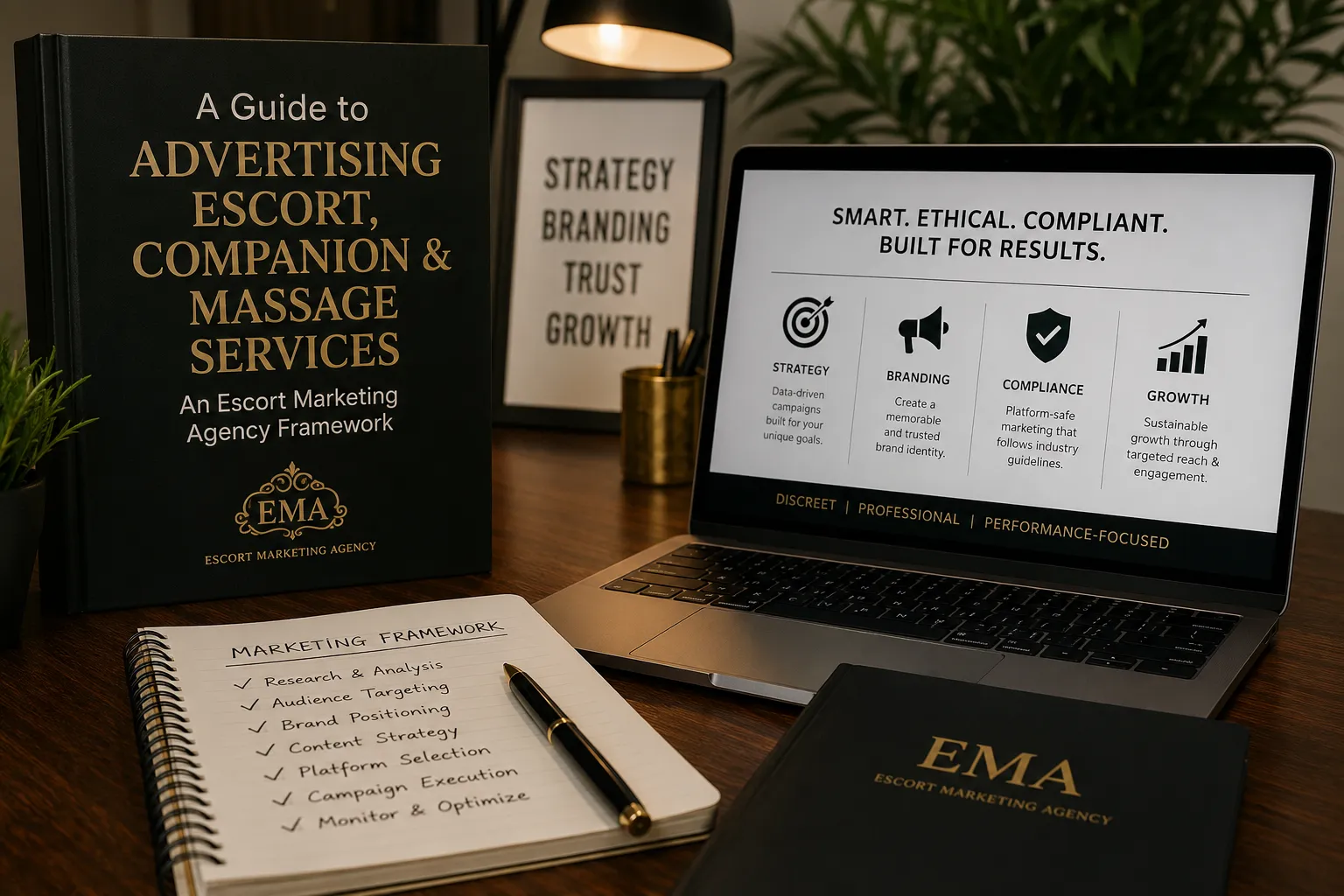
Advertising a sensitive service business is not a matter of placing the same offer on every available channel. A responsible escort marketing agency starts by establishing what the business lawfully provides, where it operates, which claims it can substantiate and which platforms permit the proposed content.
That preparation shapes the website, search strategy, listings, enquiry process and measurement plan. It also prevents a licensed therapeutic massage business from being misrepresented.
This guide presents a practical framework for promoting lawful escort, companionship and massage services without assuming that the same rules apply to every business, location or channel.
Begin with service classification, not promotion
The first campaign document should define the service accurately. Marketing cannot correct an unclear or legally unsuitable business model after publication.
“Massage,” “companion service” and “escort service” may have different meanings under local licensing, advertising and criminal laws. The allowed terminology can also depend on qualifications, premises, service delivery and jurisdiction. A phrase that is acceptable for one regulated practice may be misleading or prohibited for another.
Create a service-classification record that covers:
- The legal business entity and public trading name
- The exact services offered and excluded
- The locations or service areas in which they operate
- Any licence, registration or qualification that applies
- The minimum age and verification controls required
- The public claims the business can prove
- The information that must remain private
- The jurisdictions and platform rules governing each campaign
This working record should be reviewed by a qualified local professional when the rules are uncertain.
Separate services when the law or customer expectation requires it
Do not assume that companion and massage services should share one landing page, advert or directory listing. Combining them may create confusion even where the underlying services are lawful.
Some jurisdictions expressly regulate how massage is advertised. A published 2025 version of Hawaii’s statute, for example, restricts advertising licensed massage therapy together with escort or dating services. The current rule should always be confirmed through an official local source or qualified adviser before launch.
Separation may require different:
- Websites or clearly distinct site sections
- Service descriptions and booking processes
- Business listings and categories
- Contact details or enquiry routing
- Creative assets and public profiles
- Analytics views and campaign reports
Each public asset should honestly represent the service it promotes.
Set campaign objectives based on qualified outcomes
Campaign goals should describe a business outcome that can be measured without promising a result. “Get more traffic” is too broad to guide a useful strategy.
A better objective might be to increase suitable enquiries from a defined service area while reducing messages that ignore the booking requirements. Another could be to improve visibility for a licensed therapist’s specific treatment pages while maintaining accurate local listings.
Useful outcome groups include:
| Objective | Suitable indicators | What to avoid |
| Relevant discovery | Impressions for appropriate queries, referral visits, profile views | Treating all reach as valuable |
| Website engagement | Visits to service, policy, location and contact pages | Relying on time on page alone |
| Enquiry action | Valid forms, contact clicks, completed booking steps | Counting spam or accidental clicks |
| Enquiry quality | Requests that meet location, notice and service criteria | Reporting raw message volume |
| Reputation | Accurate listings, resolved issues, verified feedback | Creating or rewarding fake reviews |
Before making changes, record organic visibility, referral sources, unsuitable requests and the percentage of enquiries containing the required information.
Build an owned website as the campaign centre
Third-party platforms can restrict content or change their rules. An owned website provides greater control over information, analytics and the enquiry journey.
Effective escort website design should make the public brand clear without exposing private identity or operational details. It should also help an adult visitor understand the service area, terms, availability process and preferred contact method before sending a message.
Give the website a simple information architecture
Every page should answer a distinct visitor need. A practical structure may include:
- Home: Confirm the public brand, service category and main location.
- About: Explain the professional approach and relevant public credentials.
- Service pages: Describe each lawful service accurately, including essential limitations.
- Location pages: Provide genuine local information for markets actually served.
- Booking information: Set out notice, screening, cancellation and communication requirements.
- Frequently asked questions: Resolve recurring questions that do not need private discussion.
- Contact: Collect the minimum information needed for a suitable enquiry.
- Policies: Publish privacy, age, content ownership and other applicable notices.
Avoid creating several pages for the same intent. A clear hierarchy is easier for visitors to use and easier for search engines to interpret.
Design the mobile enquiry journey first
Most campaign reviews should begin on a real phone. Large media files, intrusive notices and poorly sized buttons can obstruct the information that helps a visitor decide.
Test whether a visitor can:
- Identify the official site and relevant service area
- Read the essential terms without zooming
- Move between service and booking information
- Reach the preferred contact method
- Correct a form error
- Understand what will happen after submission
Good escort website design does not rely on decorative impact alone. It reduces uncertainty and makes the next lawful action obvious.
Protect privacy without creating ambiguity
Privacy-aware design limits unnecessary data exposure while keeping the business transparent about its public service. It does not mean hiding material facts.
Use HTTPS, current software, controlled administrative access and reliable backups. Remove image metadata where appropriate, publish only media the business has permission to use and avoid exposing private addresses or personal accounts.
The initial form should request only necessary information and explain how it is handled.
Treat platform eligibility as a decision, not an assumption
Mainstream advertising, social media and local-profile products have separate rules. Eligibility may depend on the service, creative, landing page, location and account history.
Never disguise a prohibited service as a permitted one. Cloaked pages, misleading categories and evasive wording can breach platform rules and erode customer trust.
Use a pre-launch channel matrix:
| Channel | Pre-launch questions | Safe decision standard |
| Search advertising | Is the service permitted? Is the destination compliant? Are location and age restrictions met? | Launch only after the current policy is verified |
| Social advertising | Are the service, image, copy and audience allowed? | Do not rely on a similar advert being live |
| Organic social | Does the profile and content follow community rules? | Use only content the platform permits |
| Business profiles | Is the business eligible and accurately represented? | Use the real category, premises and ownership details |
| Directories | Does the publisher accept the exact service and jurisdiction? | Review quality, privacy and listing control |
| Was valid consent obtained and is an unsubscribe available? | Send only to an appropriate, permission-based audience |
Google’s sexual content advertising policy should be checked directly before using Google Ads. Do not assume that a therapeutic massage campaign and an escort campaign have the same eligibility.
Google also states that not every business is eligible for a Business Profile. Its current eligibility guidance includes rules for in-person contact, online-only businesses, service-area businesses and age-restricted services. A profile should never be created with a false category or location.
Document the policy page, review date and decision. Recheck before relaunching rejected creative or entering a new market.
Build organic visibility around real search intent
Search optimization is valuable because it can connect an eligible public website with adults actively researching a lawful service. It should not be used to make an inaccurate page appear relevant.
Begin by grouping queries according to intent:
- Brand intent: Public name, reviews and official website
- Service intent: A clearly defined service or treatment
- Local intent: A service in a genuine operating area
- Trust intent: Qualifications, process, policies or privacy questions
- Booking intent: Availability, contact and preparation information
Assign one primary page to each important group. A location page should contain real local detail rather than a city name swapped into a template. A service page should explain the service itself, not repeat a phrase in every paragraph.
Apply SEO for Massage Therapists to legitimate professional signals
SEO for Massage Therapists should reflect the practice’s actual qualifications, treatments, service area and client information. It should not imply a therapeutic credential the provider does not hold.
For a licensed or otherwise properly regulated practice, useful work may include:
- Accurate titles, headings and service descriptions
- Separate pages for genuinely distinct treatments
- Consistent public business information
- Clear practitioner credentials and licence details where required
- Fast mobile performance and accessible navigation
- Search Console monitoring and index control
- Original answers to common preparation and aftercare questions
- Local pages supported by genuine availability and context
SEO for Massage Therapists also requires restraint with health claims. Do not promise a diagnosis, cure or guaranteed outcome unless the claim is lawful, properly supported and within the practitioner’s professional scope.
Keep technical access clean
Search engines need to reach the intended public content. Check crawl paths, canonical URLs, XML sitemaps, mobile rendering and index directives.
Age notices should meet legal requirements without accidentally blocking public pages. Private, duplicate and administrative URLs should not become unnecessary search results.
Technical reviews should also cover:
- Adult-friendly hosting terms
- Core page performance
- Broken internal links
- Redirects after a redesign
- Structured data that matches visible content
- Image compression and descriptive alt text
- Security updates and backup recovery
Review these items after migrations, software changes or large content releases.
Use content to qualify the audience
Adult content writing should do more than add search phrases to a page. Its job is to answer the questions a suitable visitor needs resolved before contact.
A useful content map can include:
| Content type | Reader question | Business value |
| Service page | What is offered and what is not? | Reduces unsuitable enquiries |
| Booking guide | What information and notice are required? | Improves message quality |
| Location page | Is this service genuinely available here? | Supports relevant local discovery |
| Practitioner profile | What public experience or credentials can be verified? | Builds appropriate trust |
| FAQ | What causes repeated uncertainty? | Shortens unnecessary exchanges |
| Policy page | How are privacy, cancellations and media handled? | Sets expectations |
| Educational article | What should a reader understand before deciding? | Builds topical usefulness |
Remove expired availability, outdated prices and claims that no longer reflect the business.
Create a controlled editorial process
Sensitive content needs a review path, not just a writer. Use a brief that records the audience, page purpose, allowed terminology, prohibited claims, target location, evidence sources and CTA.
An adult content writing workflow should also record who approved the final terminology and when it needs review.
The review sequence should include:
- Service-owner accuracy review
- Jurisdiction or licensing review where required
- Platform-policy review for channel-specific copy
- Privacy and consent check
- Search and readability edit
- Final approval with date and version
This process prevents outdated claims from being copied into new channels without review.
Use directories and reputation channels selectively
Relevant directories can provide discovery, referrals and confirmation of the public brand. Poor directories can create spam, inaccurate information or privacy problems.
Evaluate a directory before submitting:
- Does it accept the exact lawful service and location?
- Are listings moderated?
- Can the business update or remove its information?
- Does the site protect account and enquiry data?
- Are profiles surrounded by relevant, legitimate content?
- Does it send real referral visits?
- Are links and paid placements disclosed appropriately?
Maintain consistent public details, but adapt each description to the directory’s audience.
Reviews require equally careful handling. Ask for feedback only through methods allowed by the platform and local law. Never fabricate reviews, gate negative feedback or reveal private client information in a response.
Earn authority without buying a risky footprint
Link building should be a by-product of relevant publishing, relationships and useful assets. A high domain metric does not make an unrelated or poorly edited site valuable.
An agency claiming to be the best adult link-building agency should be prepared to reject unsuitable opportunities. It should explain publisher relevance, editorial review, anchor choice, disclosure requirements and the reason each proposed page helps a real audience.
Sustainable opportunities may include:
- Original interviews with relevant industry publications
- Expert commentary on website, privacy or customer-experience topics
- Local citations that lawfully accept the business category
- Useful guides that independent editors choose to reference
- Partnerships based on a genuine shared audience
- Brand mentions using varied, natural anchors
Avoid automated submissions, private network packages, copied guest posts and repeated exact-match anchors. Google’s spam policies identify low-quality directory links and paid guest-post links that pass ranking credit as link-spam examples. Sponsored placements should use the qualification required by the publisher and search engine guidance.
Create a discreet but complete enquiry process
The website should tell visitors how to make an appropriate enquiry without collecting unnecessary information. A short form is not automatically a good form if it produces incomplete requests.
Explain:
- The preferred contact method
- The information required initially
- Relevant service areas and availability
- Expected response times
- Any lawful age or identity checks
- Cancellation and rescheduling rules
- Requests that fall outside the advertised service
- How submitted information is protected
Use descriptive CTAs at the right stage. “Read the booking requirements” helps a visitor who needs more information. “Submit an enquiry” suits someone who has already reviewed them.
Test confirmation messages, failed submissions, mobile keyboards and notification security. Do not place sensitive details in an email subject line or public calendar entry.
Measure one connected customer journey
Channel reports are useful only when they connect activity to qualified outcomes. Combine search, directory, website and enquiry data without creating an invasive tracking system.
A monthly review should answer:
- Which lawful service pages attracted relevant discovery?
- Which sources produced suitable enquiries?
- Where did mobile visitors abandon the journey?
- Which questions still appear repeatedly before contact?
- Which listings contain inaccurate or outdated information?
- Which content supported an enquiry rather than merely attracting a visit?
- What should be fixed, tested or stopped next month?
Use privacy-aware analytics and limited access. Do not record sensitive form fields without a clear lawful purpose.
Measure cost per qualified enquiry where possible. For organic work, track crawl health, relevant visibility and assisted enquiry paths.
Follow a 90-day implementation plan
A staged programme keeps compliance, website work and promotion in the correct order.
Days 1 to 30: establish legality, eligibility and baselines
The first month should define what can be promoted and where.
- Complete the service-classification record.
- Obtain jurisdiction-specific advice where needed.
- Inventory every website, listing and public profile.
- Check platform eligibility for each service.
- Define a qualified enquiry.
- Audit privacy, security and measurement.
- Record current visibility and enquiry quality.
Days 31 to 60: repair the owned assets
The second month should improve the information and contact journey.
- Separate conflicting service pages or campaigns.
- Rewrite core pages with accurate terms and evidence.
- Improve mobile navigation and media performance.
- Fix indexation, internal links and canonical signals.
- Simplify forms and publish clear policies.
- Correct priority directory listings.
- Build an editorial calendar from real visitor questions.
Days 61 to 90: expand carefully
The third month should test eligible channels and earn relevant attention.
- Publish one substantial resource based on a recurring decision question.
- Approach a short list of appropriate editorial partners.
- Test one conversion improvement at a time.
- Review referral quality and new backlinks.
- Compare outcomes by service, location and source.
- Stop channels that create unsuitable demand or policy risk.
- Set the next quarter from evidence gathered.
Choose specialist support by its process
An agency should be evaluated by the quality of its questions and controls, not by an unqualified promise of rankings or bookings.
Ask a prospective escort marketing agency:
- Which jurisdictions and service categories has it worked with?
- How does it verify legal and platform constraints?
- Who owns the website, content, analytics and advertising accounts?
- How are private identity details and access credentials protected?
- What does it count as a qualified enquiry?
- How does it select directories and publishers?
- How are sponsored links disclosed and qualified?
- Which activities will it refuse to perform?
- How will it report unsuccessful tests?
A useful audit should identify specific problems, evidence, priority, risk and recommended action. It should distinguish a website issue from a visibility issue and a visibility issue from an enquiry-quality problem.
Frequently asked questions
These answers provide general marketing guidance. The legal position and platform eligibility should be checked for the exact service and jurisdiction.
Can escort and massage services use the same advertising campaign?
Not automatically. Their legal classification, licensing requirements, audience and platform eligibility may differ. Some jurisdictions restrict combined advertising. Obtain appropriate advice and use separate campaigns or assets when required.
Are paid search ads available for every lawful service?
No. A service can be lawful but still restricted by an advertising platform. Review the current policy, landing page, location and creative before spending money or submitting an advert.
Can a massage provider use local search profiles?
An eligible, accurately represented massage practice may be able to use local profiles. It must follow the product’s ownership, premises, category and service-area rules. Never use a false location or category.
How often should service pages be updated?
Update them whenever availability, pricing, location, qualifications, policies or contact steps change. Conduct a scheduled accuracy review at least quarterly for core pages.
What content produces better enquiries?
Content that clearly explains service scope, location, suitability, booking requirements and boundaries helps visitors decide before contacting. The most useful topics usually come from repeated pre-enquiry questions.
Should every directory opportunity be accepted?
No. Review audience fit, moderation, reputation, privacy, referral quality and listing control. A small number of relevant profiles can be more useful than widespread low-quality submissions.
How should marketing performance be reported?
Report by journey stage: relevant discovery, useful page engagement, completed enquiry actions and qualified outcomes. Separate spam and unsuitable contacts from genuine enquiries.
When is specialist agency help useful?
Specialist help is useful when website, search, content, compliance and publisher decisions need coordination. Contact EMA to request a scoped review of the public website and current marketing assets without assuming guaranteed results.Contact EMA today
Build sustainable visibility on accuracy and control
Advertising escort companionship and massage services requires more than a list of promotional channels. The campaign must begin with accurate service classification, jurisdiction-specific review and a clear record of what each platform permits.
An experienced Escort Marketing Agency can then connect the eligible channels to a credible website, useful content, selective directories, responsible authority building and a discreet enquiry process. The result is a marketing system that can be measured and improved without relying on misleading claims or unsafe shortcuts.
Start by auditing the service definitions and public assets. Correct any ambiguity before increasing reach. A smaller, compliant campaign that attracts suitable enquiries is more valuable than broad exposure that creates account, legal or reputational risk.