 admin
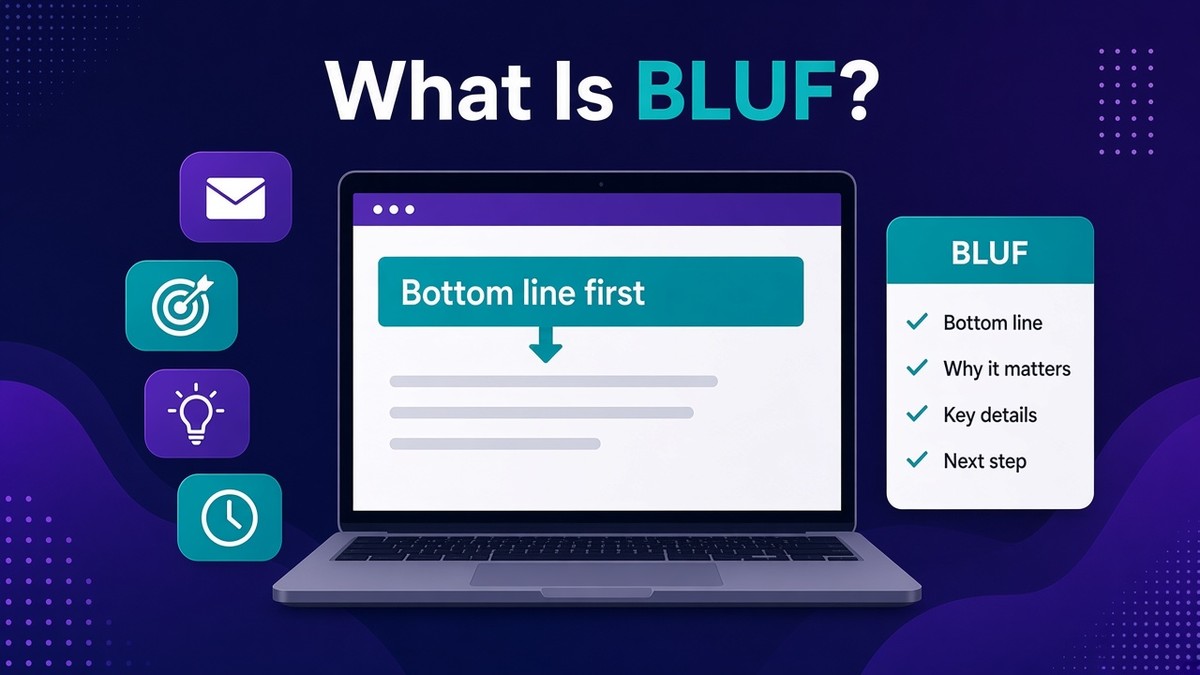
BLUF stands for “bottom line up front”. It means opening a message with the conclusion, decision or request, and putting the background after it. If a reader stopped after your first two sentences, they would still know what you want and why it matters. The rest of this guide explains where the idea comes from, why it works, how to write it, where it does not fit, and how to use our free BLUF helper to check your own drafts.
You have just seen the technique. The first paragraph gave the answer. Everything below is the supporting detail, in order of how many readers need it.
This guide is written for adult business owners, directory operators, platform marketers and the teams who write for them: client reports, proposals, briefs, emails and web pages. It is non-graphic and general in its advice.
What BLUF means
BLUF is the practice of beginning a message with its key information, then following with the context that supports it. The term comes from United States Army writing standards. According to the Wikipedia article on the subject, which cites Army Regulation 25-50 in its 17 May 2013 version, the standard requires that the main point come first and that writing be concise, organised and to the point. We read the Wikipedia summary and not the regulation itself, so check the regulation if you need the exact wording.
The same idea has other names. Journalists call it the inverted pyramid. Academics call a version of it the abstract. Executives call it the executive summary. Product teams call it the TL;DR. What they share is a belief that the reader’s time matters more than the writer’s sense of drama.
What BLUF is not
- It is not a shorter message. A BLUF message can be long. The point is where the key information sits, not how many words follow.
- It is not rude or blunt. You can lead with the conclusion in a polite, warm tone.
- It is not a license to leave out essential facts. The Wikipedia article notes that BLUF requires mastery of the topic and a clear purpose, and warns that brevity must not sacrifice essential facts.
- It is not clickbait. A BLUF opening states the real conclusion. It does not tease it.
Why BLUF works
Readers scan
Research on how people read online has pointed the same way for decades. In a study published by Jakob Nielsen on 30 September 1997, 79 percent of test users always scanned a new page and only 16 percent read word by word. That study is nearly three decades old and concerned web pages, so treat the exact figures as historical. The Nielsen Norman Group’s later work on eyetracking, which it first identified in 2006 and has reviewed since, found that people often scan in an F-shaped pattern: they read across the top, move down and read a shorter stretch, then scan down the left side. First lines get more attention than later lines, and the first words of each line get more fixations than the words after them. The group recommends putting the most important points in the first two paragraphs and starting headings with the most informative words.
You do not need to believe that every reader scans every message. You only need to accept that some readers, some of the time, will not reach your last paragraph. BLUF makes sure those readers still get the point.
The inverted pyramid supports every kind of reader
The Nielsen Norman Group describes the inverted pyramid as placing the most important information, often the conclusion, at the top, with supporting detail following in decreasing order of importance. It lists several benefits: readers form a mental model sooner, the main point costs little effort to find, skimmers can stop at any point and still get the gist, and an editor can trim the piece from the bottom without losing the core message. It also advises front-loading every element, so that headlines, subheadings and the first sentence of each paragraph carry the important point.
It forces the writer to decide
This benefit is our own observation, not a research finding. Writing the bottom line first is hard because it forces you to decide what you actually think. Many weak messages are weak because the writer has not decided yet and is hoping the reader will do it for them. If you cannot write the first sentence, you are not ready to send the message.
It helps busy decision makers
Anyone who approves, buys or signs off is usually deciding between many demands on their attention. A message that opens with the decision requested, and the deadline, lets them respond quickly or deprioritise it honestly. A message that opens with three paragraphs of background gets read later, or never.
The BLUF structure: four parts
The following is our own working framework, not an official standard. It works for most business writing.
- Bottom line. One or two sentences with the conclusion, recommendation, decision or request.
- Why it matters. One or two sentences on the reason, risk or benefit. This is what turns a statement into a case.
- Key details. The evidence, steps or options, in order of importance. Use short paragraphs or bullets.
- Next step. What you want the reader to do, by when, and what happens if they do not.
For messages that ask for something, put the request in the first part, not the last. Kabir Sehgal’s Harvard Business Review article on writing email with military precision makes a related point about subject lines: start with the purpose, and ask what you want the recipient to do. He suggests labelling subject lines with a keyword in capitals followed by a dash, such as INFO for information only, REQUEST for permission or approval and ACTION for something the recipient must do. We could read only the first part of that article, which sits behind a subscription prompt, so we credit only the subject-line advice.
A one-sentence test
Read only your first sentence. Can the reader tell what you are asking, deciding or reporting? If not, rewrite it before you touch anything else.
How to write BLUF, step by step
Step 1: Name the purpose. Complete one sentence: “After reading this, I want the reader to ___.” If the blank is “know”, write an informational message. If it is “approve”, “choose”, “send” or “fix”, write a request.
Step 2: Write the bottom line first. Do not start with a greeting paragraph, an apology or the history of the project. Begin with the answer.
Step 3: Add the reason. One sentence is often enough. Resist the urge to justify at length before the reader knows what you are justifying.
Step 4: List the details in priority order. Put the facts the reader most needs first. Use bullets for parallel items and short paragraphs for explanations.
Step 5: Close with the next step. State who does what and by when. If no action is needed, say so.
Step 6: Write the subject line or headline last. It should carry the bottom line in a few words.
Step 7: Cut. Remove anything the reader does not need to act or understand. The Nielsen Norman Group’s guidance, like most plain-language advice, favours concise, scannable writing.
BLUF in practice: realistic rewrites
The examples below are rewrites we wrote for this article, based on the kinds of messages marketers and site owners send every week. They contain no data or statistics. They are illustrations of structure, not case studies, and the details such as pages and tasks are placeholders for your own.
Example 1: a status email
Before:
Hi team, I wanted to give you an update on the website work. Over the past few weeks we have been looking at a number of areas including speed, indexing and the age gate. There were some challenges with the hosting setup, and after a few conversations with the developer we found that the age gate is probably the reason some pages are not being indexed. We think it should be fixed soon, but we need someone to confirm the change on the live site.
After:
ACTION – Approve age gate fix by Friday
Please approve the age gate change on the live site by Friday. It lets verified Googlebot reach our pages, and we believe it is the reason some pages are not indexed.
- Cause: the gate currently blocks crawlers (confirmed with the developer).
- Fix: allow verified Googlebot through the gate.
- Risk: low, and the change can be reverted.
Next step: reply “approved” and the developer will deploy it.
The “after” version is not shorter by much, but the reader knows the ask in the subject line and the first sentence.
Example 2: a client report summary
Before: “This month we carried out technical work, content publishing, and monitoring. Several pages were updated. The analytics show some movement in traffic…”
After: “Search traffic is [up/down/flat] this month, and the main reason is [reason]. We recommend [action]. Details by page are below.”
The brackets are deliberate: the bottom line is whatever your data says. The structure forces you to say it plainly. If your data does not support a clear conclusion, the honest bottom line is “no clear change yet, and here is what we are watching.”
Example 3: a web page opening
Before: “Welcome to our site. We have been in the industry for many years and pride ourselves on service…”
After: “[What you offer], for [who], in [where]. [How to book or contact].”
On a website, the first screen is where BLUF matters most, because visitors decide quickly whether the page is for them.
BLUF for the web
Most of what works in email works on the web too, with a few additions.
- Open pages with the answer. The Nielsen Norman Group says the first sentence of every paragraph should be the most important.
- Use descriptive headings. Begin headings with the most informative words.
- Write meta descriptions as summaries. Google says it builds snippets mainly from the page’s content and uses the meta description when it describes the page more accurately than the on-page text. It advises specific, accurate summaries with useful details, and warns against keyword lists and vague text. A BLUF-style description tells the searcher what the page is and what they will get.
- Write titles that carry the point. Google’s guidance says titles should be descriptive and concise, and that repeated or boilerplate titles can be rewritten by Google.
- Put the key takeaway near the top. If a reader sees only the first screen, make it count.
- Do not bury the call to action. State it early, and repeat it where it makes sense.
None of this guarantees rankings. Google does not say descriptions affect ranking directly. The benefit is clarity for the reader, which can improve how people respond to your result.
BLUF for adult-industry businesses
Adult businesses write many messages that need clarity: compliance notices to advertisers, listing guidelines for directories, policy updates, support replies, platform appeals and client reports. BLUF is especially useful here for three reasons.
1. Policy and compliance messages. When a rule changes, open with what changes, who it affects and by when. A listing guideline that starts with the history of the policy buries the one fact that people need.
2. Appeals and support. If you are writing to a platform, payment provider or host about a problem, state the account, the issue and the outcome you want in the first lines. People who review many cases will not dig for it.
3. Client reporting. Owners and managers of adult businesses are often time-pressed. A report that opens with “what changed, why and what to do” gets acted on.
Keep content non-graphic and professional in all of these. Clear structure also helps with risk: when the key facts and requests are written plainly and early, there is less room for misunderstanding.
When BLUF does not fit
BLUF is a tool, not a law. Consider other structures in these cases. These are our own judgement calls.
- Sensitive or emotional news. Bad news about a person, such as a dismissal, may need a short, human lead-in. Still, avoid long preambles. A single sentence of context before the point is usually enough.
- Narrative and storytelling. Fiction, case-study stories and brand narratives often build toward a point. That is a different job.
- Persuasion that needs a sequence. Occasionally an argument only makes sense in order. If so, give a one-line summary first, then the sequence.
- When you do not yet know. If you have no conclusion, say so in the first line, “I do not have a recommendation yet; here are the options.” That is still BLUF.
- Formal documents with required formats. Legal notices and some submissions have fixed structures. Follow them.
Common BLUF mistakes
- Starting with a greeting essay. A short greeting is fine. A paragraph is not.
- Burying the ask. If the request is in paragraph four, it is not up front.
- A vague bottom line. “We have some updates” is not a bottom line. “Rankings fell after the migration; we know why” is.
- Overloading the first sentence. One idea per sentence. If the first sentence has three clauses, split it.
- Hedging the conclusion. Words such as “perhaps”, “might”, “I think” and “sort of” weaken the opening. Use them only when you are truly uncertain, and then say what you are uncertain about.
- Leaving out the why. A conclusion with no reason invites arguments.
- Dropping essential facts for the sake of brevity. Brevity serves clarity. It should not remove key information.
- Forgetting the next step. A good opening with no clear action still leaves the reader stuck.
- Writing the subject line last and badly. Make the subject line carry the main point.
- Misleading openings. Do not state a conclusion your evidence does not support.
A BLUF checklist
Before you send or publish, check:
- Can a reader tell the purpose from the subject line or headline?
- Does the first sentence state the conclusion, decision or request?
- Is the reason given within the first two sentences?
- Are the details in priority order?
- Is there one clear next step, with an owner and a date?
- Are the paragraphs short and the headings descriptive?
- Have you cut everything the reader does not need?
- Is every statement accurate and supportable?
Free BLUF rewriter tool
To make the checklist easier, we built a free BLUF helper. It runs entirely in your browser, and nothing you paste is sent anywhere. It has three parts.
- BLUF checker. Paste a draft and the tool flags common problems: a long first sentence, a request or deadline that appears late, hedging words in the opening, very long paragraphs and a missing next step.
- Reorder suggestion. The tool scores each sentence for how much it looks like a bottom line (for example, sentences containing a recommendation, a request, a decision or a deadline) and suggests moving the best candidate to the top.
- BLUF builder. Fill in the bottom line, the reason, the key details and the next step, choose a subject label such as INFO, REQUEST or ACTION, and the tool assembles a ready-to-edit message.
What the tool is, and is not
It is a rule-based helper. It does not use artificial intelligence to rewrite your text, and it cannot understand your subject. It looks at patterns such as sentence length, certain words and where they appear. The reorder suggestion is a starting point, and you should always edit the result yourself. It cannot know whether your conclusion is right. If a draft is sensitive, confidential or legally significant, review it carefully before sending.
How to use it
- Paste your draft into the checker.
- Read the flags. Decide which are real problems and which are fine for this message.
- Try the reorder suggestion. If the proposed first sentence is not your real bottom line, write it yourself.
- Use the builder for messages you write often, such as status updates and requests.
- Reread the final text aloud. If the first two sentences work on their own, you have it.
Free BLUF Checker and Rewriter
Check a draft for “bottom line up front” problems, get a reorder suggestion, or build a BLUF message from scratch. Runs in your browser. Nothing is sent anywhere.
Frequently asked questions
What does BLUF stand for?
Bottom line up front.
Where does BLUF come from?
It is associated with United States Army writing standards. The Wikipedia article cites Army Regulation 25-50 (17 May 2013 version) as the source of the requirement to put the main point first.
Is BLUF the same as the inverted pyramid?
They are closely related. The inverted pyramid is the journalism and web-writing name for putting the most important information first, followed by details in decreasing order of importance.
Is BLUF only for the military?
No. It is used in government, business, healthcare, journalism and academia, for example in executive summaries, abstracts and email subject lines.
Can BLUF make emails too blunt?
It can if you drop courtesy. A polite one-line greeting, then the bottom line, is a good pattern.
Does BLUF help SEO?
It helps readers, and clear titles, descriptions and first paragraphs are consistent with Google’s guidance. Google does not say BLUF affects rankings, and nobody can guarantee a ranking from a writing style.
Should I use BLUF for every message?
Use it whenever the reader needs to act, decide or understand quickly. Consider other structures for sensitive or narrative writing.
Next steps
Take the last three messages you sent and read only their first two sentences. If the reader could not tell what you wanted, rewrite them with the four-part structure and compare the replies you get.
Escort Marketing Agency (EMA) is a B2B digital marketing agency that works with adult businesses on technical SEO, website development and clear, effective communication with search engines and customers alike. Connect with us today.
This article is general information, not legal advice. Check the rules for each market you serve.
References
- Wikipedia, “BLUF (communication)” (secondary source; cites U.S. Army Regulation 25-50, 17 May 2013): https://en.wikipedia.org/wiki/BLUF_(communication)
- Nielsen Norman Group, “Inverted Pyramid: Writing for Comprehension”: https://www.nngroup.com/articles/inverted-pyramid/
- Jakob Nielsen, “How Users Read on the Web” (30 September 1997): https://www.nngroup.com/articles/how-users-read-on-the-web/
- Nielsen Norman Group, “F-Shaped Pattern of Reading on the Web” (published 12 November 2017; reviewed 19 August 2026): https://www.nngroup.com/articles/f-shaped-pattern-reading-web-content/
- Kabir Sehgal, “How to Write Email with Military Precision,” Harvard Business Review (22 November 2016; partly paywalled): https://hbr.org/2016/11/how-to-write-email-with-military-precision
- Google Search Central, “Control your snippets in search results”: https://developers.google.com/search/docs/appearance/snippet
- Google Search Central, “Influencing your title links”: https://developers.google.com/search/docs/appearance/title-link