admin
admin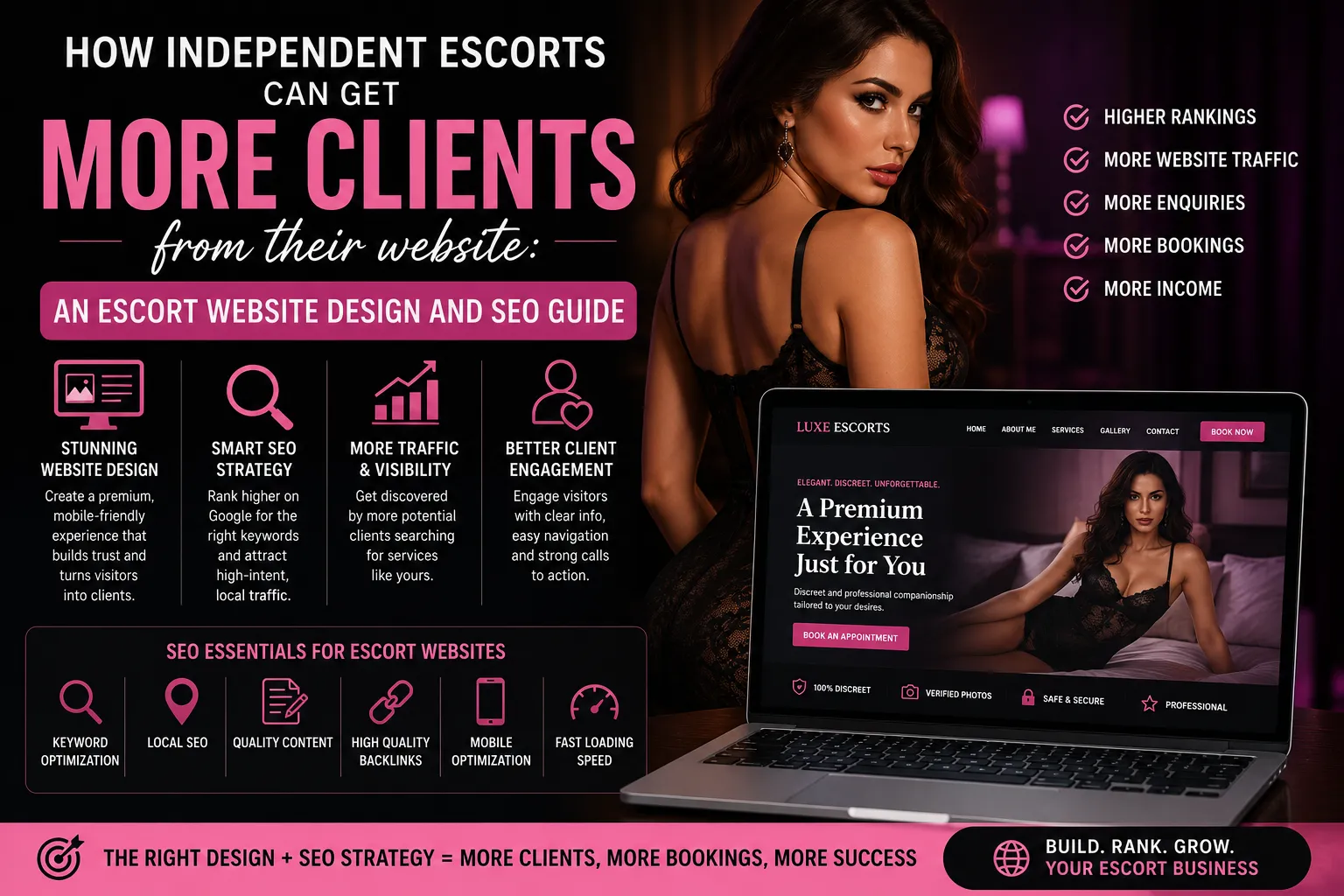
A website can do more than display a gallery and contact details. For an independent professional, it can become the centre of a client acquisition system: attracting relevant visitors, answering their questions, establishing trust and making a discreet enquiry feel straightforward. Effective escort website design supports every stage of that journey.
Getting more clients does not simply mean chasing more traffic. The better objective is to earn more qualified enquiries from adults who are in the right location, understand the service, respect the stated boundaries and are ready to follow the contact process. That requires design, content, search visibility and conversion planning to work together.
This guide explains how to build a sustainable client acquisition system while protecting privacy, complying with the law in the relevant jurisdiction and avoiding unreliable ranking promises.
Start with the right definition of a website conversion
Traffic is useful only when it leads to an appropriate next step. Before changing a page, define what a successful visit should produce.
For most independent websites, the primary conversion is a qualified enquiry through a designated form or messaging channel. Supporting conversions may include viewing availability, reading the booking process, checking the service area or returning to the site through a branded search.
A useful definition of a qualified enquiry might include:
- The visitor is an adult and is in a lawful, relevant market.
- They have read the essential service, rate and availability information.
- They use the requested contact channel and provide the necessary details.
- Their request respects the professional’s published terms and boundaries.
- The enquiry is specific enough to evaluate without a long exchange.
This definition changes how the website should be judged. A page with 1,000 unfocused visits and five unsuitable messages may be less valuable than a page with 150 relevant visits and ten well-formed enquiries. Track quality, not vanity.
Build an owned website instead of depending on one platform
Directories and social profiles can introduce a public brand to new audiences, but they are rented channels. Their rules, visibility and account access may change. A personal domain gives the owner more control over presentation, content, analytics and the enquiry journey.
The goal is not necessarily to abandon every third-party platform. It is to make the website the authoritative source that those profiles support. Public listings should use consistent stage-name details, link to the correct page and avoid publishing private identity information. The website should then give visitors the context that a short directory profile cannot.
An owned site is particularly valuable for:
- Explaining the public brand in an original voice
- Publishing accurate location and availability information
- Setting expectations before an enquiry
- Building recognition for a stage name
- Measuring how visitors find and use the site
- Retaining control of content and enquiry paths
Think of directories as discovery points and the website as the decision environment.
Use escort website design to reduce uncertainty
Visual quality matters, but a beautiful page that leaves basic questions unanswered will not perform well. Strong design makes the next decision easy and removes uncertainty without overcrowding the screen.
A visitor should be able to understand the following within a short mobile session:
- Whose official website is this?
- Which areas are relevant?
- What information should I review before making contact?
- How do I submit a suitable enquiry?
- What privacy and communication expectations apply?
That usually calls for a compact navigation structure: Home, About, Services or Experience, Locations or Travel, Booking Information, FAQs and Contact. Labels should be plain rather than clever. The primary contact action should remain easy to find without appearing aggressively on every line.
Professional escort website design should also account for the realities of a media-rich site. Images need appropriate dimensions, compression and lazy loading. Buttons need comfortable tap targets. Text must remain readable without zooming. Forms should request only information that is genuinely needed.
Design for trust, not appearance
Trust is built through consistency and verifiable details rather than exaggerated claims. The domain, stage name, visual identity, written tone and public profiles should feel like parts of the same brand.
Useful trust elements can include:
- A clear statement that the site represents an independent professional
- Original copy that sounds specific to the person and market
- Current availability or a clearly dated update
- Transparent contact steps and response expectations
- Images that the site has permission to publish
- A privacy notice and secure connection
- Straightforward policies covering cancellations and communication
Avoid fake reviews, fabricated awards, copied biographies or unprovable superlatives. They create doubt and can introduce legal or reputational risk. A quieter, more precise presentation is usually more persuasive.
Make the mobile journey the default journey
Do not treat mobile as a smaller version of desktop. Review it as the main experience.
Test the site on a real phone using a slower connection. Can a visitor identify the location, read key information, open the menu and reach the enquiry option with one hand? Do large images delay the first useful content? Does an age notice prevent search engines or legitimate users from accessing the page correctly?
Mobile testing should cover several screen sizes, browsers and common failure states. Check what happens when a form contains an error or a messaging app is unavailable.
Give every page one clear search purpose
SEO for an adult website begins with page ownership. Each important search intention should have one best page, and each page should have a distinct reason to exist.
A practical site map may contain:
| Page type | Main visitor need | Useful content |
| Home | Confirm identity and relevance | Brand summary, main market, key links, enquiry route |
| About | Assess fit and trust | Original profile, values, communication style, professional context |
| Service information | Understand the offer | Clear descriptions, boundaries, inclusions and preparation |
| Location page | Confirm geographic relevance | Genuine local context, availability pattern, travel details |
| Booking information | Learn the process | Required details, notice periods, screening, cancellation terms |
| FAQ | Resolve common concerns | Concise answers based on real pre-enquiry questions |
| Contact | Submit a qualified request | Minimal form, preferred channel, response expectations |
Do not make several pages compete for the same phrase. Assign a primary intent to each URL and link related pages back to it.
Create location pages only when they add local value
A location page should help someone planning an enquiry in that area. Changing one city name across dozens of otherwise identical pages creates little value and can resemble doorway content.
A worthwhile page may explain when the area is relevant, how far in advance an enquiry is needed, whether travel dates apply and which practical details a visitor should know. It should not expose a home address, private routine or other sensitive information.
Only publish a location page when there is a genuine reason to serve that market. One useful regional page may be better than many duplicates.
Write content from real decision questions
Adult SEO content should help a visitor make an informed decision. Start with questions that repeatedly appear before a suitable enquiry, then answer them clearly on the appropriate page.
Good topics may include how to use the contact process, how much notice is helpful, how travel availability is announced, what information is required and how privacy is handled. The aim is not to publish endless keyword-led articles. It is to remove recurring uncertainty.
Google’s guidance encourages helpful, reliable, people-first content that adds original value instead of merely rewriting other pages. For a personal website, first-hand knowledge is an advantage. Specific explanations of the public brand, process and market are more useful than generic marketing paragraphs.
Fix the technical foundations before expanding content
Content cannot perform consistently if search engines cannot access, interpret or index the intended pages. A technical review should establish a clean baseline before a large publishing programme begins.
Check these areas first:
- Index control: Important public pages should be indexable, while private, duplicated or administrative URLs should not appear in search.
- Crawl paths: Navigation and internal links should allow every important page to be reached without relying on a search box.
- Canonical signals: Each indexable page should identify the preferred URL, especially where tracking parameters or alternate versions exist.
- Sitemaps: The XML sitemap should contain current, canonical pages rather than errors, redirects or private URLs.
- Performance: Compress media, use modern formats, reduce unnecessary scripts and monitor real mobile loading.
- Security: Use HTTPS, current software, strong access controls, backups and a hosting provider that permits lawful adult-industry content.
- Structured data: Add only markup that accurately represents visible content and is supported for the page type.
- Age notices: Implement any legally required access notice without accidentally hiding all useful public content from crawlers.
Google Search Console can reveal indexing problems, search queries and page-level visibility. Analytics can show landing-page engagement and enquiry actions. Neither tool should collect more personal information than necessary.
Technical SEO is not a one-time launch task. Recheck the site after redesigns, plugin changes, migrations and large content updates.
Connect directories to the owned-site strategy
Escort Directory SEO should focus on consistency, referral quality and appropriate audience fit. A listing is useful when it can send relevant people or help them confirm that they have found the correct public brand.
Choose directories selectively. Review the site’s editorial standards, audience, location coverage, moderation, listing control and reputation. A small set of maintained profiles can outperform a large number of poor listings.
Keep public details consistent enough to avoid confusion, but do not duplicate the full website biography across every platform. Use a concise profile and direct visitors to the most relevant website page. Update or remove listings when details change.
Measure directory value through referral visits, qualified enquiries and brand searches. If a platform sends spam or creates privacy concerns, its visibility may not justify the risk.
Build authority without creating a link problem
Links can help people discover a website and can support search engines’ understanding of its reputation. However, relevance and editorial quality matter more than raw volume.
An agency describing itself as the best adult link-building agency should demonstrate its process rather than promise the largest package. It is the one willing to explain where links may appear, why those publications are relevant, how anchors will vary and what risks have been rejected.
A conservative authority plan may include:
- Accurate profiles on carefully reviewed industry platforms
- Genuine interviews or expert contributions to relevant publications
- Useful resources that editors would choose to reference
- Local or professional citations that lawfully accept the business type
- Brand mentions with natural, varied anchors
- Periodic reviews of new and suspicious referring domains
Avoid automated link blasts, copied guest posts, hidden links, sitewide footer placements and large batches of exact-match anchors. Google’s spam policies identify paid links that pass ranking credit and optimized anchors in guest posts as potential link spam. A publisher may need to qualify a sponsored link with rel=”sponsored” or rel=”nofollow”.
Adult SEO requires patience because relevant editorial opportunities may be narrower. That is a reason to apply stronger quality control, not lower it.
Turn contact into a clear, discreet process
Once the right visitor reaches the site, the enquiry path should feel predictable. Uncertainty at this stage produces abandoned forms, incomplete messages and avoidable back-and-forth.
A good contact page explains:
- Which channel is preferred
- What information an initial enquiry should include
- The usual response window
- Whether advance notice is required
- What screening or verification steps may apply
- Which requests will not receive a response
- How submitted information is handled
Ask only for the minimum information needed at the first step. Use clear field labels and show useful error messages. Confirm that a submission succeeded without revealing sensitive details on screen or in an insecure notification.
Place contextual calls to action after sections that answer a decision question. “Review the booking process” is appropriate when a reader still needs information; “Send a discreet enquiry” is appropriate when they are ready to contact. Not every button needs to say “Book now.”
Measure the path from discovery to qualified enquiry
Measurement should show where the system works and where visitors encounter friction. Begin with a small monthly dashboard.
Track indicators in four groups:
| Stage | Useful indicators | Question answered |
| Discovery | Search impressions, relevant queries, referral visits | Are appropriate people finding the site? |
| Engagement | Landing-page reading, key-page visits, return visits | Are they finding useful information? |
| Action | Contact clicks, valid form submissions, message starts | Can they reach the intended next step? |
| Quality | Suitable enquiries, response-worthy requests, confirmed outcomes | Is visibility supporting the business? |
Numbers need context. A fall in total visits may be acceptable if unsuitable traffic declines while qualified enquiries hold steady. A rise in contact clicks may not be progress if the messages lack required information.
Annotate major site changes so comparisons make sense. Review performance by landing page, device, market and referral source. Avoid invasive session recording on sensitive forms.
Follow a focused 90-day improvement plan
Trying to redesign, rewrite and promote everything at once creates noise. A staged plan makes the effect of each change easier to evaluate.
Days 1 to 30: establish the baseline
The first month should resolve risk and measurement gaps before adding new pages.
- Define a qualified enquiry and the markets that matter.
- Review the site on mobile and document contact friction.
- Check indexation, canonical URLs, sitemaps and important crawl paths.
- Inventory every page and assign its main purpose.
- Identify duplicated, outdated or unsafe public information.
- Configure privacy-aware conversion measurement.
- Record baseline search, referral and enquiry-quality data.
Days 31 to 60: improve the core journey
The second month should strengthen the pages most visitors need before making contact.
- Refine the home page around identity, location and next steps.
- Rewrite the profile and booking information in an original voice.
- Improve image performance and mobile interaction.
- Simplify navigation and contact forms.
- Create or consolidate location pages based on genuine market needs.
- Add internal links that guide visitors between related decisions.
- Update priority directory profiles to match the public brand.
Days 61 to 90: earn and learn
The third month should expand useful visibility without sacrificing quality.
- Publish one or two resources based on recurring visitor questions.
- Approach a small set of relevant publications with original contribution ideas.
- Review referring domains and anchor diversity.
- Compare landing pages by qualified enquiry contribution.
- Test one contact-page improvement at a time.
- Retire tactics that create volume without suitable outcomes.
- Set the next quarterly priorities from evidence, not assumptions.
Independent professionals who need technical, content and authority work coordinated can consider privacy-aware SEO support from EMA. A useful initial audit should identify specific issues, rank them by impact and explain what should happen next without guaranteeing a position or number of clients.
Avoid the mistakes that quietly reduce enquiries
Many websites lose opportunities through accumulated small problems rather than one dramatic failure. A quarterly review should look for the following patterns.
- Design without a journey: The site looks polished but leaves location, process or contact steps unclear.
- Huge unoptimized media: Galleries delay the information and actions mobile visitors need.
- Copied profile text: Reused directory copy gives visitors no added reason to trust the owned website.
- Thin city pages: Dozens of near-identical URLs provide no genuine local help.
- Keyword repetition: Awkward phrases reduce clarity without establishing authority.
- Unqualified link buying: High-volume packages introduce irrelevant domains and manipulative anchors.
- Conflicting public details: Different names, locations or contact methods make the brand look unreliable.
- Over-collection: Forms and analytics gather more personal data than the first enquiry requires.
- No outcome review: Traffic reports grow while nobody checks whether suitable enquiries improve.
Fixing these issues is often more valuable than launching another channel. A technically sound, credible website can make existing search, directory and referral traffic work harder.
Frequently asked questions
These concise answers address common planning questions, but implementation should always reflect the applicable laws, platform rules and privacy requirements.
How long does Adult SEO take to produce useful results?
There is no universal timeline. Starting authority, competition, technical condition, content quality and market demand all affect progress. Early improvements may appear in crawl health and enquiry usability, while meaningful organic visibility usually requires consistent work and measurement over time.
Does a new independent website need many pages?
No. A small set of complete, distinct pages is better than a large collection of thin ones. Begin with the visitor’s essential decisions, then add pages only when a real question or search intent needs its own answer.
Should every city have a separate page?
Only when the business genuinely serves that city and can provide useful, location-specific information. If the pages would be almost identical, consolidate them into a stronger regional or travel page.
Are escort directories still useful?
They can be useful for discovery, referrals and public-brand confirmation when the directory is relevant and well managed. Evaluate each listing by qualified traffic, control, reputation and privacy rather than domain metrics alone.
What makes a contact form effective?
It asks for the minimum details needed to assess an enquiry, works reliably on mobile, explains the next step and handles submitted data appropriately. Test both successful and failed submissions regularly.
Can a redesign damage existing search visibility?
Yes, if URLs, internal links, content or index settings change without a migration plan. Preserve valuable URLs where possible, map necessary redirects, keep important content and monitor Search Console after launch.
Authority matters, but link acquisition should follow relevance and editorial judgment. First fix the site, publish useful material and maintain credible profiles. Then pursue selective mentions and contributions rather than buying volume.
What should an independent professional ask an SEO agency?
Ask how it protects privacy, evaluates publishers, handles local pages, reports qualified outcomes and responds when a tactic is not working. Request a clear scope, ownership terms and access policy. Be cautious of guaranteed rankings or unexplained link packages.
Make the website a stronger decision environment
Getting more suitable clients from a website is not about a single design trick or ranking tactic. It is the outcome of reducing uncertainty at every stage: relevant discovery, clear presentation, credible information, discreet contact and careful follow-up.
The strongest escort website design is mobile-first, privacy-aware and built around genuine visitor decisions. Its content gives every important page a purpose. Its technical setup makes that content accessible. Its promotion earns relevant attention without relying on risky shortcuts.
Start by defining a qualified enquiry and reviewing the complete mobile journey. Fix the core pages and measurement before producing more content. Then use search, selected directories and editorial relationships to bring the right audience into a website that is ready to help them decide.
Call Us @ +91 7980282056
Email Us @ leo@escortmarketing.agency