 admin
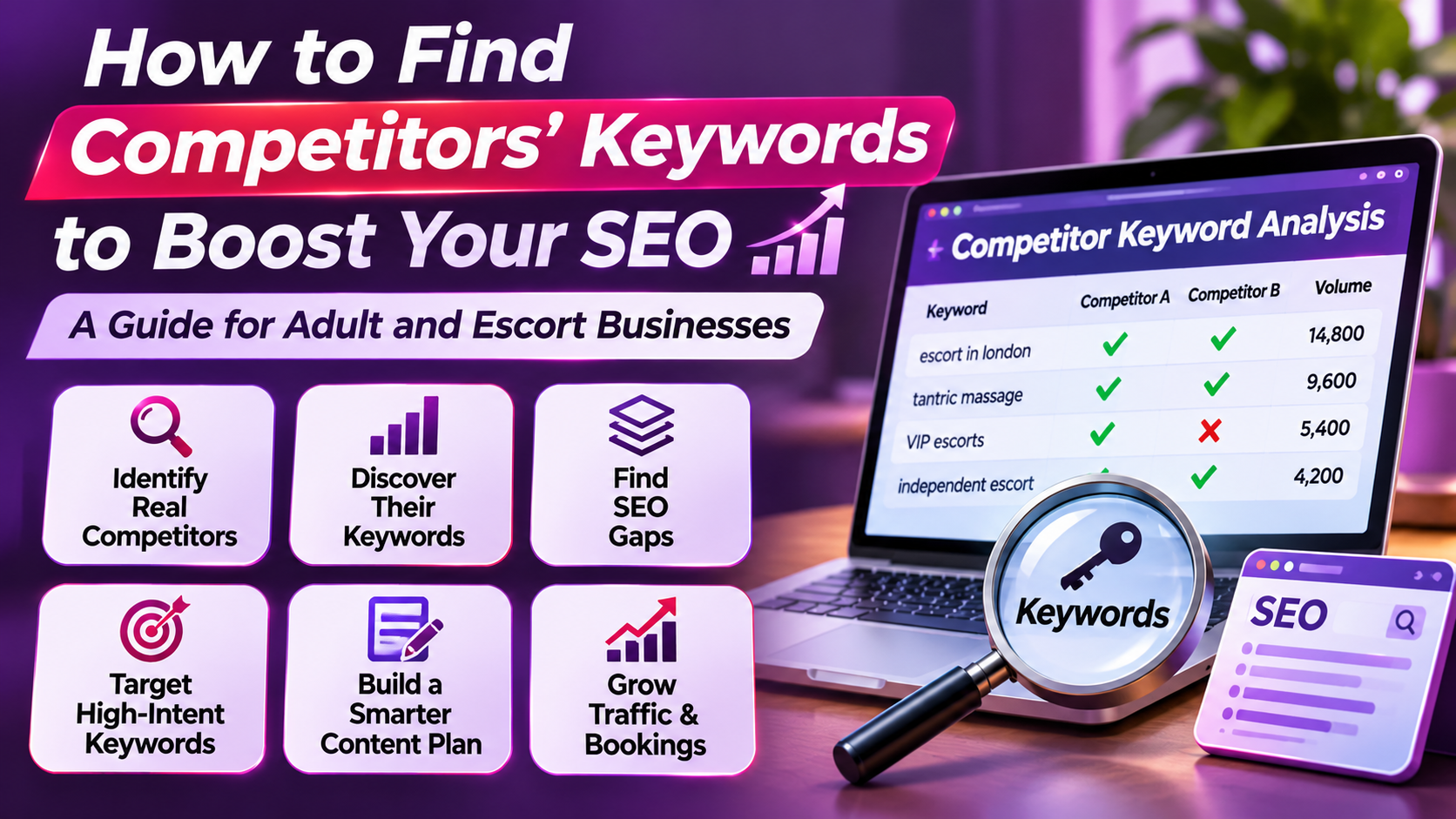
Short answer: You find a competitor’s keywords by looking at the pages they publish, the searches where they appear, and, if you have access, a keyword-gap tool that compares their rankings with yours. The list is the easy part. The value comes from filtering it for relevance and intent, grouping it into clusters, and giving each cluster one page that deserves to rank. In the adult and escort sector the usual shortcuts work less well: search engines filter explicit suggestions, “adult” and “escort” match unrelated topics, and some tools cannot return data for sensitive terms. This guide shows each method, with real data from a check made on 6 November 2026. It is general information, not legal advice.
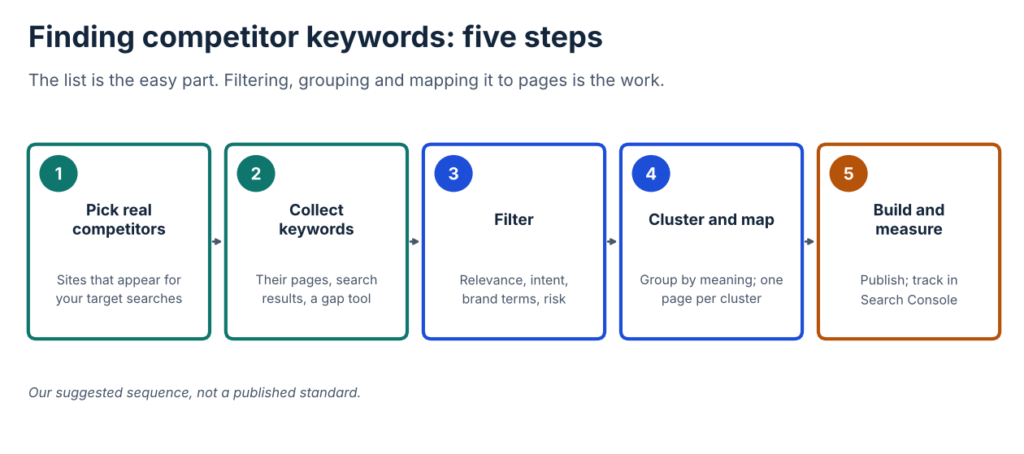
A five-step process for finding competitor keywords: pick real competitors, collect keywords, filter, cluster and map to pages, build and measure.
Figure 1. Five steps from competitor list to published pages. Most of the effort goes into steps 3 and 4.
How to use this guide
If you have no paid tools, start with the manual method and Search Console. If you have a tool such as Semrush or Ahrefs, read the gap-tool section and then the filtering section, because that is where most people go wrong. If you run an adult or escort business, read the section on why the usual shortcuts fail before you spend any money.
A note on data: this article does not quote search volumes or keyword difficulty scores. Volume and difficulty come from paid tools and are estimates, and the data source available when this was written could not return them. Where numbers appear, they are counts of things we observed, and each is labelled with its source and date.
Before you start: decide what you want to learn
Competitor research goes wrong when it has no question. Pick one before you open a tool. Useful questions include: Which topics do the sites that appear for our target searches cover that we do not? Which of our pages could be improved by adding something competitors already explain well? Which terms do competitors use for the same service, and are we using different words? Which topics does nobody cover clearly?
Write the question at the top of your spreadsheet. If a keyword does not help answer it, it does not need a row. This keeps the work small, and it makes the result easier to explain to an owner or a client who wants to know why you are building a page.
What competitor keywords are, and what they are not
A competitor’s keywords are the searches for which their pages appear in results. Tools usually define this precisely. Semrush’s Keyword Gap documentation, for example, says organic keywords are those where a domain “has an organic ranking within the top 100 results on Google.”
That definition tells you three things worth remembering.
- It is a ranking, not a sale. A competitor can rank for a term that brings no customers.
- It is a snapshot. Rankings move, and tools refresh on their own schedules.
- It is an estimate. Volumes, traffic and difficulty scores in these tools are the vendor’s models. Treat them as a way to compare options, not as facts.
Google’s own SEO Starter Guide (last updated 10 December 2025) frames keyword thinking around people, not lists: “Think about the words that a user might search for to find a piece of your content.” It adds that “users who know a lot about the topic might use different keywords” from beginners. A competitor’s list is useful because it shows words real searchers and real publishers use. It does not replace thinking about your own customers.
Who your competitors really are
Business competitors and search competitors are often different. A business competitor sells what you sell. A search competitor is any site that appears for the searches you care about. A directory, a review site, a news publisher or a forum thread can beat you for a keyword without being anything like you.
For keyword research, search competitors matter more. To find them:
- Make a list of five to ten searches a customer might use to find you.
- Run each search and note the sites on the first page. Ignore ads.
- Count how often each site appears across your searches. Sites that appear repeatedly are your search competitors.
- Keep two or three to study first. Ahrefs’ guide to content gap analysis suggests entering “1-3 competing domains,” and, when you compare several, filtering for keywords “where at least two sites rank in the top 10” so that you see terms with proven demand.
Search from a clean browser with personalization turned down, and note your location, because results vary. Google’s Performance report help says a query listed in your data does not guarantee your site appears for it in a live search, because results vary by time, place, device and search history. The same is true of what you see when you search.
Method 1: Read your competitor’s pages by hand
The cheapest method needs no tool. Open a competitor’s page that targets a term you want, and record five things:
- the title tag (shown in the browser tab or the page source);
- the meta description;
- the H1, the main heading;
- the H2 headings, which show how the page is organized;
- the URL slug.
Google’s title link guidance and snippet guidance explain how titles and descriptions can be shown in results. Headings are where publishers state what a page covers, so they are a good place to read what a competitor thinks searchers want.
A real example
On 6 November 2026 we read the public HTML of two adult SEO service pages: Reboot’s page and EMA’s own page. This is not a ranking comparison and it names no volumes. It shows what the method produces.
| Element | Reboot | EMA |
| Title tag | Adult SEO Agency – Adult SEO Services | Reboot | Adult SEO Agency for Creators & Platforms | EMA |
| H1 | Adult SEO agency | Adult SEO Agency: Rank Your Adult Business |
| Some H2 headings | Increase revenue with our adult SEO services; Adult SEO challenges we solve; Why Reboot as your adult SEO company; Our adult SEO services; Adult brands we will help you compete with; Our Adult SEO agency process | What is Adult SEO?; Why SEO Matters for Adult Websites; Adult SEO services for your business; What your free audit covers; Confidential adult SEO services; How Our Adult SEO Strategy Works |
(Both pages were read as public HTML. Other headings and page elements exist; this is a sample.)
Reading across the rows, several themes appear. Both pages use “adult SEO agency” in the title and H1. Both use “adult SEO services” in a heading. Reboot adds “adult SEO company”, a “challenges we solve” section and a “compete with” section. EMA adds “What is Adult SEO?” and a free audit section. None of that proves what ranks. What it gives you is a list of topics that competitors consider part of the page, and a question to ask of your own page: do we cover each of these, and if not, is that deliberate?
Record it so you can reuse it
Whichever method you use, put what you find in one spreadsheet, so the next review starts from last time’s notes. Useful columns are:
- competitor and page URL;
- date read;
- title tag, H1 and the H2 headings;
- the topic each heading covers, in your own words;
- intent (informational, commercial, transactional or navigational);
- whether you already have a page or section on it;
- your decision (add, improve, skip) and the reason.
The “reason” column matters more than it looks. Six months later, a note that says “skipped: not our service” saves you from reopening the same question.
Method 2: Look at the search results themselves
Search results show which page types search engines treat as relevant. For each target search, note:
- Page types. Are results service pages, guides, directories or listicles? If the first page is all guides, a service page may struggle to match what searchers want.
- The words that repeat across several titles are the words searchers and publishers both expect.
- What does nobody answer well?
Do not copy what you see. Google’s spam policies (last updated 28 August 2026) define scraping as “taking content from other sites, often through automated means,” and list “copying content from other sites, modify it only slightly” among its examples. The same page defines scaled content abuse as many pages generated “for the primary purpose of manipulating search rankings,” producing “large amounts of unoriginal content that provides little to no value to users, no matter how it’s created.” Competitor research is for finding topics. The pages you write should add something the results do not already have.
Method 3: Autocomplete, and why it fails in this sector
Search suggestions are a classic source of keyword ideas. In the adult sector they behave differently, and we tested it.
On 6 November 2026 (UTC) we sent 15 seed phrases to DuckDuckGo’s public suggestion endpoint, one query per phrase. The result is in Figure 2.
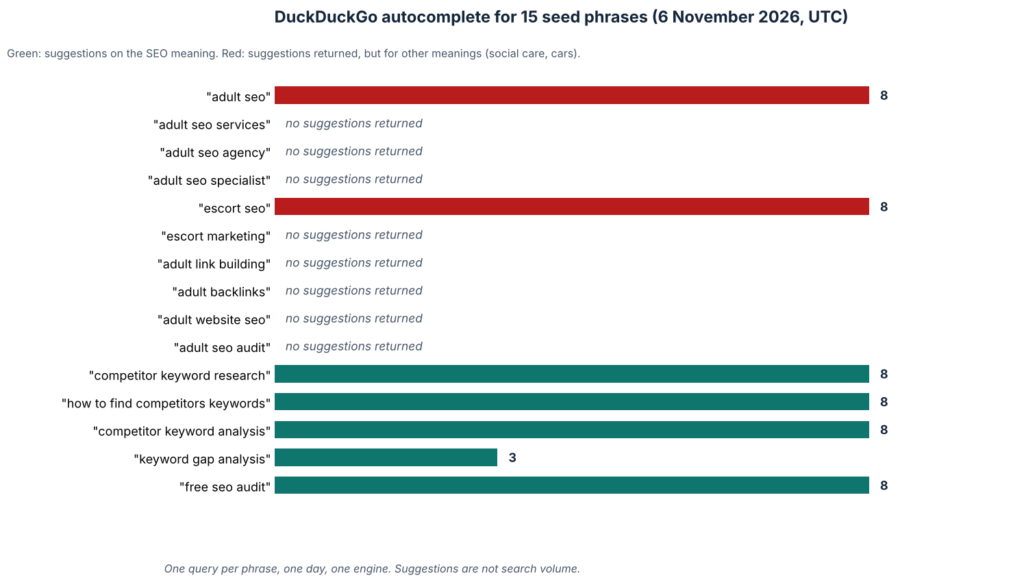
A bar chart of DuckDuckGo autocomplete suggestions for 15 seed phrases: general SEO phrases returned eight suggestions each, adult seo and escort seo returned eight off-topic suggestions, and most other adult phrases returned none.
Figure 2. DuckDuckGo autocomplete for 15 seed phrases on 6 November 2026 (UTC). Suggestions are not search volume.
What we saw:
- General SEO phrases such as “competitor keyword research”, “competitor keyword analysis” and “free seo audit” returned eight suggestions each, all on topic.
- “adult seo” returned eight suggestions, but none about SEO. They included adult social care and adult soccer leagues.
- “escort seo” returned eight suggestions about vehicles and security companies.
- Eight other adult-industry phrases, including “adult seo services”, “adult seo agency”, “adult link building” and “adult backlinks,” returned no suggestions at all.
This is one engine on one day, so do not generalize. It matches how Google describes its own system, however. Its Autocomplete policies say Google uses systems to prevent predictions that violate its Search policies, and list “sexually explicit content” among the categories removed, including “closely-related variations.” The same page says autocomplete “doesn’t simply display the most common queries on a given topic,” so it “shouldn’t be compared against Google Trends.”
Two lessons follow for adult and escort businesses.
- Autocomplete is unreliable for sector terms. Missing suggestions do not mean nobody searches for the term.
- The words “adult” and “escort” are ambiguous. Search engines also show results about adult social care and cars. Add words that fix the meaning, such as “SEO”, “agency”, “website” or “marketing”, and check the first page of results to see which meaning wins.
Method 4: Keyword-gap tools
Gap tools compare your domain with competitors and list the keywords they rank for that you do not. Two well-documented examples are Semrush’s Keyword Gap and Ahrefs’ Content Gap. (We have not run either for this article, because we did not have access to paid accounts. What follows is from the vendors’ own documentation.)
Semrush Keyword Gap. According to its knowledge-base page, the tool “offers a side-by-side comparison between keyword profiles of up to five competitors.” It sorts keywords into groups:3
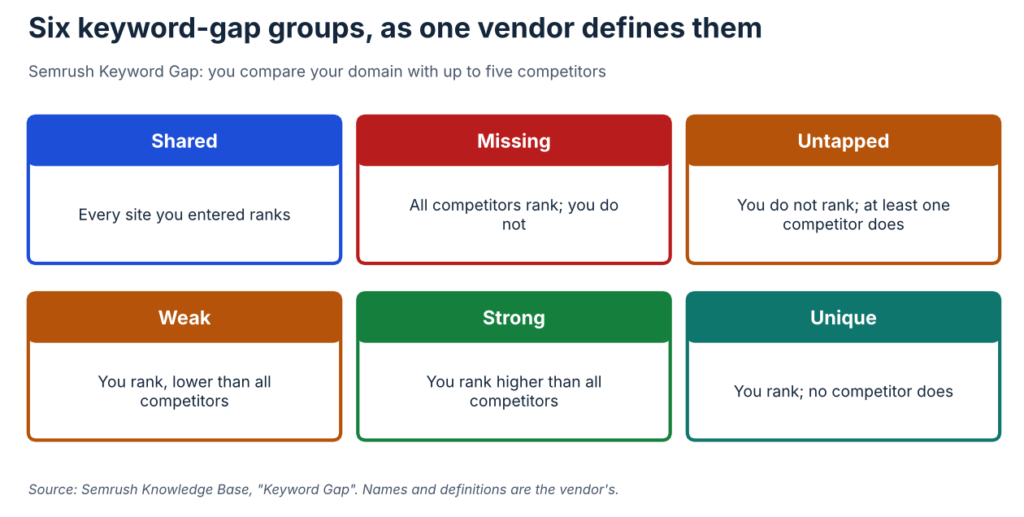
Six boxes showing Semrush’s Keyword Gap groups: Shared, Missing, Untapped, Weak, Strong and Unique, each with a one-line definition.
Figure 3. The six keyword-gap groups as Semrush defines them. The names and definitions are the vendor’s.
Filters include position (a custom range such as 11 to 20, which the page gives as an example for second-page rankings), intent, keyword difficulty, search volume and CPC. The page lists daily request limits and results-per-report limits by plan.
Ahrefs Content Gap. Ahrefs’ help article says Content Gap “shows keywords that competitor sites rank for but your target site does not,” and that you can enter up to 10 competitors. Its content gap analysis guide adds practical steps: if the report holds over 100,000 keywords, filter out competitor brand terms and irrelevant topics, then export to CSV. It also says that “it’s important that you go beyond simply exporting a list of missing keywords,” and that where you already have a relevant page, adding missing sections may close a gap without creating a new page.
The same guide offers example filters, such as excluding terms below 20 monthly searches and setting a maximum keyword difficulty of 30 to find “low-hanging fruit.” Those are the author’s example thresholds for one site, not rules. In a niche with low measured volume, a cutoff of 20 can remove most of the useful terms.
What to do with each gap group
The group names are the vendor’s. The actions are our judgment, not Semrush’s advice.
- Missing (all competitors rank, you do not): the strongest candidates for a new section or page, after filtering for relevance and intent.
- Untapped (you do not rank, at least one competitor does): worth reviewing, but weaker evidence than “missing”, because only some sites have chosen the topic.
- Weak (you rank, but below all competitors): improve an existing page first. Compare your page with theirs: is a question unanswered, or a section missing?
- Strong (you rank above all competitors): protect these pages. Do not rewrite them without a reason, and keep them current.
- Shared (everyone ranks): the baseline for the topic. If you are missing from the list of shared terms in your own country, check indexing and access before you write anything.
- Unique (you rank, nobody else does): a possible point of difference. Check whether it brings enquiries before you build on it.
Whichever group a term sits in, return to the filtering steps below. A gap is only an opportunity if the term is relevant, the intent fits a page you can build, and the rules allow it.
Check the tool can see your sector. Google’s Keyword Planner help says “keywords with very low search volumes, or keywords that are considered sensitive aren’t discoverable or forecastable.” Adult terms may fall into that group. Whatever tool you use, run a test with a few of your core phrases before you rely on its totals. If a tool returns blank or zero for terms you know customers use, its lists will be incomplete for your sector.
Method 5: Start with the keywords you already have
Your own data is the only keyword source that is exact. Google’s Performance report in Search Console shows four metrics: clicks, impressions, click-through rate and average position. Its Queries tab groups them by the search terms users typed, and the default view covers the past three months.
Use it to answer questions competitor tools cannot:
- Which queries already bring impressions but few clicks? Your title or description may not match what searchers want.
- Which queries sit in the middle of the results? Pages with some visibility are often cheaper to improve than pages with none. (This is our rule of thumb, not a published threshold.)
- Which of your competitors’ topics do you already cover? Compare their headings with your queries before you write anything new.
Search Console only shows your own site, so it cannot show a competitor’s queries. That is why the two sources work together: the competitor list shows what exists, and your own report shows what you already own.
Method 6: Trends, for direction only
Google Trends can show whether interest in a topic is rising or falling, but it is a poor tool for small niches. Its help page says numbers are scaled from 0 to 100 as a proportion of all searches in a place and period, that it uses a sample, and that “Trends only shows data for popular terms, so search terms with low volume appear as ‘0.’” For a narrow phrase, a zero tells you the term is below Trends’ threshold, not that nobody searches it.
A worked example: reading modifiers from real suggestions
Even when autocomplete fails for your sector, it can teach you how searchers phrase a question in general. On 6 November 2026 (UTC), DuckDuckGo returned these eight suggestions for “competitor keyword research”:
- competitor keyword research
- competitor keyword research tool
- competitor keyword research tool free
- ppc keyword competitor research tool
- ppc keyword competitor research software
- do competitor and keyword research
- keyword research competitor analysis
- keyword research and competitor analysis
Reading them as a researcher, you can pull out the modifiers: tool, software, free, ppc, and the reordered phrase keyword research and competitor analysis. Each modifier is a question to ask of your own topic. Do searchers want a tool or a method? Do they want a free option? Is the intent paid advertising (the “ppc” suggestions) or organic search? For an organic SEO guide, you would drop the “ppc” variants and keep “tool” and “free” as sections. This is the same filtering process, applied to a small real list, and it takes minutes.
The suggestions are not volumes. They show wording, not demand. Use them to shape headings, then confirm demand with Search Console once a page exists.
Filter the list before you use it
A raw competitor list is mostly noise. Filter it in this order.
- Remove terms for services you do not offer or places you do not serve. Ahrefs’ guide gives an example where a competitor ranked for 120 keywords that looked irrelevant to the business, and the author skipped them.
- Competitor brand terms. Remove searches that contain a competitor’s name. People searching for a brand want that brand.
- Mark each term as informational (learning), commercial (comparing options), transactional (ready to act) or navigational (looking for a specific site). These are the four intent labels used by common tools. Match each term to the page type that fits it.
- In this sector, remove terms whose main meaning is not yours. Check the first page of results.
- Compliance and platform limits. Remove terms you cannot legally or practically serve. Check the rules for your markets, and Google’s explicit-content guidelines (last updated 17 September 2026) if any pages are explicit.
- Fit with your offer. A term can be relevant and still wrong for the page you have.
What remains is a shortlist you can reason about. If it is still long, group it.
Build clusters and map them to pages
A cluster is a group of keywords that share a meaning and can be answered well by one page. The rule of thumb: if the same page could reasonably satisfy two searches, they belong together. If they need different pages, they do not.
Here is the method on real material. Using the headings from the two adult SEO service pages we read on 6 November 2026, we grouped each page’s heading phrases by meaning.
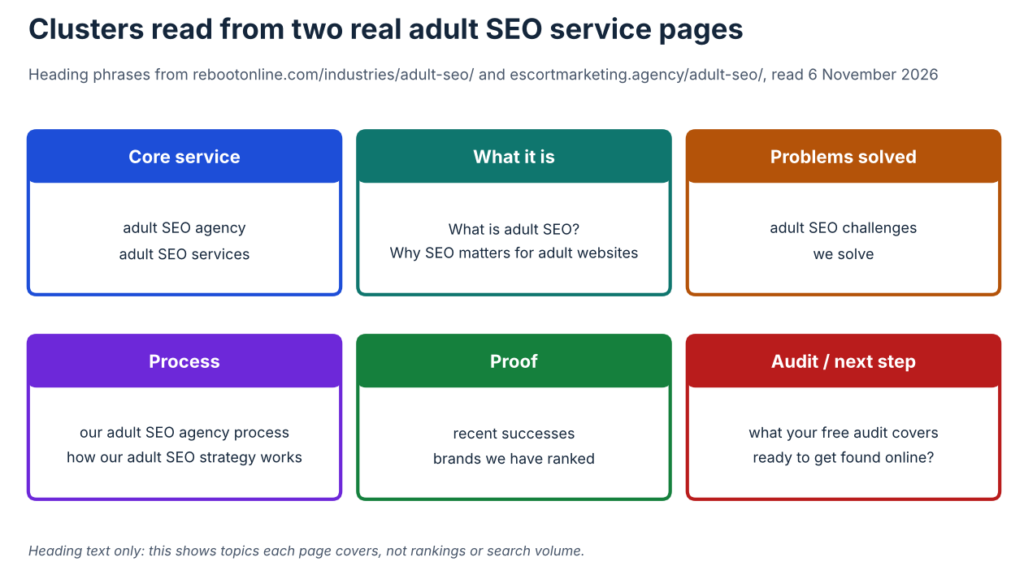
Six boxes showing clusters read from two real adult SEO service pages: core service, what it is, problems solved, process, proof, and audit or next step, each with example heading phrases.
Figure 4. Clusters read from the headings of two real adult SEO service pages. Heading text only: no rankings or search volume are implied.
| Cluster | Real heading phrases | Likely intent | Page job |
| Core service | “adult SEO agency”, “adult SEO services” | Commercial | Main service page |
| What it is | “What is Adult SEO?”, “Why SEO Matters for Adult Websites” | Informational | Section on the service page or a guide |
| Problems solved | “Adult SEO challenges we solve” | Commercial | Section or a dedicated guide |
| Process | “Our Adult SEO agency process”, “How Our Adult SEO Strategy Works” | Commercial | Section that explains what happens after contact |
| Proof | “Read about our recent successes”, “Escort & Adult Brands We’ve Ranked Worldwide” | Commercial | Section with real examples |
| Audit or next step | “What your free audit covers”, “Ready to get found online?” | Transactional | Call to action |
Five points follow from the table.
- Each cluster is a topic, not a phrase. “Adult SEO agency” and “adult SEO services” sit together because one page answers both.
- Intent decides the page. The informational cluster fits a guide. The transactional cluster fits a form or call to action.
- Clusters map to sections as often as to pages. Both sample pages cover most clusters on one page. Creating a separate page for every cluster would split the topic.
- Gaps are questions. If you are missing a cluster that your competitor has, ask whether your customers need it. If they do, add a section. If they do not, leave it.
- Mapping is a decision. Write down which cluster belongs to which page, and which page does not target it. That prevents two pages competing for the same searches.
To scale this: put the shortlist in a spreadsheet with columns for keyword, cluster, intent, page and status. Sort by cluster. Name each cluster by its main meaning. Assign each cluster to one existing or planned page. Then write briefs.
Turn clusters into a plan
Not every cluster is worth building first. Score each one on four things, then decide. The scoring below is our judgment, not a published method.
| Question | Why it matters |
| Does it match something you sell or a question customers ask? | Relevance beats volume. |
| Can you say something the current results do not? | Pages with nothing new rarely earn a place. Google’s helpful content guidance asks why the content exists. |
| How much work is it? | A section is cheaper than a guide, and a guide is cheaper than a tool. |
| What is the risk? | Check rules about explicit content, claims, reviews and advertising. |
Begin with clusters that score well on relevance and originality and low on risk. Improve an existing page before you build a new one.
Write a brief for each cluster
A cluster is not a page until someone writes it. A short brief keeps the page tied to the research:
- The reader and the question. Who searches this, and what do they need to know?
- The main terms and close variations, taken from your shortlist, used naturally. Google’s SEO Starter Guide warns that “excessively repeating the same words over and over (even in variations) is tiring for users.”
- The page type. A service page, a guide, a comparison, a help page or a section of an existing page.
- What the page adds. The one thing that other results lack: a worked example, a checklist, first-hand experience, a clearer explanation.
- Sources and rules to check. Any claims that need support, and any compliance points.
- How you will know it worked. The query set and the conversion you will watch in Search Console.
If you cannot fill in “what the page adds,” do not write the page yet.
Adult and escort sector: what changes
Four things are different in this sector.
Tools may have less data. Google’s Keyword Planner help says sensitive keywords may not be discoverable or forecastable, and our autocomplete test showed most adult-industry phrases returning no suggestions. Absence of data is not absence of demand. Lean on Search Console, your own enquiry data and manual reading of competitor pages.
Words have two meanings. “Adult” and “escort” match social care, soccer leagues, cars and security companies in our test. Add context words, and check the first page of results before you add a term to a cluster. Venue-type businesses meet the same problem; EMA’s guide to SEO tactics for sex club websites looks at tactics for that kind of site.
Explicit and non-explicit content should be separated. Google recommends that sites with a significant mix “group the explicit pages on a separate domain or subdomain.” Decide which cluster belongs on which part of your site, and check that age gates do not block Googlebot from pages you want indexed.
Competitor pages may make claims you cannot. A competitor’s headline may promise rankings, results or client counts. Do not copy claims. Google’s helpful content page asks “Why” content is created, and a page that promises what it cannot show is a risk for you, not an advantage.
Keep it current
Competitor pages change. Rankings change. Search Console shows new queries as they appear. Set a schedule:
- Monthly: check Search Console queries for new terms and pages that moved.
- Quarterly: repeat the competitor reading for your two or three main competitors, and update your cluster sheet.
- After a major change: re-check after a site migration, a redesign or a competitor launch.
Measure the work by what it is for: enquiries and conversions from the pages you built, not the length of the keyword list.
Common mistakes
- Treating a competitor’s keyword list as a to-do list.
- Choosing terms by volume alone.
- Ignoring intent, so that a service page chases informational searches.
- Copying competitor pages instead of covering the topic better.
- Targeting a term whose main meaning is not yours.
- Building a page for every keyword instead of every cluster.
- Leaving competitor brand terms in the list.
- Trusting a tool that returns blanks for your sector.
- Using autocomplete as a source of volume.
- Never checking your own Search Console data.
- Skipping a rules check for explicit content or claims.
- Measuring list size rather than enquiries.
Three scenarios
These are illustrative situations built from the method above, not case studies.
A directory operator. The operator reads the headings of three directories that appear repeatedly for city-level searches, notes that each has a “how to list” section the operator’s site lacks, and checks Search Console to see whether any queries already point to a listing-request page. They add a how-to section to an existing page rather than creating a new one.
An escort agency. The agency finds that its main competitor’s service page uses “confidential” in a heading. It reviews its own page, sees that confidentiality is covered only in the footer, and adds a section that explains how enquiries are handled. It does not copy the competitor’s wording.
A platform marketer. The marketer runs a gap report and finds many terms about creator payouts. Most are not relevant to the platform’s audience, so they are filtered out. A small cluster about verification is relevant, and the marketer builds one help page for it.
When to hire an adult and escort SEO specialist
You can do a lot of this yourself. You may want an adult and escort SEO specialist when:
- you need to compare many competitors and cannot get reliable data from your tools;
- your keyword list is large and you cannot decide how to group or prioritize it;
- you have explicit and non-explicit sections and need to know what crawlers see;
- you want a link strategy to support the pages you build and need adult link building experience;
- you do not have time to run, record and re-run the process.
If you hire one, ask what they will check first, what you will receive, how they handle terms that tools cannot measure, which tactics they refuse, and how they report what they cannot verify. Google’s page on whether you need an SEO warns against anyone who guarantees rankings.
Escort Marketing Agency (EMA) is a digital marketing agency for adult businesses, not an adult service. On its adult link building page, EMA describes a free backlink audit delivered as a clear priority report in five business days, at no cost or obligation. You can ask for a free audit report from that page. For a venue-focused example of how EMA writes about the sector, see its guide to SEO tactics for sex club websites. Judge any provider, EMA included, by the questions above.
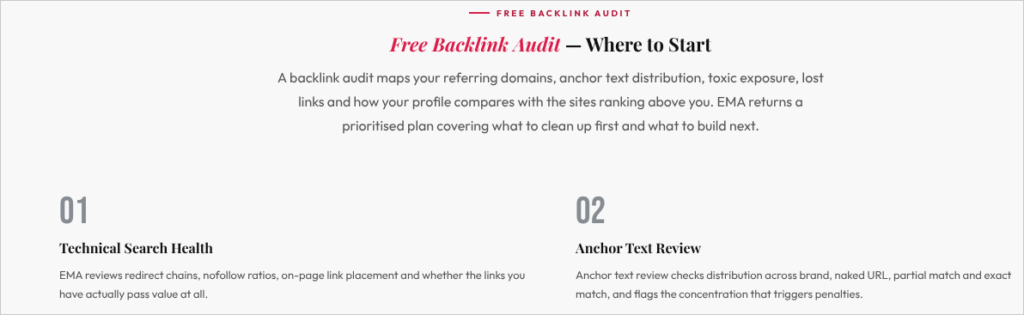
Figure 5. EMA’s free backlink audit section as it appeared on 7 November 2026.
Frequently asked questions
How do I find my competitors’ keywords for free? Read their page titles, headings and URLs by hand, study the search results for your target searches, and use your own Search Console data. Free tools exist, but they have less data than paid ones.
Do I need a paid tool? No, but a gap tool saves time when you are comparing several sites. Check that it returns data for your sector before you pay.
Are competitor keywords the same as the keywords I should target? No. They show what competitors rank for. You still need to filter for relevance, intent and fit, and check the rules that apply to you.
Is it legal to analyze competitors’ keywords? Reading public pages and search results is normal research. Copying their content is a different matter, and Google’s spam policies name scraping and lightly modified copying as abusive. Get legal advice if you are unsure.
Why does autocomplete show nothing for adult terms? Google says its systems remove predictions that violate its policies, including sexually explicit content and closely related variations. Our own test on 6 November 2026 found most adult-industry phrases returned no suggestions on DuckDuckGo either.
How many competitors should I study? Start with two or three. Ahrefs suggests one to three, and says to focus on keywords where at least two sites rank in the top 10 when you compare several.
Should I use search volume to choose keywords? Use it as one input, not the main one. Volumes are estimates, and tools may not report sensitive terms. Relevance and intent come first.
How often should I repeat the research? Check Search Console monthly and re-read competitor pages quarterly.
Can a specialist do this for me? Yes. A specialist can handle the tools, the filtering and the mapping. Ask them what data they will use for terms the tools cannot measure.
Final thoughts
Finding a competitor’s keywords takes an afternoon. Knowing which ones to act on takes judgment: relevance, intent, meaning, rules and fit. Start with manual reading and your own Search Console data, add a gap tool if you have one, and group what is left into clusters that map to pages. In the adult and escort sector, expect gaps in the data and double meanings in the terms, and plan for both.
If you would like a second opinion on where your site stands, ask for a free audit report from EMA. Connect with us today or visit https://escortmarketing.agency/.
References
- Google Search Central, “SEO Starter Guide” (last updated 10 December 2025): https://developers.google.com/search/docs/fundamentals/seo-starter-guide
- Google Search Console Help, “Performance report (Search)”: https://support.google.com/webmasters/answer/7576553
- Google Search Central, “Spam policies for Google web search” (last updated 28 August 2026): https://developers.google.com/search/docs/essentials/spam-policies
- Google Search Help, “Autocomplete policies”: https://support.google.com/websearch/answer/7368877
- Google Trends Help, “How Trends data is adjusted”: https://support.google.com/trends/answer/4365533
- Google Ads Help, “About Keyword Planner”: https://support.google.com/google-ads/answer/7337243
- Google Search Central, “Guidelines for sites with explicit content” (last updated 17 September 2026): https://developers.google.com/search/docs/specialty/explicit/guidelines
- Google Search Central, “Creating helpful, reliable, people-first content”: https://developers.google.com/search/docs/fundamentals/creating-helpful-content
- Google Search Central, “Influencing your title links in search results”: https://developers.google.com/search/docs/appearance/title-link
- Google Search Central, “Control your snippets in search results”: https://developers.google.com/search/docs/appearance/snippet
- Google Search Central, “Do you need an SEO?”: https://developers.google.com/search/docs/beginner/do-i-need-seo
- Semrush Knowledge Base, “Keyword Gap”: https://www.semrush.com/kb/28-keyword-gap
- Ahrefs Help, “How to use Content Gap to find keyword ideas from competitor websites”: https://help.ahrefs.com/en/articles/9025740-how-to-use-content-gap-to-find-keyword-ideas-from-competitor-websites
- Ahrefs, “How to Do a Content Gap Analysis [With Template]” (updated 17 February 2025): https://ahrefs.com/blog/content-gap-analysis/
- Reboot, “Adult SEO agency” page (public HTML read 6 November 2026): https://www.rebootonline.com/industries/adult-seo/
- Escort Marketing Agency, “Adult SEO” page (public HTML read 6 November 2026): https://escortmarketing.agency/adult-seo/
- Escort Marketing Agency, “10 Proven SEO Tactics to Rank a Sex Club Website Higher in 2026” (blog; published 30 December 2025, updated 7 August 2026): https://escortmarketing.agency/seo-tactics-for-sex-club-websites/
- Escort Marketing Agency, “Adult Link Building” page: https://escortmarketing.agency/adult-link-building/