 admin
Short answer: A guest post is an article you write for someone else’s website so that their readers meet your expertise. Done well, it earns attention, trust and the occasional enquiry. Done as a link-building shortcut, it is one of the tactics Google names in its spam policies. This guide explains what guest posts are, what Google has actually said about them, how to find and vet publishers, how to pitch and write a post an editor will run, and what to expect if you work in the adult and escort sector, where many mainstream publishers say no. It is general information, not legal advice.
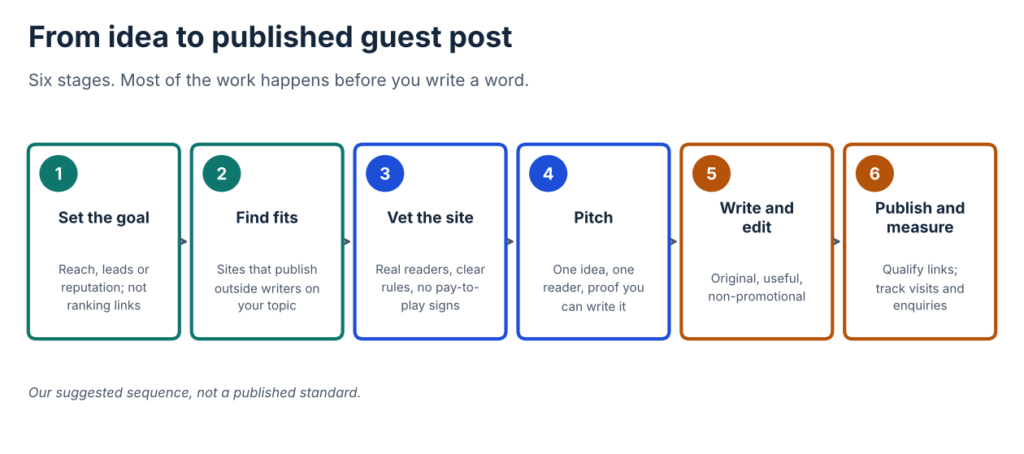
A six-stage process for a guest post: set the goal, find fits, vet the site, pitch, write and edit, publish and measure.
Figure 1. Six stages from idea to published guest post. Most of the work happens before the writing starts.
How to use this guide
Read the first three sections if you want to know what a guest post is and where the rules sit. Read the step-by-step section if you are ready to pitch. Read the adult-specific section before you pick a publisher, because the sector changes which sites are realistic. The hiring section is for owners who would rather hand the work to a specialist.
One thing to settle first: this guide treats guest posting as a way to reach readers and build credibility. It does not treat it as a way to manufacture ranking signals. That is not a moral position; it is what Google’s own documentation points to, and the next sections show where.
What a guest post is (and is not)
A guest post is an article written by someone outside a publication’s staff and published on that publication’s site, usually with a short author bio. The writer gives the publisher useful content. The publisher gives the writer an audience. Nobody pays for the other side of the exchange, at least in the classic version.
The label gets stretched, so it helps to separate the nearby formats. They carry different expectations for payment, disclosure and links.
| Format | Who writes it | Who pays | What matters for links |
| Guest post | You, for the publisher’s readers | Usually nobody | Google’s John Mueller said in 2020 that links the guest author supplies should not pass signals and should be sponsored or nofollow |
| Sponsored or paid post | You or the publisher | You pay the publisher | Google says paid placements should use sponsored (or nofollow); the FTC expects a clear ad label |
| Contributed byline in a multi-author publication | A named expert | Usually nobody | The publisher’s rules decide; some remove company links altogether |
| Press release | The brand | Often a distribution fee | Google lists optimized anchor text in press releases distributed on other sites as link spam |
| Link insertion into an old article | Nobody new writes anything | Often money | Buying or selling links for ranking is a named spam practice |
Two points follow from the table. First, “guest post” and “paid post” are different things in Google’s and the FTC’s eyes, so you should know which one you are doing. Second, a post can be perfectly legitimate and still not earn a followed link. That is normal and is not a failure.
Why people write guest posts
Matt Cutts, then head of Google’s web spam team, wrote on 20 January 2014 that “there are still many good reasons to do some guest blogging,” and named exposure, branding, reach and community. In the same post he wrote that “if you’re using guest blogging as a way to gain links in 2014, you should probably stop.” Both sentences are still a fair summary of the safe side of the practice.
In practice, the reasons that hold up are:
- Put an idea in front of readers who do not know you yet.
- A byline on a respected publication tells a buyer you know the subject.
- Editors, other contributors and readers become contacts for later work.
- Referral visits and enquiries. A handful of well-matched readers can be worth more than many unmatched ones.
- A usable asset. The post is something you can point to in a sales conversation.
The reason that does not hold up is the one many people start with: acquiring followed links to lift rankings. The next section shows why.
What Google says about guest posts
Several different sources are often blended together in guest-posting advice. It is worth separating them by what they actually are.
Google’s spam policies (formal documentation). The link spam section of Google’s spam policies lists, among other practices, “buying or selling links for ranking purposes,” including “exchanging money for links, or posts that contain links.” It also lists “links with optimized anchor text in articles, guest posts, or press releases distributed on other sites.” The page shows a last-updated date of 28 August 2026. It also says links bought or sold for advertising or sponsorship should be marked with rel=”nofollow” or rel=”sponsored”.
Google’s link documentation (formal documentation). The page on qualifying outbound links says to mark “advertisements or paid placements” with sponsored, user-generated content with ugc, and to use nofollow when the other values do not fit. It does not mention guest posts by name. Google’s link best practices add that anchor text should be “descriptive, reasonably concise, and relevant,” and that keyword-stuffed link text is treated as a spam violation.
Statements by Google staff (informal, but widely cited). On 11 June 2020, Google’s John Mueller replied on X that when a guest author supplies the content and the links, “those links shouldn’t be passing signals,” and that it is “fine to see it as a way of reaching a broader audience.” Search Engine Roundtable reported it the next day and noted that it extended his 2017 position that all guest-post links should be nofollowed, paid or not. In a video hangout reported on 1 November 2021, Mueller said Google uses “lots of different signals to try to figure out what might be a guest post,” that anchor text alone does not make a post a problem, and that links in guest posts should be nofollow, like advertisements. Treat these as guidance from a Google spokesperson, not as policy text, but they point the same way as the policies.
Google’s enforcement history. When Google began its December 2022 link spam update on 14 December 2022, it said its SpamBrain system could now detect both sites buying links and sites used for passing outgoing links. Links Google identifies as spam are neutralized, which means they stop counting. There is no manual action notice in Search Console for that, and Google’s spam-updates help page says that when links are nullified, “the link credit that was previously generated is lost” and cannot be regained. (These details come from Search Engine Roundtable’s coverage; Google’s own blog post could not be read in full.)
Matt Cutts’s 2014 post. In The decay and fall of guest blogging for SEO, Cutts wrote that he would not recommend accepting a guest post “unless you are willing to vouch for someone personally or know them well.” In a comment reply, he said nofollowed links in a guest post do not affect PageRank and fall within Google’s guidelines, and that a good post with nofollowed links can still bring exposure.
Put together, the position is consistent across twelve years: write guest posts for readers, expect the links you supply to be qualified, and do not rely on them for rankings. If a placement only makes sense because of the followed link, it is the kind Google’s policies and systems are built to discount.
The second rule: who the post is really for
Google’s page on creating helpful, reliable, people-first content (last updated 5 October 2026) frames content quality around three questions: Who created it, How was it created, and Why was it created. For a guest post, that translates directly:
- Who: is the author clearly identified, with a byline and a short bio that shows why they know the subject?
- How: if automation or AI helped, is that disclosed where a reader would expect it? Some publishers ban fully AI-generated posts outright.
- Why: does the post exist to help the publisher’s readers, or mainly to carry a link? Google treats content made “primarily to attract search engine visits” as misaligned with what its systems reward, and editors tend to spot the same thing faster than any algorithm.
The “why” question is also the one that decides whether an editor accepts your pitch.
Is a guest post right for you?
Before you pitch, check four things.
- Your goal. If the goal is reach, credibility or enquiries, guest posting fits. If it is “more followed links,” it does not, and you are better off spending time elsewhere.
- Your subject. You need something to say that readers of another site would value and that you know first-hand. Pitching a generic overview rarely works.
- Your capacity. A good post can take a day or more to research and write, plus editing rounds. One strong post beats ten rushed ones.
- Your sector. If you run an adult or escort business, the number of publishers that will take your pitch is smaller. The adult-specific section below covers what that means in practice.
If you pass all four, continue. If you fail the first, read the section on alternatives.
Step by step: how to get a guest post published
1. Set a goal you can measure
Write down one goal and one number. “Ten qualified enquiries a quarter from referral traffic” is something you can track. “Better SEO” is not. The goal also decides which publishers are worth your time: a site with a small, well-matched audience can beat a large general one.
2. Find publishers that actually take outside writers
Look for sites that already publish people who do not work there. Signs include a “write for us” or contributor page, bylines that differ from article to article, and author bios that mention other employers. Read the last ten posts. Ask whether your topic would sit naturally among them, whether they cover the same ground repeatedly, and whether anyone in the audience resembles your customer.
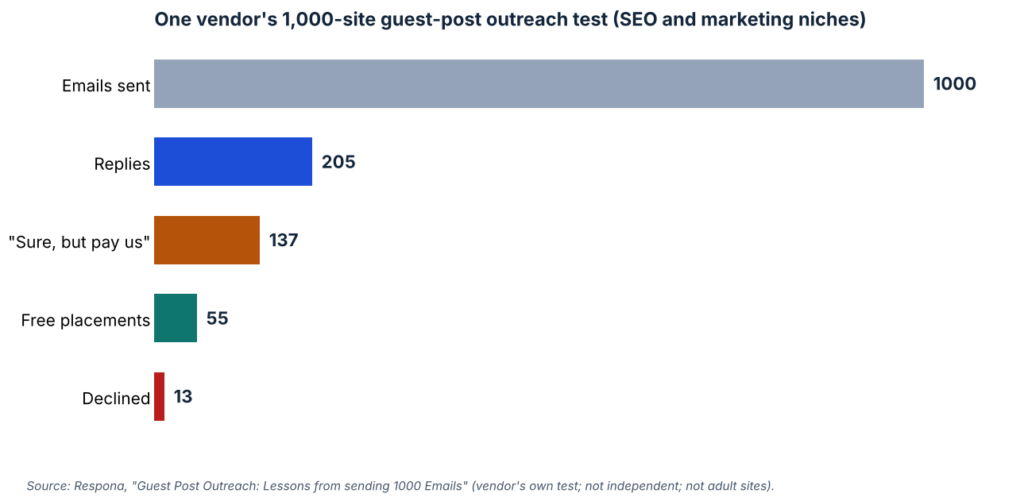
Be careful with “write for us” search results. Many of those pages belong to sites that exist to sell placements. Respona, a link-building software vendor, reported its own test of this: it emailed 1,000 sites found through “write for us” searches in the SEO, digital marketing and content marketing niches over a couple of weeks, using a generic pitch. Its write-up reports 205 replies (just above 20%). Of those, 55 offered a free guest post, 137 replied that you would need to pay, and 13 declined. That is one vendor’s test, not independent research, and it did not involve adult sites. It still shows how common “pay to play” is among sites that advertise for guest posts.
A bar chart of one vendor’s outreach test: 1,000 emails sent, 205 replies, 137 asking for payment, 55 offering free placements, 13 declining.
Figure 2. One vendor’s 1,000-site guest-post outreach test. Vendor-run, not independent, and not adult-specific.
3. Vet each publisher before you pitch
Spend ten minutes per site on a short check. A site that fails several of these is not worth a pitch.
- Real readers. Does the site have comments, shares, newsletter mentions or other signs people read it? Do not rely on third-party “authority” scores alone.
- Editorial standards. Are there published guidelines, named editors and visible corrections?
- Topical fit. Does it already cover your subject, and does it cover it well?
- Pay-to-play signs. Does it advertise “sponsored post” pricing next to its “write for us” page? Do posts look written to fit a keyword list rather than for readers?
- Spam signs. Are there pages of unrelated topics, casino or loan links, or thin posts all linking to commercial sites? Cutts’s advice about vouching for a source applies in both directions.
- Rules about links. Does it say how it treats author links?
- Adult-friendliness. Does it publish business, marketing or legal posts that relate to adult industries, or does it ban the topic? Ask before you write anything.
4. Read the guidelines like a contract
Real contributor guidelines tell you what the editor will do to your post. As one example, the Search Engine Journal contributor guidelines (read for this guide) say posts must be “exclusive to Search Engine Journal and 100% original,” that contributors must not write “to sell a product or recommend a particular product or service,” and that “no links to people’s home pages for their companies” are allowed for quotes or cited sources. They also say the publication does “not accept articles or content entirely generated by AI systems,” may “add rel=”nofollow” to any link or remove a link at any time,” requires disclosure when a company or person in the post is related to the author, and offers a followed link from a contributor profile only after meeting criteria such as writing at least five articles.
That single set of guidelines shows what many serious publishers want: original work, no sales pitch, no home-page links, and editorial control over links. If a site you are targeting is stricter or looser than that, you will find out in the guidelines, not after you have written 2,000 words. ### 5. Build a pitch an editor can say yes to in a minute
Editors read pitches between other jobs. A pitch that works is short, specific and about their readers. It has five parts:
- A first line that shows you read the site. Mention one recent post and how your idea differs from it.
- One idea, stated as a working headline. Not a list of ten topics.
- Who it helps and what they will be able to do afterward. Name the reader.
- Why you. One or two lines of first-hand experience. Not a sales paragraph.
- A short outline and a proposed length. Three to five bullets.
Pick angles that have a real, checkable hook. For adult and escort businesses writing for business or marketing publications, good hooks tend to be rules that changed. Examples with public sources: the Ofcom guidance on age checks for services in the UK; the FTC Consumer Reviews and Testimonials Rule for anyone who collects reviews; the CAN-SPAM compliance guide for email marketing; and Google’s guidelines for sites with explicit content for site structure and age gates. Each gives you something concrete to teach, rather than something generic to promote.
A short template you can adapt:
Subject: Pitch: [working headline]
Hi [editor’s name], I read your post on [specific post]. Your readers may also want to know [gap]. I would like to write [headline] for [reader type]. It would cover [point 1], [point 2] and [point 3], at about [length] words, with [source or data]. I [one line of first-hand experience]. If it fits, I can send a draft in [time]. Thanks, [name, role, link to previous work].
Do not attach a finished article unless the guidelines ask for one. Do not send the same pitch to many sites at once without saying so; many publications want exclusivity, and a fully original draft written for one site cannot be reused unchanged on another.
6. Write the post for the publisher’s reader
Write the post the way the publication’s best contributors do. Open with the answer. Give the reader something they can use: a checklist, a decision rule, a worked example, a mistake to avoid. Use first-hand material: something you saw, measured or learned that other writers did not. Cite sources by name and link them where the publisher allows it.
Keep it non-promotional. Mention your company only where it is needed to explain where your experience comes from, and only if the guidelines allow it. If you cannot make the post useful without promoting yourself, it is not ready.
Check the draft against Google’s three questions. Who: a clear byline and bio. How: a note of any AI or automation use, and a policy check, because some publishers refuse AI-generated posts. Why: would the post still be worth publishing if it carried no link at all?
7. Handle links and the author bio
This is where most guest-post trouble starts, so keep it plain.
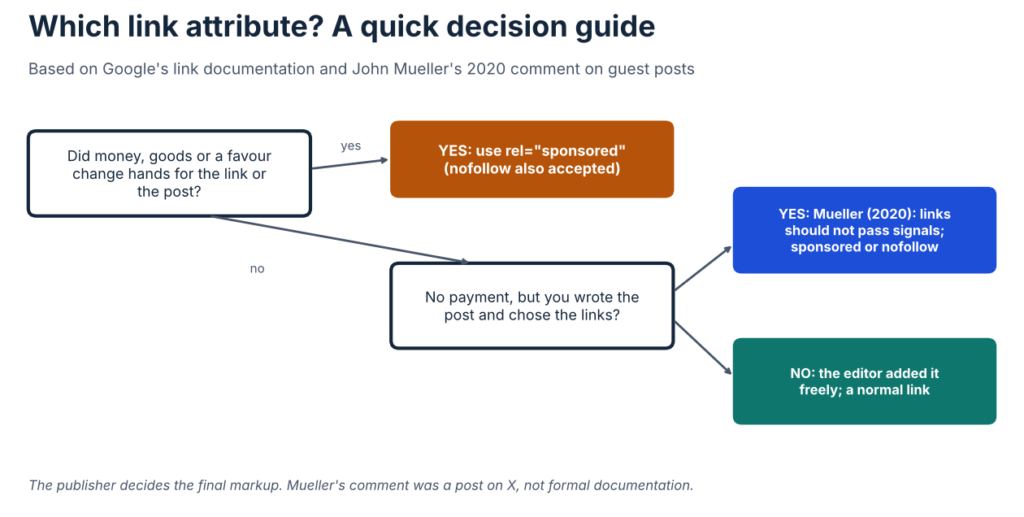
A decision guide for link attributes: paid links use sponsored; unpaid guest-author links should be sponsored or nofollow per Mueller’s 2020 comment; links the editor adds freely are normal links.
Figure 3. Which link attribute applies. The publisher decides the final markup.
- Use few links, and make each one earn its place. A single link to a genuinely useful page beats three links to your service pages.
- Write descriptive anchors. Google’s guidance asks for text that is “descriptive, reasonably concise, and relevant.” A link on “Ofcom’s guidance on age checks” tells readers where they are going. A link on a money keyword repeated across posts tells Google you are building links. The spam policy’s example is a paragraph where several phrases are each linked to the same URL.
- Link to a page a reader would want. For a business audience, that is usually a guide, tool or study, not a sales page. Avoid pointing a post on a mainstream site at an explicit page. Google’s explicit-content guidance notes that SafeSearch is designed to filter pages with “links, pop-ups, or ads that display or point to explicit content,” so linking from a general-audience page to an explicit one is a risk for the host.
- Expect nofollow or sponsored. Accept whatever markup the publisher uses. Do not ask an editor to change a qualified link to a plain one. If you paid, the link should be sponsored (or nofollow).
- Keep the bio factual. Name, role, one sentence of credibility, one link. Do not stuff it with keywords.
- Do not trade posts for links. Google’s spam policies name “excessive link exchanges” and “partner pages exclusively for the sake of cross-linking.”
8. Submit, edit and respond
Send the draft in the format the guidelines ask for. Expect edits: structure, tone, removed links, a headline change. Respond promptly, and do not fight a reasonable cut. If an editor removes a company mention or a link, that is the system working as the guidelines said it would. Ask for the publication date and the URL.
9. Disclose any paid relationship
If you pay for the placement, or give something of value for it, the post is an advertisement under most readings, and the FTC’s Native Advertising guide says an ad should not “suggest or imply to consumers that it’s anything other than an ad.” It adds that disclosures should be “clear and prominent on all devices,” that terms like “Ad” or “Advertisement” work better than ambiguous ones like “Promoted,” and that responsibility reaches “everyone who participates directly or indirectly” in creating or presenting the ad. Use the label the publisher requires and mark links sponsored. Disclosure rules differ by country, so get legal advice for your markets.
10. Promote, measure and keep the relationship
After publication, share the post on your own channels, thank the editor and answer comments. Then measure it against the goal you set in step 1:
- Referral sessions from the publisher’s domain, tagged with a campaign parameter if the link allows.
- Enquiries that mention the post, and the share that came through the post’s link.
- Brand mentions in newsletters, social posts and other articles.
- Links that appear in Search Console’s Links report, noting which are qualified.
A single post rarely changes a business. Three or four good posts for the same audience, a year apart, can.
A checklist before you submit
Run this list on the finished draft. If any answer is no, fix it before the editor sees it.
- The post answers one question for one named reader, and the answer appears early.
- Every claim that could be checked has a named source, and the source link works.
- Anything from your own experience says so plainly, with what you did and what you saw.
- Your company appears only where the guidelines allow it, and nowhere as a sales pitch.
- There are few links, each with descriptive anchor text, and none points to an explicit page.
- Any use of AI tools is allowed by the publisher and disclosed if they ask.
- The bio is short and factual, and your relationship to anyone named in the post is disclosed.
- You have not sent the same draft to another site.
- You have a goal and a number to check three months after publication.
A draft that passes this list is much easier for an editor to accept, and much easier for you to defend later.
The adult and escort sector: what changes
Adult and escort businesses face a narrower field. Four things matter.
Many mainstream publishers decline the vertical. On its adult link building page, EMA states that “guest posting, journalist outreach, resource page link building and digital PR all decline adult sites.” That is EMA’s own view of the market, and it is not independent evidence. The practical consequence is simple: expect more “no” than “yes,” and do not take it personally.
Be clear about what you are pitching. A business or marketing post about SEO, compliance or advertising rules is different from content about explicit services. Pitch the former. Do not pitch explicit material to general publications, and do not link to explicit pages from them.
Check the publisher’s own policy. Policies differ: a publisher may ban links to adult sites, allow business topics, or allow a link only in a contributor bio. Ask before you write. If they refuse in writing, you have saved a week.
Separate explicit and non-explicit content. Google recommends that sites with a significant mix “group the explicit pages on a separate domain or subdomain,” and describes the adult meta tag and RTA label for labelling pages. It also says age gates must not stop Googlebot from crawling content you want indexed, with requests verified. These points matter for any site you link to, because a guest post is only as useful as the page it sends readers to. (The page was last updated on 17 September 2026.)
Where do adult-relevant guest posts go, then? Rather than name outlets that change their rules often, here are the categories worth checking: trade publications and newsletters for the industry, associations and event sites that publish member content, directory and platform blogs, podcasts and webinars, and marketing, privacy or payments blogs that accept pieces about adult-sector rules. Read each one’s guidelines first, and be ready to hear that adult topics are not accepted.
Alternatives when guest posts are closed
If you cannot get a guest post published, you can still reach the same goals. EMA’s own guide to adult backlinks guest posting SEO treats guest posting as one of several ways to earn links for adult sites, alongside owned resources worth citing and accurate directory listings:
- Publish an asset on your own site that is worth citing. A guide, tool or dataset other writers can reference. Link to it from your social profiles and newsletter.
- Contribute quotes and data. Short, sourced comments in articles and podcasts reach readers without requiring a full post.
- List your business in the places where listings are normal. Directories and industry listings still carry weight when chosen carefully, and each should be read for terms and for link qualification.
- Speak or take part in a panel. Event pages often link to speaker bios.
- Build the audience you own. An email list and a useful newsletter reduce your dependence on anyone else’s rules. Comply with the CAN-SPAM rules if you email people in the US.
None of these is a shortcut. All of them are slower than buying a link and more durable than one.
Common mistakes
- Choosing a site by an authority score without reading the site.
- Pitching the same generic topic to hundreds of sites.
- Writing a promotional post and calling it a guest post.
- Using the same keyword anchor across several posts.
- Paying for a placement and not disclosing it.
- Asking an editor to change a nofollow link to a followed one.
- Linking from a general-audience site to an explicit page.
- Accepting a “free” post that turns out to need payment, with no disclosure.
- Reusing text across sites without telling the editors.
- Measuring links instead of enquiries.
- Ignoring the publisher’s guidelines on AI-generated content.
- Treating a single post as a campaign.
If you inherit an old profile full of low-quality guest-post links, remember that Google’s disavow help page calls the tool “an advanced feature” that “should only be used with caution,” and says that in most cases Google can assess which links to trust without it. Remove what you can; use the tool only if you meet its conditions.
Three scenarios
These are illustrative situations built from the rules above, not case studies.
A directory operator. The goal is more listing requests from businesses that already trust the site. The operator pitches a business-trade blog on a piece about how age-verification rules affect directory listings, citing Ofcom’s guidance. They ask for a plain author bio link to a non-explicit “how to list” page, and accept nofollow. They measure listing requests that mention the post, not rankings.
An escort agency. The goal is credibility with corporate clients booking event hosts. The agency does not pitch adult publications. It writes a post on client confidentiality and consent practices for an events-industry blog, with no sales copy, and asks whether the blog allows a bio link. If the blog declines, the agency publishes the same material on its own site and shares it in its newsletter.
A platform marketer. The goal is advertiser trust. The marketer pitches an advertising trade publication on how reviews and testimonials rules affect adult advertisers, citing the FTC’s rule. They disclose their employer, avoid product mentions, and keep one link to a cited source.
When to hire an adult and escort SEO specialist
Many owners can handle a small guest-post programme. You may want an adult and escort SEO specialist when:
- you have an old link profile from past link buying and need an audit before building more;
- you cannot tell which of your links are followed, qualified or toxic;
- publishers keep declining and you need a plan beyond guest posts;
- you run several domains, languages or age-gated sections and need to know what crawlers see;
- you do not have time to vet publishers and track results.
If you hire one, ask what they will check first, what they will deliver, which link tactics they refuse, how they vet publishers, how they disclose paid placements, and how they report what they cannot verify. Google’s page on whether you need an SEO warns against anyone who guarantees rankings.
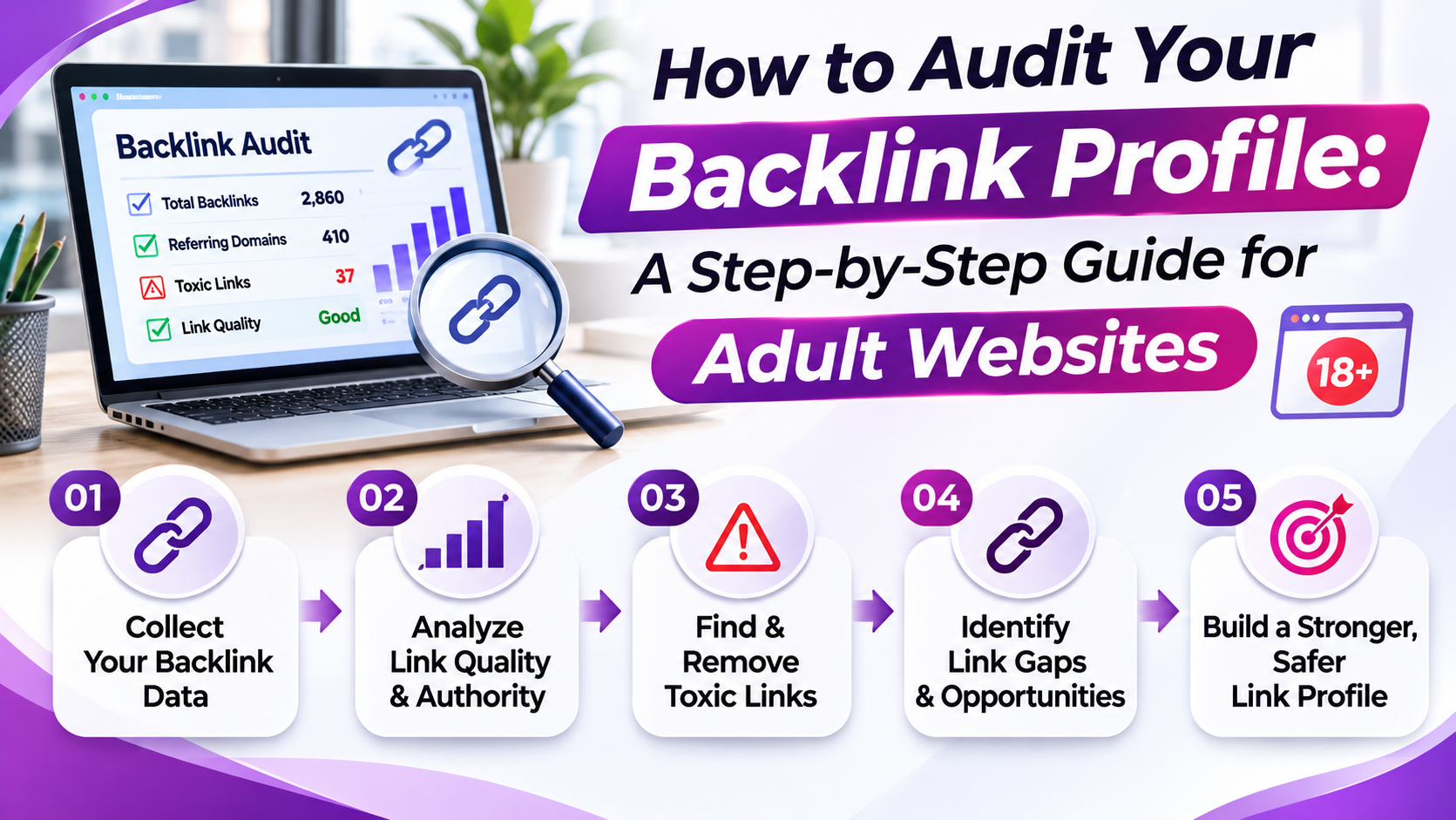
Escort Marketing Agency (EMA) is a digital marketing agency for adult businesses, not an adult service. On its adult link building page, EMA describes a free backlink audit that reviews referring domains, anchor text distribution, toxic exposure and lost links, and compares your profile with sites ranking above you, delivered as a priority report in five business days. You can ask for a free audit report from that page. EMA says it works without private blog networks, link farms or automated placements. For more on how EMA approaches the topic, see its guide to adult backlinks guest posting SEO. Judge any provider, EMA included, by the questions above.
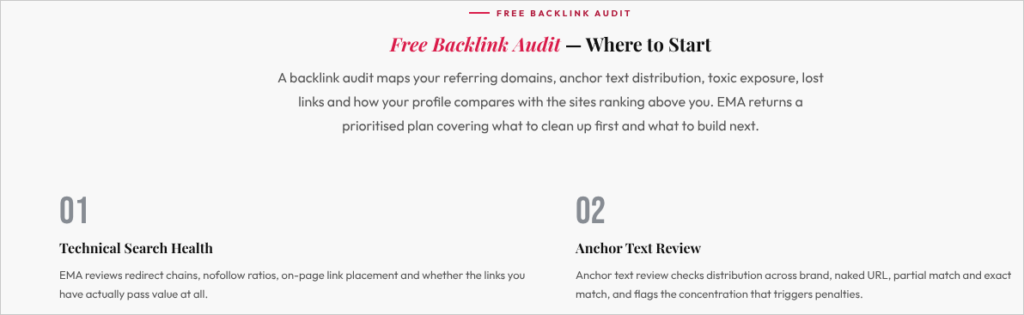
A screenshot of the free backlink audit section on EMA’s adult link building page, describing what the audit covers (captured 7 November 2026).
Figure 4. EMA’s free backlink audit section as it appeared on 7 November 2026.
Frequently asked questions
Do guest posts help SEO?
Not through the links you supply. Google’s John Mueller said in 2020 that those links should not pass signals. Guest posts can still help your business through reach, referral visits and credibility.
Are guest posts against Google’s rules?
Guest posting itself is not banned. Google’s spam policies list “links with optimized anchor text in articles, guest posts, or press releases distributed on other sites” and paid links that pass ranking credit as spam. Writing a useful post for a publisher’s readers is different.
Should my guest post links be nofollow?
Mueller said they should be sponsored or nofollow when the author supplies the links. Publishers usually set the markup, and you should accept it.
Can I pay for a guest post?
You can pay for advertising, but Google says paid links should be marked sponsored or nofollow, and the FTC expects a clear ad label. Selling or buying links for ranking is a named spam practice.
How long does it take to get one published?
It varies by publication, and no reliable benchmark exists for adult topics. Plan for pitching, editing and scheduling to take weeks, not days.
How many guest posts do I need?
There is no magic number. A few well-matched posts for one audience beat many for none. Measure enquiries, not post counts.
Can I link to an explicit page?
Avoid it from general-audience sites. Google’s guidance says SafeSearch is designed to filter pages with links that point to explicit content. Link to a non-explicit business page instead.
Can I publish AI-written posts?
Check the publisher. Search Engine Journal’s guidelines, for example, do not accept content entirely generated by AI. Google’s helpful content guidance asks whether AI use is disclosed where readers would expect it.
What if no publisher will take an adult topic?
Use the alternatives above, and publish a citable asset on your own site.
Final thoughts
A guest post is a good way to meet readers who do not know you, and a poor way to buy ranking signals. If you treat it as the first, the rules line up: write something useful, follow the publisher’s guidelines, accept whatever link markup they choose, disclose anything paid, and measure enquiries. If you work in the adult and escort sector, expect fewer open doors and plan for other routes alongside it.
If you would like a second opinion on your link profile before you pitch, ask for a free audit report from EMA. Connect with us today or visit https://escortmarketing.agency/.
References
- Google Search Central, “Spam policies for Google web search” (last updated 28 August 2026): https://developers.google.com/search/docs/essentials/spam-policies
- Google Search Central, “Qualify your outbound links to Google” (last updated 10 December 2025): https://developers.google.com/search/docs/crawling-indexing/qualify-outbound-links
- Google Search Central, “SEO link best practices for Google”: https://developers.google.com/search/docs/crawling-indexing/links-crawlable
- Google Search Central, “Creating helpful, reliable, people-first content” (last updated 5 October 2026): https://developers.google.com/search/docs/fundamentals/creating-helpful-content
- Google Search Central, “Guidelines for sites with explicit content” (last updated 17 September 2026): https://developers.google.com/search/docs/specialty/explicit/guidelines
- Google Search Console Help, “Disavow links to your site”: https://support.google.com/webmasters/answer/2648487
- Google Search Central, “Do you need an SEO?”: https://developers.google.com/search/docs/beginner/do-i-need-seo
- Search Engine Roundtable, “Google: All guest posts links should be nofollowed, paid or not” (12 June 2020; reports John Mueller’s post on X, 11 June 2020): https://seroundtable.com/google-guests-posts-nofollow-links-29605.html
- Search Engine Roundtable, “Google: We use many signals to detect guest posts” (1 November 2021; reports a video hangout): https://www.seroundtable.com/google-uses-many-signals-to-detect-guest-posts-32338.html
- Search Engine Roundtable, “Google December 2022 link spam update” (15 December 2022; secondary report): https://www.seroundtable.com/google-december-2022-link-spam-update-34574.html
- Matt Cutts, “The decay and fall of guest blogging for SEO” (20 January 2014): https://www.mattcutts.com/blog/guest-blogging/
- Federal Trade Commission, “Native Advertising: A Guide for Businesses”: https://www.ftc.gov/business-guidance/resources/native-advertising-guide-businesses
- Federal Trade Commission, “Consumer Reviews and Testimonials Rule: Questions and Answers”: https://www.ftc.gov/business-guidance/resources/consumer-reviews-testimonials-rule-questions-answers
- Federal Trade Commission, “CAN-SPAM Act: A Compliance Guide for Business”: https://www.ftc.gov/business-guidance/resources/can-spam-act-compliance-guide-business
- Ofcom, “Age checks to protect children online”: https://www.ofcom.org.uk/online-safety/protecting-children/age-checks-to-protect-children-online
- Search Engine Journal, “Writers’ guidelines for Search Engine Journal”: https://www.searchenginejournal.com/writers-guidelines-for-search-engine-journal/
- Respona, “Guest Post Outreach: Lessons from sending 1000 Emails” (vendor’s own test; not independent): https://respona.com/blog/guest-post-outreach/
- Escort Marketing Agency, “Discover the power of backlinks and guest posting on adult sites to boost your SEO game” (blog; published 5 November 2026): https://escortmarketing.agency/adult-backlinks-guest-posting-seo/
- Escort Marketing Agency, “Adult Link Building” page: https://escortmarketing.agency/adult-link-building/